Bradycardia Practice Test (ACLS)
A symptomatic bradycardia exists when what 3 criteria are present?
A. 1. The heart rate is slow. 2. The patient has symptoms. 3. The symptoms are due to the slow
heart rate.
B. 1. The
...
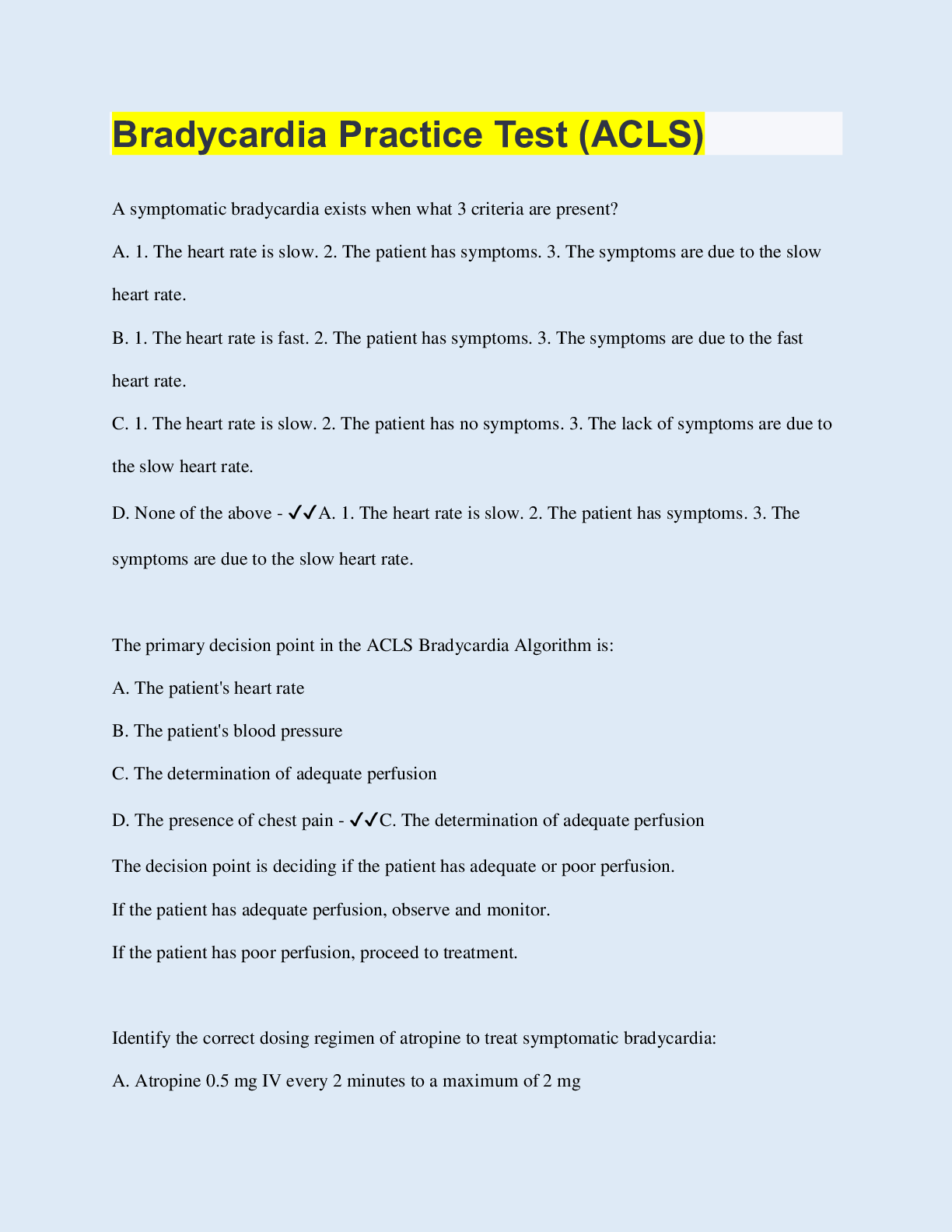
Bradycardia Practice Test (ACLS)
A symptomatic bradycardia exists when what 3 criteria are present?
A. 1. The heart rate is slow. 2. The patient has symptoms. 3. The symptoms are due to the slow
heart rate.
B. 1. The heart rate is fast. 2. The patient has symptoms. 3. The symptoms are due to the fast
heart rate.
C. 1. The heart rate is slow. 2. The patient has no symptoms. 3. The lack of symptoms are due to
the slow heart rate.
D. None of the above - ✔✔A. 1. The heart rate is slow. 2. The patient has symptoms. 3. The
symptoms are due to the slow heart rate.
The primary decision point in the ACLS Bradycardia Algorithm is:
A. The patient's heart rate
B. The patient's blood pressure
C. The determination of adequate perfusion
D. The presence of chest pain - ✔✔C. The determination of adequate perfusion
The decision point is deciding if the patient has adequate or poor perfusion.
If the patient has adequate perfusion, observe and monitor.
If the patient has poor perfusion, proceed to treatment.
Identify the correct dosing regimen of atropine to treat symptomatic bradycardia:
A. Atropine 0.5 mg IV every 2 minutes to a maximum of 2 mg
B. Atropine 1 mg IV every 3-5 minutes to a maximum of 3 mg
C. Atropine 1 mg every 5 minutes to a maximum of 3 mg
D. Atropine 0.5 mg IV every 3-5 minutes to a maximum of 3 mg - ✔✔D. Atropine 0.5 mg IV
every 3-5 minutes to a maximum of 3 mg
The correct dose of atropine in bradycardia is 0.5 mg given every 3 to 5 minutes to a maximum
dose of 3 mg. Atropine should be used cautiously in the presence of cardiac ischemia or MI as it
may worsen ischemia and increase infarct size. Doses lower than 0.5 mg may result in a
paradoxical slowing of the heart.
What is not a precaution for TransCutaneousPacing?
A. TCP is contraindicated in severe hypothermia and is not recommended for asystole.
B. Conscious patients require analgesia for discomfort unless delay for sedation will
cause/contribute to deterioration.
C. Avoid AV nodal blocking agents
D. Do not assess the carotid pulse to confirm mechanical capture; electrical stimulation causes
muscular jerking that may mimic the carotid pulse. - ✔✔C. Avoid AV nodal blocking agents
Precautions for TCP are as follows:
TCP is contraindicated in severe hypothermia and is not recommended for asystole.
Conscious patients require analgesia for discomfort unless delay for sedation will
cause/contribute to deterioration.
Do not assess the carotid pulse to confirm mechanical capture; electrical stimulation causes
muscular jerking that may mimic the carotid pulse.
[Show More]