MULTIPLE CHOICE QUESTIONS
8-1 Point and Confidence Interval Estimates for a Population Mean
81. Which of the following statements applies to a point estimate?
a. The point estimate is a parameter.
b. The point estima
...
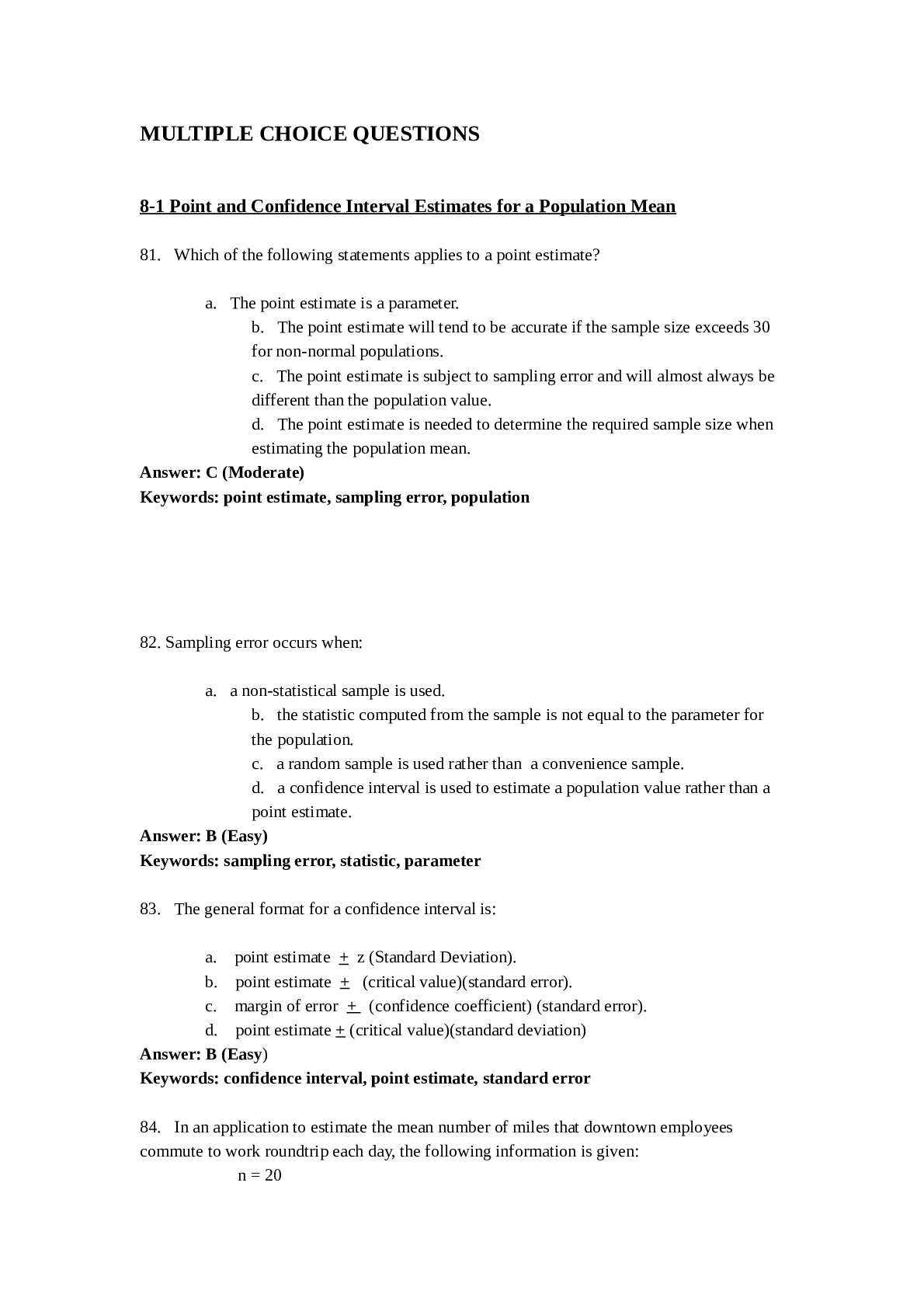
MULTIPLE CHOICE QUESTIONS
8-1 Point and Confidence Interval Estimates for a Population Mean
81. Which of the following statements applies to a point estimate?
a. The point estimate is a parameter.
b. The point estimate will tend to be accurate if the sample size exceeds 30
for non-normal populations.
c. The point estimate is subject to sampling error and will almost always be
different than the population value.
d. The point estimate is needed to determine the required sample size when
estimating the population mean.
Answer: C (Moderate)
Keywords: point estimate, sampling error, population
82. Sampling error occurs when:
a. a non-statistical sample is used.
b. the statistic computed from the sample is not equal to the parameter for
the population.
c. a random sample is used rather than a convenience sample.
d. a confidence interval is used to estimate a population value rather than a
point estimate.
Answer: B (Easy)
Keywords: sampling error, statistic, parameter
83. The general format for a confidence interval is:
a. point estimate + z (Standard Deviation).
b. point estimate + (critical value)(standard error).
c. margin of error + (confidence coefficient) (standard error).
d. point estimate + (critical value)(standard deviation)
Answer: B (Easy)
Keywords: confidence interval, point estimate, standard error
84. In an application to estimate the mean number of miles that downtown employees
commute to work roundtrip each day, the following information is given:
n = 20
3.50
4.33
s
x
If the desired confidence level is 95 percent, the appropriate critical value is:
a. z = 1.96.
b. t = 2.093.
c. t = 2.086.
d. .7826.
Answer: B (Moderate)
Keywords: t-statistic, confidence level
85. In an application to estimate the mean number of miles that downtown employees
commute to work roundtrip each day, the following information is given:
n = 20
3.50
4.33
s
x
The point estimate for the true population mean is:
a. 1.638.
b. 4.33 + 1.638.
c. 4.33.
d. 3.50
Answer: C (Easy)
Keywords: point estimate, population mean
86. In an application to estimate the mean number of miles that downtown employees
commute to work roundtrip each day, the following information is given:
n = 20
3.50
4.33
s
x
Based on this information, the upper limit for a 95 percent confidence interval estimate for the
true population mean is:
a. about 5.97 miles.
b. about 7.83 miles.
c. nearly 12.0 miles.
d. about 5.86 miles
Answer: A (Difficult)
Keywords: confidence interval, upper limit, t-statistic
87. In developing a confidence interval estimate for the population mean, which of the
following is true?
a. The larger the sample standard deviation, the wider will be the interval
estimate, all -------other things being equal.
b. If the population standard deviation is unknown, the appropriate critical
value should -----be obtained from the t-distribution.
c. The confidence interval developed from a smaller sample size will have a
larger -----------margin of error than one obtained using a larger sample size,
all other things being -------equal.
d. All of the above are true.
Answer: D (Moderate)
Keywords: confidence interval, population mean, t-distribution, sample size
88. Which of the following will increase the width of a confidence interval (assuming that
everything else remains constant)?
a. decreasing the confidence level
b. increasing the sample size
c. a decrease in the standard deviation
d. decreasing the sample size
Answer: D (Moderate)
Keywords: sample size, confidence interval
89. In an effort to estimate the mean dollars spent per visit by customers of a food store, the
manager has selected a random sample of 100 cash register receipts. The mean of these was
$45.67 with a sample standard deviation equal to $12.30. Assuming that he wants to develop
a 90 percent confidence interval estimate, which of the following is the margin of error that
will be reported?
a. About + $2.02
b. Nearly $50.20
c. $1.645
d. About $1.43
Answer: A (Difficult)
Keywords: margin of error, confidence interval
90. In an effort to estimate the mean dollars spent per visit by customers of a food store, the
manager has selected a random sample of 100 cash register receipts. The mean of these was
$45.67 with a sample standard deviation equal to $12.30. Assuming that he wants to develop
a 90 percent confidence interval estimate, the upper limit of the confidence interval estimate
is:
a. about $2.02.
b. approximately $65.90.
c. about $47.69.
d. None of the above.
Answer: C (Difficult)
Keywords: upper limit, confidence interval, estimate
91. The margin of error is:
a. the largest possible sampling error at a specified level of confidence.
b. the critical value times the standard error of the sampling distribution.
c. Both a and b
d. the difference between the point estimate and the parameter.
Answer: C (Moderate)
Keywords: margin of error, sampling error, critical value
92. Which of the following statements is true with respect to the confidence level associated
with an estimation application?
a. The confidence level is a percentage value between 50 and 100 that
corresponds to the percentage of all possible confidence intervals, based on a
given sample size, that will contain the true population value.
b. The probability that the confidence interval estimate will contain the true
population value.
c. The degree of accuracy associated with the confidence interval estimate.
d. None of the above.
Answer: A (Moderate)
Keywords: confidence level, population value
93. In a situation where the population standard deviation is known and we wish to estimate
the population mean with 90 percent confidence, what is the appropriate critical value to use?
a. z = 1.96
b. z = 2.33
c. z = 1.645
d. Can’t be determined without knowing the degrees of freedom
Answer: C (Moderate)
Keywords: critical value, confidence interval, population mean
94. In developing a confidence interval estimate for the population mean, the t-distribution is
used to obtain the critical value when:
a. the sample contains some extreme values that skew the results.
b. the population standard deviation is unknown.
c. the sampling that is being used is not a statistical sample.
d. the confidence level is low
Answer: B (Moderate)
Keywords: t-distribution, confidence interval
95. Which of the following statements is true with respect to the t-distribution?
a. The t-distribution is symmetrical.
b. The exact shape of the t-distribution depends on the number of degrees of
freedom.
c. The t-distribution is more spread out than the standard normal
distribution.
d. All of the above are true.
Answer: D (Moderate)
Keywords: t-distribution, degrees of freedom, spread
96. A popular restaurant takes a random sample n=25 customers and records how long each
occupied a table. The found a sample mean of 1.2 hours and a sample standard deviation of
0.3 hours. Find the 95% confidence interval for the mean.
a. 1.2 .118
b. 1.2 .124
c. 1.2 .588
d. 1.2 .609
Answer: B (Moderate)
Keywords: confidence interval, t-distribution
97. If a decision maker wishes to reduce the margin of error associated with a confidence
interval estimate for a population mean, she can:
a. decrease the sample size.
b. increase the confidence level.
c. increase the sample size
d. use the t-distribution
Answer: C (Moderate)
Keywords: margin of error, confidence interval, confidence level
98. When small samples are used to estimate a population mean, in cases where the
population standard deviation is unknown:
a. the t-distribution must be used to obtain the critical value.
b. the resulting margin of error for a confidence interval estimate will tend
to be fairly small.
c. there will be a large amount of sampling error.
d. None of the above.
Answer: A (Moderate)
Keywords: sample size, population mean, t-distribution
99. An educational organization in California is interested in estimating the mean number of
minutes per day that children between the age of 6 and 18 spend watching television per day.
A previous study showed that the population standard deviation was 21.5 minutes. The
organization selected a random sample of n = 200 children between the ages of 6 and 18 and
recorded the number of minutes of TV that each person watched on a particular day. The
mean time was 191.3 minutes. If the leaders of the organization wish to develop an interval
estimate with 98 percent confidence, what critical value should be used?
a. z = 1.645
b. t = 2.38
c. Approximately z = 2.33
d. Can’t be determined without knowing the margin of error.
Answer: C (Moderate)
Keywords: z-value, confidence interval
100. An educational organization in California is interested in estimating the mean number
of minutes per day that children between the age of 6 and 18 spend watching television per
day. A previous study showed that the population standard deviation was 21.5 minutes. The
organization selected a random sample of n = 200 children between the age of 6 and 18 and
recorded the number of minutes of TV that each person watched on a particular day. The
mean time was 191.3 minutes. If the leaders of the organization wish to develop an interval
estimate with 98 percent confidence, what would be the upper and lower limits of the interval
estimate?
a. Approximately 187.76 minutes ----- 194.84 minutes
b. About 141.21 minutes ------- 241.40 minutes
c. Approximately 188.3 minutes -------- 194.3 minutes
d. None of the above.
Answer: A (Moderate)
Keywords: confidence interval, upper, lower, limit, z-value
101. An educational organization in California is interested in estimating the mean number of
minutes per day that children between the age of 6 and 18 spend watching television per day.
A previous study showed that the population standard deviation was 21.5 minutes. The
organization selected a random sample of n = 200 children between the age of 6 and 18 and
recorded the number of minutes of TV that each person watched on a particular day. The
mean time was 191.3 minutes. If the leaders of the organization wish to develop an interval
estimate with 95 percent confidence, what will the margin of error be?
a. Approximately + 1.52 minutes
b. About + 2.98 minutes
c. z = 1.96
d. Approximately + 42.14 minutes
Answer: B (Moderate)
Keywords: margin of error, confidence interval, z-value
[Show More]