NHA - Certified Medical Administrative
Assistant (CMAA) Study Guide AVTEC
Already Passed
Computer Scheduling ✔✔Electronic appointment book
Book Scheduling ✔✔Hard copy appointment book
Wave Booking ✔✔Patients are sch
...
NHA - Certified Medical Administrative
Assistant (CMAA) Study Guide AVTEC
Already Passed
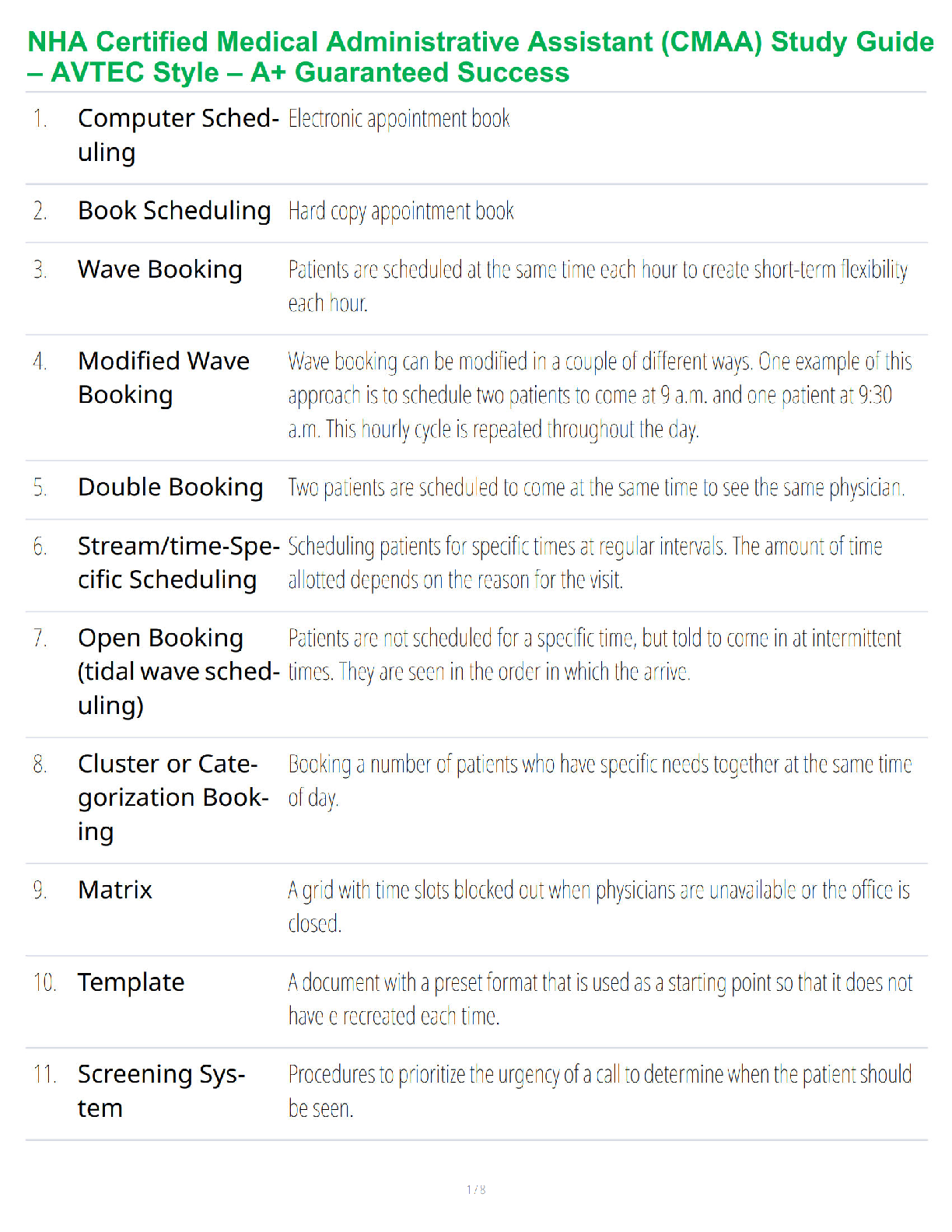
Computer Scheduling ✔✔Electronic appointment book
Book Scheduling ✔✔Hard copy appointment book
Wave Booking ✔✔Patients are scheduled at the same time each hour to create short-term
flexibility each hour.
Modified Wave Booking ✔✔Wave booking can be modified in a couple of different ways. One
example of this approach is to schedule two patients to come at 9 a.m. and one patient at 9:30
a.m. This hourly cycle is repeated throughout the day.
Double Booking ✔✔Two patients are scheduled to come at the same time to see the same
physician.
Stream/time-Specific Scheduling ✔✔Scheduling patients for specific times at regular intervals.
The amount of time allotted depends on the reason for the visit.
Open Booking (tidal wave scheduling) ✔✔Patients are not scheduled for a specific time, but told
to come in at intermittent times. They are seen in the order in which the arrive.
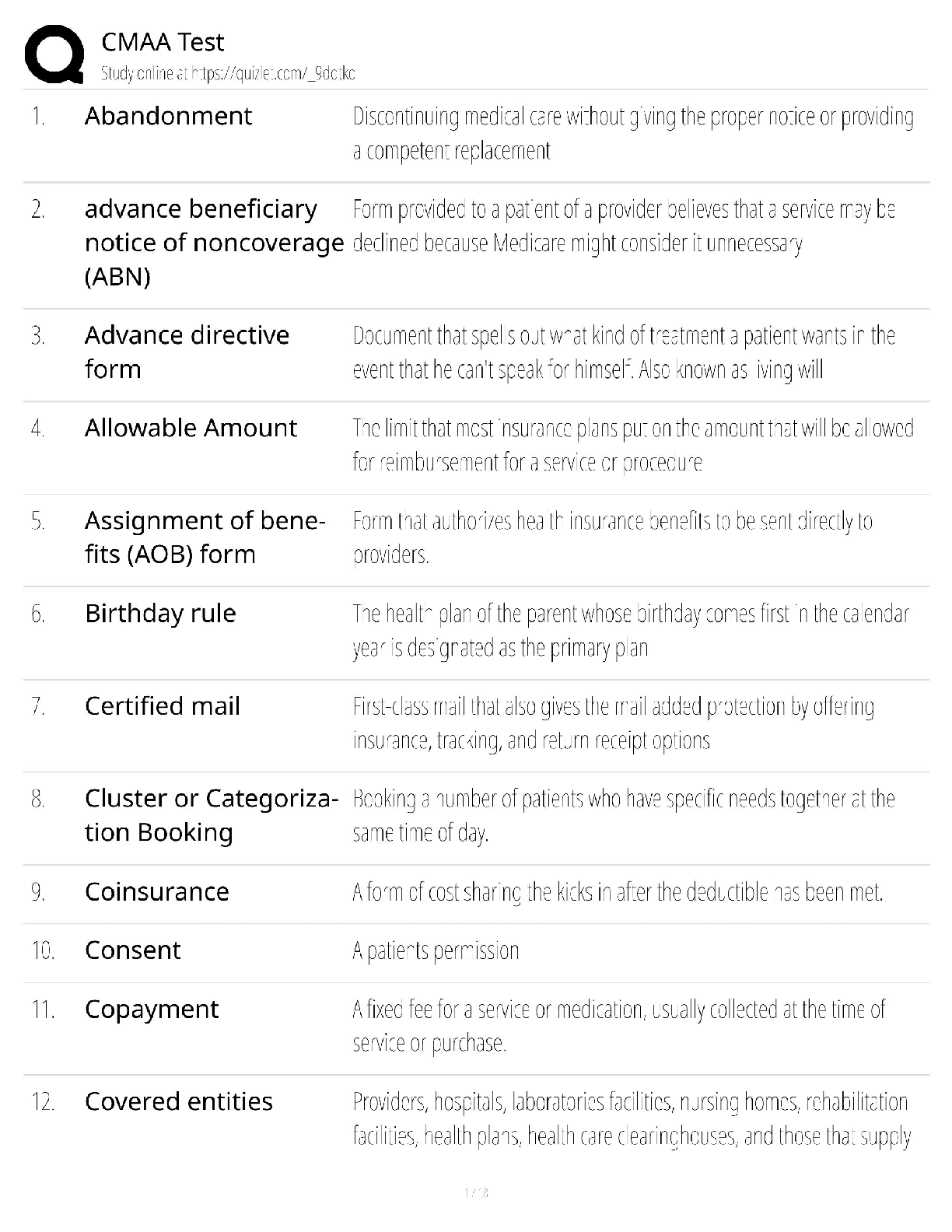
Cluster or Categorization Booking ✔✔Booking a number of patients who have specific needs
together at the same time of day.
Matrix ✔✔A grid with time slots blocked out when physicians are unavailable or the office is
closed.
Template ✔✔A document with a preset format that is used as a starting point so that it does not
have e recreated each time.
Screening System ✔✔Procedures to prioritize the urgency of a call to determine when the patient
should be seen.
Certified Mail ✔✔First-class mail that also gives the mail added protection by offering
insurance, tracking, and return receipt options.
Appointment Cards ✔✔Used to remind patients of scheduled appointments and to eliminate
misunderstandings about dates and time.
Health Insurance Portability and Accountability Act (HIPAA) of 1996 ✔✔Legislation that
includes Title II, the first parameters designed to protect the privacy and security of patient
information.
What are three advantages of computer scheduling? ✔✔Display available and scheduled times;
length and type of appointment required and day or time preferences.
When scheduling appointments, what factors need to be taken into account? ✔✔The needs of the
patient, the habits and preferences of the provider, and the capacity of the facility.
Electronic Medical Record (EMR) ✔✔An electronic record of health information that is created,
added to, managed, and reviewed by authorized providers and staff within a single health care
organization.
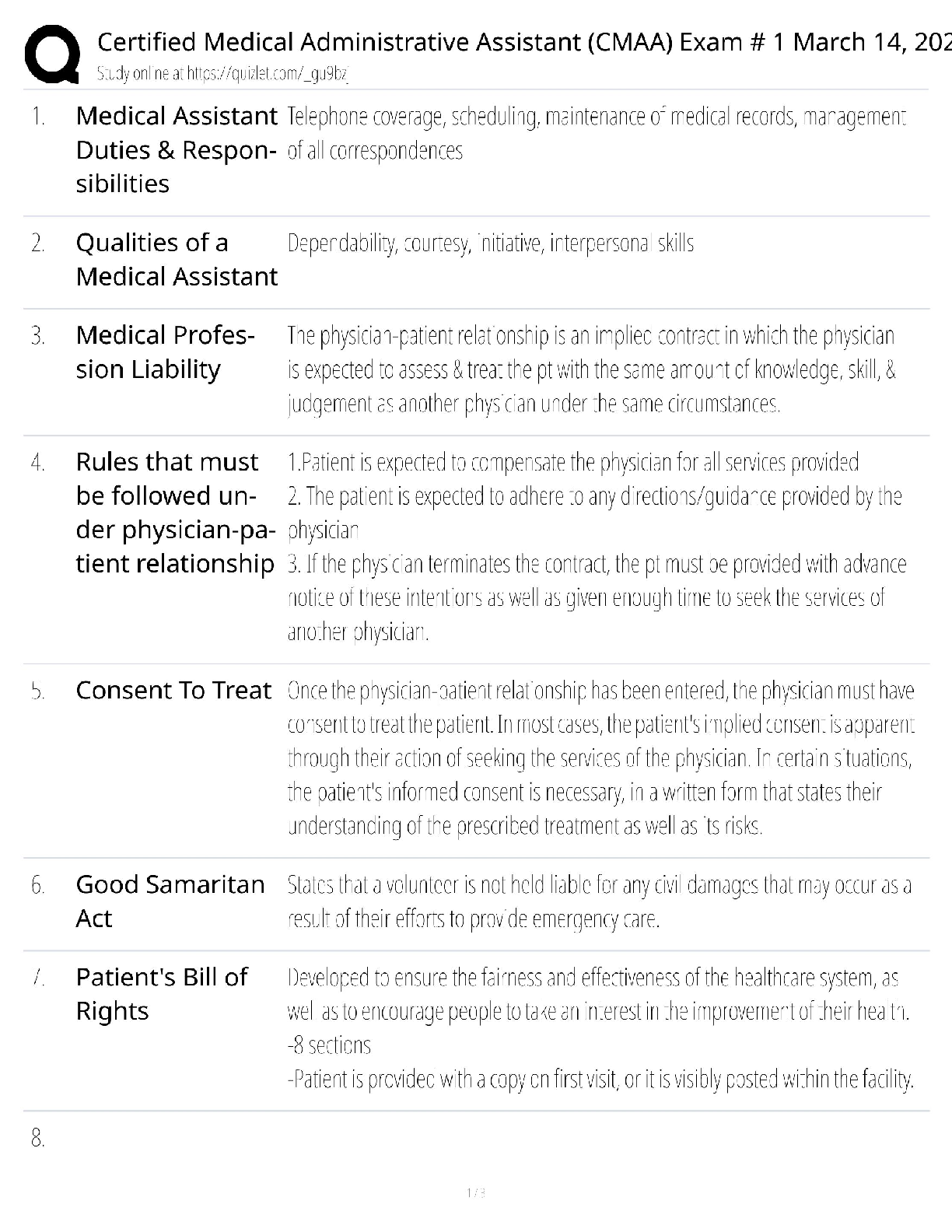
Advance Directive Form ✔✔Document that spells out what kind of treatment a patient wants in
the event that he can't speak for himself. Also known as living will.
Protected Health Information (PHI) ✔✔Information about health status or health care that can be
linked to a specific individual.
What are three types of demographics? ✔✔Name, address, and marital status.
Health Insurance ✔✔Financial support for medical needs, hospitalization, medically necessary
diagnostic tests and procedures, and may kinds of preventive services.
Electronic Health Record (EHR) ✔✔An electronic health record of health-related information
about a patient that conforms to nationally recognized interoperability standards that can be
created, managed, and reviewed by authorized providers and staff from more than one health
care organization.
Co payment ✔✔Fees collected from patient at the time of services.
Guarantor ✔✔Person or entity responsible for the remaining payment of services after insurance
has paid.
Birthday Rule ✔✔The health plan of the parent whose birthday comes first in the calendar year
is designated as the primary plan.
Healthcare Common Procedure Coding System (HCPCS) ✔✔A group of codes and descriptors
used to represent health care procedures, supplies, products, and services.
Reimbursement ✔✔Payment from insurance companies.
International Classification of Diseases, ICD-9-CM and/or ICD-10-CM ✔✔Track a patient's
diagnosis and clinical history.
Current Procedural Terminology (CPT) and Healthcare Common Procedure Coding System
(HCPCS) ✔✔Are used to report provider services for the purpose of reimbursement.
Medicare ✔✔Federally funded health insurance provided to people age 65 or older, people
younger than 65 who have certain disabilities, and people of all ages with end-stage kidney
disease.
Modifiers ✔✔Added information or changed description of procedures and services, and are a
part of valid CPT or HCPCS codes.
Health History ✔✔Form that asks patients to list any illnesses or surgeries they have had, family
history, medications taken, chronic health issues, allergies, and other physicians they consulted.
Notice of Privacy Practices ✔✔Document informing a patient of when and how their PHI can be
used.
Consent ✔✔A patient's permission
Patient Financial Responsibility form ✔✔Form that confirms that the patient is responsible for
payments to the provider.
Assignment of benefits (AOB) form ✔✔Form that authorizes health insurance benefits to be sent
directly to providers.
Living Will ✔✔Document that spells out what kind of treatment a patient wants in the even that
he can't speak for himself. Also know as advance directive.
DNR Form ✔✔Form that states that the patient does not want to be revived after experience a
heart episode or other kind of life-threatening event.
Encounter Form ✔✔A document used to collect data about elements of a patient visit that can
become part of a patient record or be used for management purposes.
Regular Referral ✔✔When a physician decides that a patient needs to see a specialist.
Urgent Referral ✔✔When and urgent, but not life-threatening, situation occurs, requiring that the
referral be taken care of quickly.
STAT Referral ✔✔Needed in an emergency situation, and can be approved immediately over the
telephone after the utilization review has approved the faxed document.
Active Files ✔✔Section of medical charts for patients currently receiving treatment.
Inactive Files ✔✔Section of medical charts for patients the provider has not seen for 6 months or
longer.
Closed Files ✔✔Section of medical charts for patients who have died, moved away, or
terminated their relationship with the physician.
Purging ✔✔The process of moving a file from active to inactive status
Provisional Diagnosis ✔✔A temporary or working diagnosis.
Differential Diagnosis ✔✔The process of weighing the probability that other diseases are the
cause of the problem.
Direct Filing System ✔✔System in which the only information needed for filing and retrieval is
a patient's name.
Cross-reference ✔✔Reference to corresponding information in a separate location.
Privacy Rule ✔✔A HIPAA rule that establishes protections for the privacy of individual's health
information.
Individually Identifiable Health Information ✔✔Documents or bits of information that identify
the person or provide enough information so that the person could be identified.
Bookkeeping ✔✔Part of the office's accounting functions, to include recording, classifying, and
summarizing financial transactions.
Copayment ✔✔A fixed fee for a service or medication, usually collected at the time of service or
purchase.
Deductible ✔✔The amount a patient must pay before insurance pays anything.
Coinsurance ✔✔A form of cost sharing the kicks in after the deductible has been met.
Statement ✔✔A request for payment.
Explanation of Benefits (EOB) ✔✔A record of a patient's fees.
Accounts Receivable Ledger ✔✔Document that provides detailed information about charges,
payments, and remaining amounts owed to a provider.
Fee-for-service ✔✔Model in which providers set the fees for procedures and services.
Allowable Amount ✔✔The limit that most insurance plans put on the amount that will be
allowed for reimbursement for a service or procedure.
Resource-based Relative Value Scale (RBRVS) ✔✔System that provides national uniform
payments after adjustments across all practices throughout the country.
Medicare Part B ✔✔Voluntary supplemental medical insurance to help pay for physicians' and
other medical professionals' services, medical services, and medical-surgical supplies not
covered by Medicare Part A.
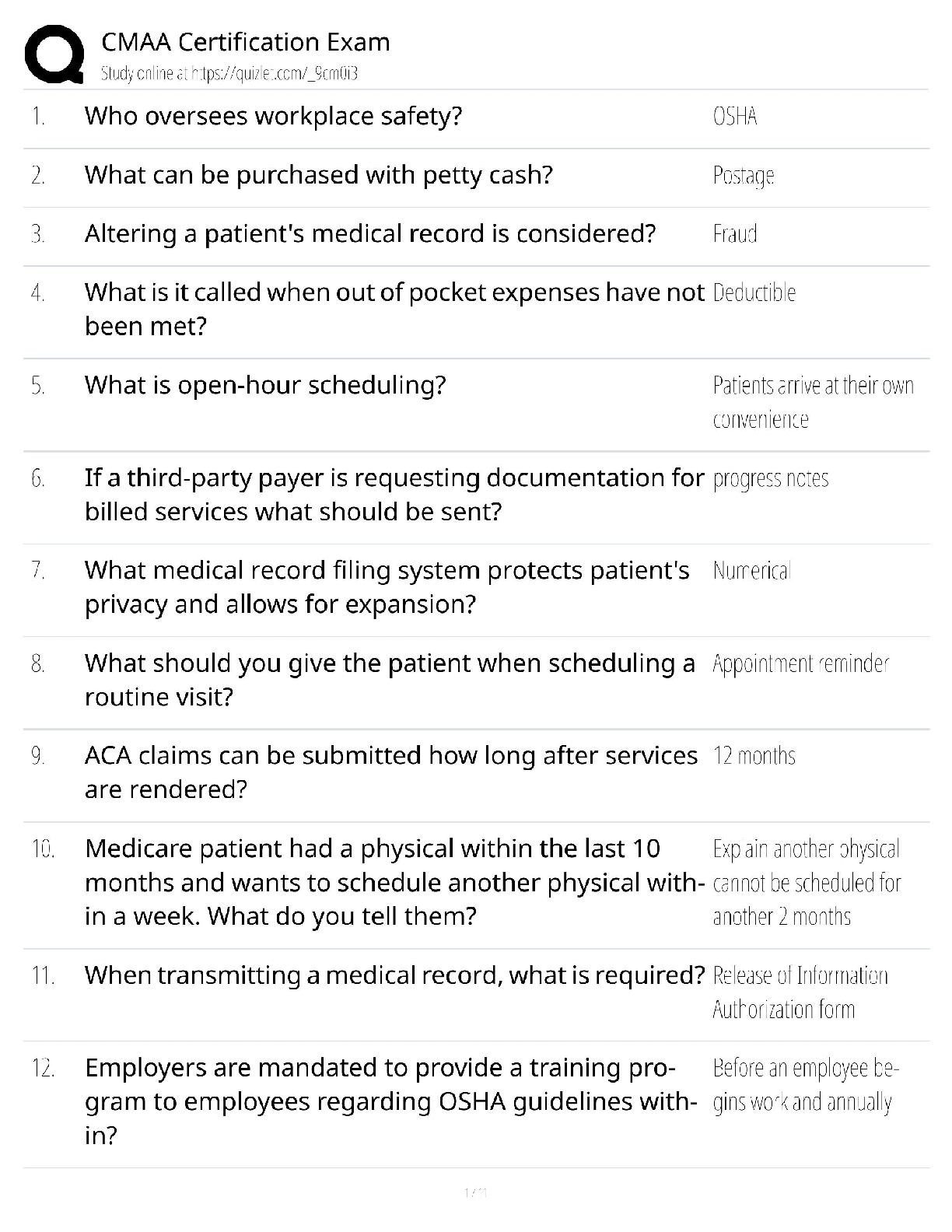
Petty Cash Fund ✔✔A small amount of cash available for expenses such as postage, parking
fees, small contributions, emergency supplies, and miscellaneous small items.
Disbursement ✔✔The record of the funds distributed to specific expense accounts.
Daily Journal ✔✔A chronological record of bills received, bills paid, and payments and
reimbursements received.
Day Sheet ✔✔A daily record of financial transactions and services rendered.
End-of-day Summary ✔✔Document consisting of proof of posting sections, month-to-date
accounts receivable proof, and year-to-date accounts receivable proof.
Single-entry System ✔✔A method of bookkeeping that relies on a one-sided accounting entry to
maintain financial information.
General Journal ✔✔Document where transactions are entered.
Double-entry bookkeeping ✔✔A system in which every entry to an account requires an opposite
entry to a different account.
Subsidiary Journals ✔✔A document where transactions are summarized and later recorded in a
general ledger.
Invoice ✔✔A document that describes items purchased or services rendered and shows the
amount due.
Assets ✔✔The properties owned by a business.
Equities ✔✔What is left of assets after creditors' liabilities have been subtracted.
Liabilities ✔✔The equity of those to whom money is owed (creditors).
First-class Mail ✔✔Sealed or unsealed typed or handwritten material, including letters, postal
cards, postcards, and business reply mail.
Priority Mail ✔✔First-class mail weighing more than 13 ounces.
Standard Mail ✔✔Mail that includes advertising, promotional, directory, or editorial material, or
any combination of such material.
Insured Mail ✔✔Mail that has insurance coverage against loss or damage.
Registered Mail ✔✔Mail of all classes protected by registering and requesting evidence of its
delivery.
Packing Slip ✔✔A list of items in a package.
Terminal Numbering System ✔✔Assigning consecutive numbers to patients while separating the
digits in the number into groups of twos or threes.
[Show More]
.png)
.png)
.png)

.png)




.png)