New Material Questions will come from Modules 12-14 in the Didactic class, Labs 9 & 10 in the
clinical course reading assignments, PowerPoints presentations and laboratory/clinical work.
Old Questions will come from Mo
...
New Material Questions will come from Modules 12-14 in the Didactic class, Labs 9 & 10 in the
clinical course reading assignments, PowerPoints presentations and laboratory/clinical work.
Old Questions will come from Modules 1-11 in the didactic class, Labs 1-8 in the clinical course,
including reading assignments, PowerPoints presentations and laboratory/clinical work.
Source: A=Arnold J=Jarvis CM=Clinical Manual
T=Touhy N=Nies
Topic
New Material
Number
of
Question
s
Focus Reading
Intercultural 3 A: 113-114
Communication & T: 44-50
Providing Culturally N: 369
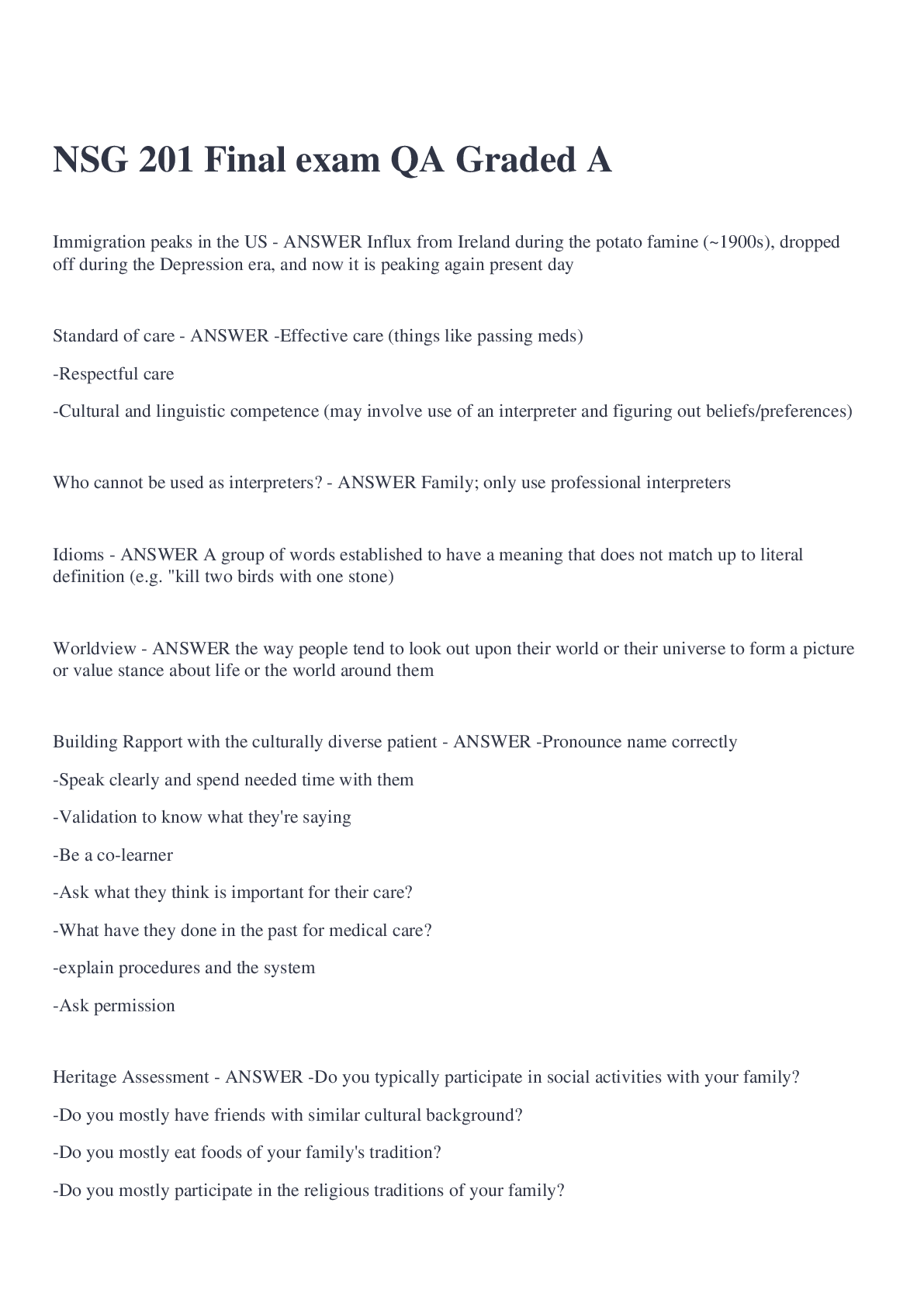
Competent Care • Assess if a translator is needed for PT (it should not be a
family member or friend)
- Why can’t a family member be the interpreter?
- They may not understand our medical technology
- They may say what they want to say.
• We need to make sure that they understand what they are
consenting to
- Informed consent and client autonomy.
• Avoid idioms or saying’s that can be taken literally such as,
“when pigs fly”, “last straw”
- This is part of communication. Idioms say things that
aren’t really accurate.
- Different countries have different idioms. From our
perspective, it’s the same problem—what are they
meaning?
-
-
RACE / ETHNICITY- self-identification and social group
RELIGION AND SPIRITUALITY- organized believes vs.
individual experiences
Worldview—Arnold: The way people tend to look out upon their
world or their universe to form a picture or value stance about life
or the world around them
- The way we see things
- Things that might change your world view:
Ex: A big event like 9/11,
Culture: Beliefs, customs, and traditions of a specific group of
people. Norms what we share, tradition.
o Knowing one’s own culture and being
self-aware is important
o Use understanding to listen, empathize, and
understand your own care
o Food is part of culture—Turkey dinner—
meat, mashed potatoes, gravy!
-
Religion: refers to a belief system to which an individual adheres
- EX: rituals and practices
Spirituality: Spirituality can be defined as a complex and
multidimensional part of the human experience— our inner belief
system.
- EX: purpose in life, peace, hope, love End of life.
Building Rapper with a culturally diverse Pt:
• Pronounce Pt name correctly and verify you are saying
their name right!
• Speak clearly and spend time
- You have to spend that time with them—sometimes you
have to talk to the charge nurse to arrange your load.
• Validate information
• Being a co-learner—we are learning as we are helping them
learn. Stepping outside of what you are comfortable with
and trying to bring them from a place where they may not be
as healthy to a place that they would like to be.
• Asking permission—being respectful. This is huge! We
think it’s good, but maybe they don’t
• Explain procedures and the system
Assessing Nutritional
Status
3 J: 180-182, 187, table 12.2,
Marasmus: inadequate energy intake, no caloric intake, including
protein
Kwashiorkor: inadequate protein intake but have colaric energy
[Show More]

.png)
.png)
.png)


 (1).png)