Linear Programming
Problem 1 (4 points, Exer. 41 in Linear Programming Exercises): Let P 2 Rn×n be a matrix with
the following two properties:
• all elements of P are nonnegative: pij ≥ 0 for i = 1; · · · ; n and j =
...
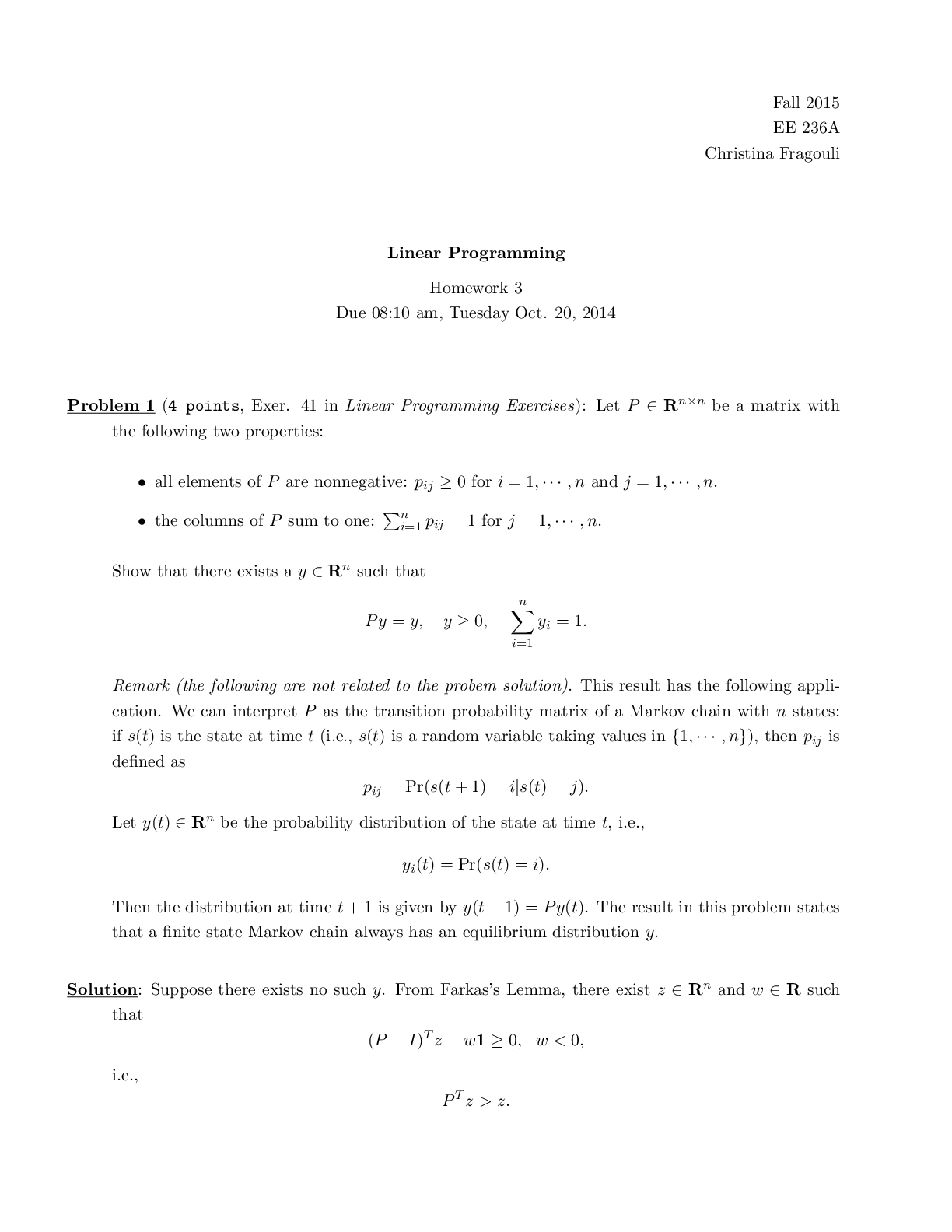
Linear Programming
Problem 1 (4 points, Exer. 41 in Linear Programming Exercises): Let P 2 Rn×n be a matrix with
the following two properties:
• all elements of P are nonnegative: pij ≥ 0 for i = 1; · · · ; n and j = 1; · · · ; n.
• the columns of P sum to one: Pn i=1 pij = 1 for j = 1; · · · ; n.
Show that there exists a y 2 Rn such that
P y = y; y ≥ 0;
nX i
=1
yi = 1:
Remark (the following are not related to the probem solution). This result has the following application. We can interpret P as the transition probability matrix of a Markov chain with n states:
if s(t) is the state at time t (i.e., s(t) is a random variable taking values in f1; · · · ; ng), then pij is
defined as
pij = Pr(s(t + 1) = ijs(t) = j):
Let y(t) 2 Rn be the probability distribution of the state at time t, i.e.,
yi(t) = Pr(s(t) = i):
Then the distribution at time t + 1 is given by y(t + 1) = P y(t). The result in this problem states
that a finite state Markov chain always has an equilibrium distribution y.
Solution: Suppose there exists no such y. From Farkas’s Lemma, there exist z 2 Rn and w 2 R such
that
(P − I)T z + w1 ≥ 0; w < 0;
i.e.,
PT z > z:Since the elements of P are nonnegative with unit column sums, we must have
(PT z)i ≤ max
j
zj;
which contradicts z < PT z.
Problem 2 (4 points, Exer. 46 in Linear Programming Exercises): For the following two LPs, check
(and prove whether) the proposed solution is optimal, by using duality:
1. For the LP
minimize 47x1 + 93x2 + 17x3 − 93x4
subject to
26666664
−1 −6 1 3
−1 −2 7 1
0 3 −10 −1
−6 −11 −2 12
1 6 −1 −3
37777775
266664
x1
x2
x3
x4
377775
≤
26666664
−3
5
−8
−7
4
37777775
Is x = (1; 1; 1; 1) optimal?
2. For the LP
maximize 7x1 + 6x2 + 5x3 − 2x4 + 3x5
subject to
266664
1 3 5 −2 3
4 2 −2 1 1
2 4 4 −2 5
3 1 2 −1 −2
377775
26666664
x1
x2
x3
x4
x5
37777775
≤
266664
4 3 5 1
377775
; xi ≥ 0; i = 1 : : : 5
Is x = (0; 4=3; 2=3; 5=3; 0) optimal?
Solution:
1. Clearly, x∗ = (1; 1; 1; 1) is feasible: it satisfies the first four constraints with equality and
the fifth constraint with strict inequality. To prove that x∗ is optimal, we construct a dual
optimal z∗ as a certificate of the optimality. z∗ must satisfy:
AT z∗ + c = 0; z∗ ≥ 0; zk∗(bk − aT k x∗) = 0; k = 1; : : : ; 5:
From the complementarity conditions we see that z5∗ = 0, and the dual equality constraints
reduce to a set of four equations in four variables
266664
−1 −1 0 −6
−6 −2 3 −11
1 7 −10 −2
3 1 −1 12
377775
266664
z∗
1
z∗
2
z∗
3
z∗
4
377775
+
266664
47
93
17
−93
377775
= 0:These equations have a unique solution (3; 2; 2; 7; 0). Therefore,
z∗ = (3; 2; 2; 7; 0):
This implies that the optimality condition holds, and x∗ = (1; 1; 1; 1) is optimal.
2. We consider the given problem as the dual problem and we can form the primal problem as
minimize cT y
subject to Ay ≤ b
y ≤ 0;
where
A =
26666664
1 4 2 3
3 2 4 1
5 −2 4 2
−2 1 −2 −1
3 1 5 −2
37777775
; b =
26666664
−7
−6
−5
2
−3
37777775
; c =
266664
−4
−3
−5
−1
377775
:
Let us suppose ~ x = (0; 4=3; 2=3; 5=3; 0)T is dual optimal, and ~ y is primal optimal. Then
according to the optimality condition, we have
x~i(b − Ay~)i = 0; i = 1; : : : ; 5;
cT y~ = −bT x; ~
where the first constraints are according to the complementary slackness and the second
constraint is due to the strong duality. We can solve the above equations, which contain four
equations and four variables. Then we can get the solution: ~ y = (−1; −1; 0; −1)T .
Obviously, ~ y is not primal feasible, since the last constraint of Ay ≤ b is not satisfied. Therefore, ~ x = (0; 4=3; 2=3; 5=3; 0)T is not optimal.
Problem 3 (4 points, Exer. 47 in Linear Programming Exercises)
Consider the polyhedron
P = fx 2 R4jAx ≤ b; Cx = dg
where
A =
266664
−1 −1 −3 −4
−4 −2 −2 −9
−8 −2 0 −5
0 −6 −7 −4
377775
; b =
266664
−8
−17
−15
−17
377775
andC = h13 11 12 22i ; d = 58
1. Prove that ^ x = (1; 1; 1; 1) is an extreme point of P.
2. Prove that ^ x is optimal for the LP
minimize cT x
subject to Ax ≤ b
Cx = d
with c = (59; 39; 38; 85).
3. (Bonus)(1 point) is ^ x the only optimal point? if not, describe the entire optimal set.
You can use any software, but you have to justify your answers analytically.
Solution:
(a) We have
b − Ax^ = (1; 0; 0; 0);
i.e., all inequalities except the first one are active. We therefore have to examine the rank of the
matrix
266664
−4 −2 −2 −9
−8 −2 0 −5
0 −6 −7 −4
13 11 12 22
377775
The rank is four. Hence ^ x is an extreme point.
(b) To prove ^ x is optimal, we have to find a z 2 R4 and y 2 R satisfying
z ≥ 0; A~T z + CT y + c = 0; zi(~bi − a~T i x^) = 0; i = 1; :::; 4:
The complementary slackness conditions imply that z1 = 0, so the optimality conditions reduce to
zi ≥ 0, i = 2; :::; 4, and
266664
−4 −8 0 13
−2 −2 −6 11
−2 0 −7 12
−9 −5 −4 22
377775
266664
z2
z3
z4
y
377775
=
266664
−59
−39
−38
−85
377775
This is a set of four equations in four variables, with an invertible coefficient matrix. It has a unique
solution
z2 = 1; z2 = 2; z3 = 0; y = −3:From this we conclude that the optimality conditions at ^ x are solvable and that there is a unique
dual solution
z^ = (0; 1; 2; 0); y = −3:
(c) Any primal optimal x must satisfy the complementary slackness conditions with the dual optimal
solution found in part (b). Conversely, any x that is primal feasible and complementary with ^ z is
optimal. This yields the following conditions on x:
Ax ≤ b; Cx = d; ~bi − a~T i x = 0; i = 2; 3:
This leaves only one possibility for an extreme point other than ^ x to be optimal: it is possible that
there is an optimal extreme point at which the first inequality is active. To see if this yields a
feasible point, we have to solve the set of equations
266664
−1 −1 −3 −4
−4 −2 −2 −9
−8 −2 0 −5
13 11 12 22
377775
266664
x1
x2
x3
x4
377775
=
266664
−8
−17
−15
58
377775
The solution is ~ x = (0:7542; 1:8375; 0:3917; 1:0583). To verify that ~ x is feasible, we plug it in in the
fourth inequality. We find
h−8 −2 0 −5i x~ = −18 ≤ −17: (1)
Therefore ~ x is feasible. We conclude that there are two optimal extreme points, ^ x and ~ x. Any
convex combination of ^ x and ~ x is also optimal, i.e., the optimal set is
Xopt = fθx^ + (1 − θ)~ xjθ 2 [0; 1]g : (2)
Problem 4 (3 points, Exer. 50 in Linear Programming Exercises): A matrix A 2 R(mp)×n and a vector
b 2 Rmp are partitioned in m blocks of p rows:
A =
266664
A1
A2
... Am
377775
; b =
266664
b1
b2
...
bm
377775
;
with Ak 2 Rp×n, bk 2 Rp.
(a) Express the optimization problem
minimize
mP
k=1
jjAkx − bkjj1 (3)
as an LP.(b) Suppose rank(A) = n and Axls − b 6= 0, where xls is the solution of the least-squares problem
minimize jjAx − bjj2:
Derive the dual program and show that it can be simplified as
maximize Pm k=1 bT k zk
subject to Pm k=1 AT k zk = 0
jjzkjj1 ≤ 1; k = 1; : : : ; m
(c) For the setup of (b), show that the optimal value of (3) is bounded below by
Pm k=1 jjrkjj2
maxk=1;··· ;m jjrkjj1
where rk = Akxls − bk for k = 1; · · · ; m.
Solution:
(a) The problem is equivalent to the LP
minimize 1T y
subject to −yk1 ≤ Akx − bk ≤ yk1; k = 1; : : : ; m;
with an auxiliary variable y 2 Rm.
(b) The dual problem can be written as
maximize
mP
k=1
bT
k (uk − vk)
subject to
mP
k=1
AT
k (uk − vk) = 0
1T (uk + vk) = 1; k = 1; : : : ; m
uk ≥ 0; vk ≥ 0;
with variables uk; vk 2 Rp. We can derive the simplified equivalent problem
maximize
mP
k=1
bT
k zk
subject to
mP
k=1
AT
k zk = 0
jjzkjj1 ≤ 1; k = 1; : : : ; m:
This can be testified as follows (see, page 6-16). If uk, vk are feasible for the first problem, then
zk = uk − vk is feasible for the second problem. If zk is feasible for the second problem, then
(uk)i = maxf(zk)i; 0g+αk and (vk)i = maxf−(zk)i; 0g+αk are feasible for the first problem, where
αk = (1 − jjzkjj1)=(2p).
(c) For the least square solution xls, we have the following property:
(AT A)xls = AT b:
[Show More]