ECON 444 Homework 5 Problem Set 5 Answers
Document Content and Description Below
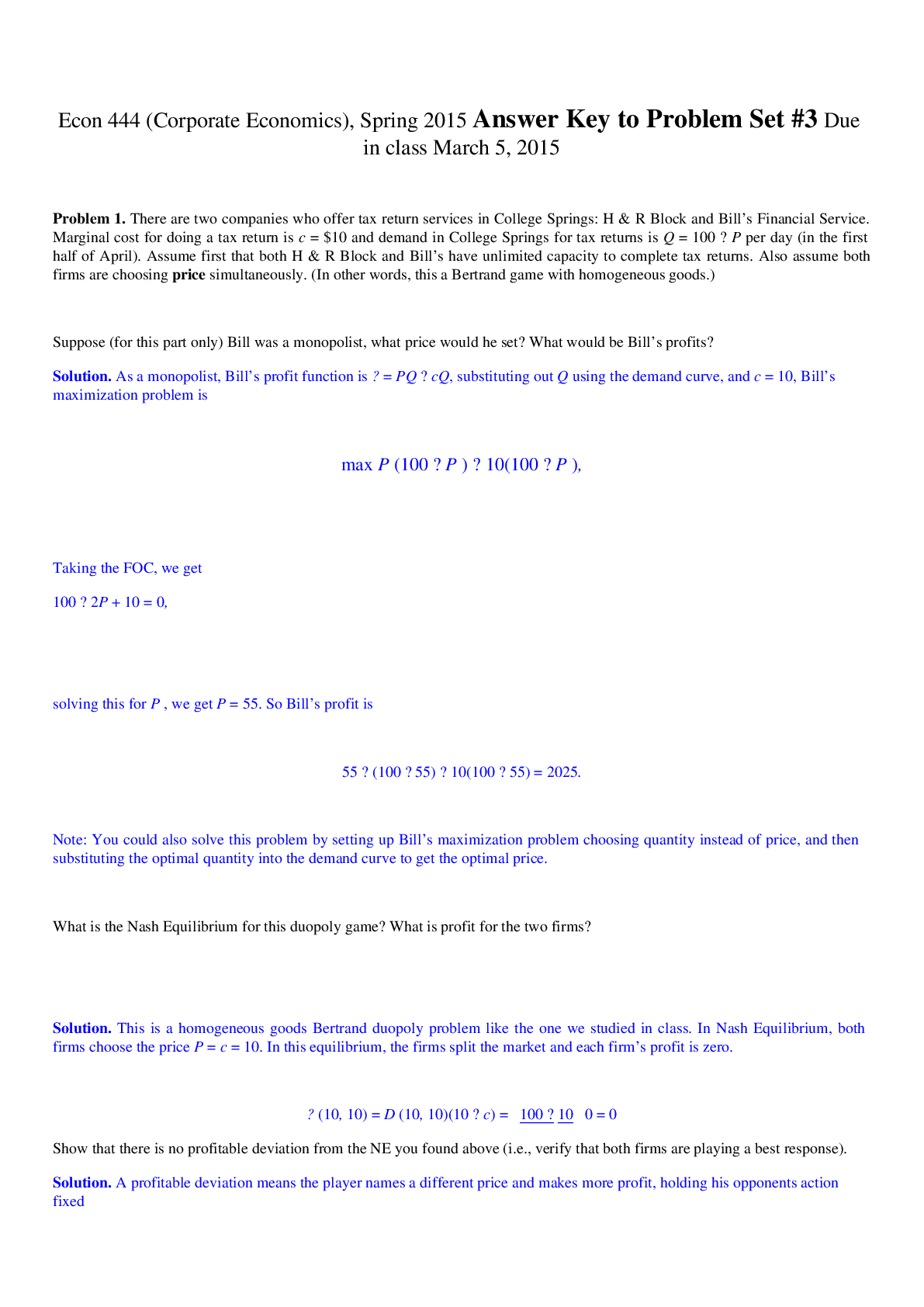
ECON 444 Homework 5 Problem Set 5 Answers (Penn State University) Problem 1. TomsonBook is the monopoly publisher which produces the textbook “Corporate Economics.” TomsonBook sells in two separate markets, domestic mark
...
[Show More]
Last updated: 3 years ago
Preview 1 out of 12 pages
Instant download
.png)
Buy this Document to get the Full Access Instantly
Provided by Students Who Aced it
We Verify Document Content to Gurantee Accuracy
Reviews( 0 )
Document information
Connected school, study & course
About the document
Uploaded On
Feb 06, 2023
Number of pages
12
Written in
All

Additional information
This document has been written for:
Uploaded
Feb 06, 2023
Downloads
0
Views
114
Topic Tags
Recommended For You
Get more on EXAM ».png)
$8
11 Pages
ECON 444 Homework 3 Problem Set 3 Answers (Penn State Universi...

$13.5
9 Pages
ECON 444 Homework 7 Problem Set 7 Answers (Penn State Universi...
, Latest Questions and Answers with Explanations, All Correct Study Guide, Download to Score A.png)
$13
19 Pages
ECON 444 Homework 5 Problem Set 5 Answers (Penn State Universi...
, Latest Questions and Answers with Explanations, All Correct Study Guide, Download to Score A.png)
$13
20 Pages
ECON 444 Homework 6 Problem Set 6 Answers (Penn State Universi...
, Latest Questions and Answers with Explanations, All Correct Study Guide, Download to Score A.png)
$13
28 Pages
ECON 444 Homework 4 Problem Set 4 Answers (Penn State Universi...

More related documents below