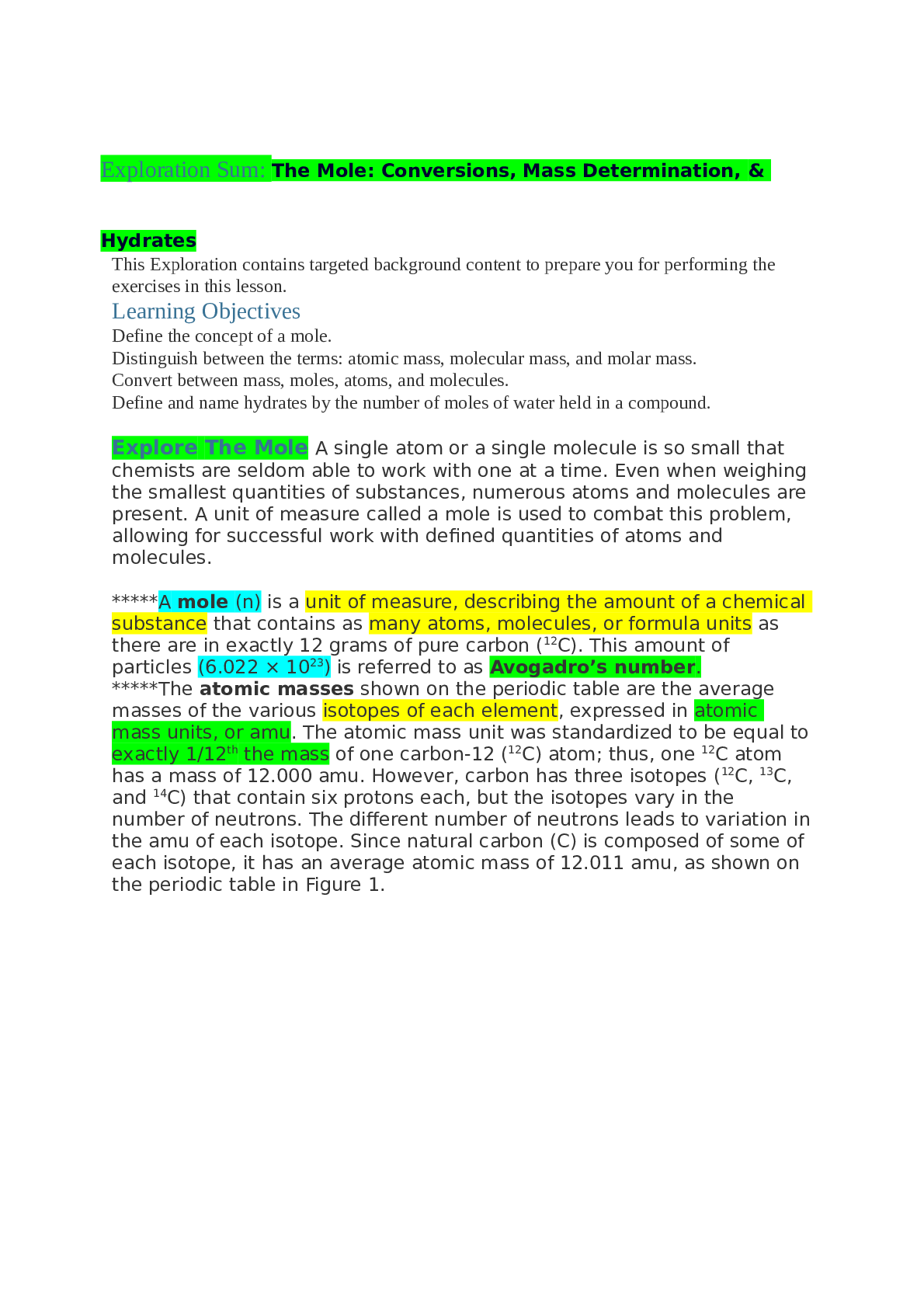
The Mole conversions, Mass Determination, & hydrates
This Exploration contains targeted background content to prepare you for performing the
exercises in this lesson.
Learning Objectives
Define the concept of a mole.
...
The Mole conversions, Mass Determination, & hydrates
This Exploration contains targeted background content to prepare you for performing the
exercises in this lesson.
Learning Objectives
Define the concept of a mole.
Distinguish between the terms: atomic mass, molecular mass, and molar mass.
Convert between mass, moles, atoms, and molecules.
Define and name hydrates by the number of moles of water held in a compound.
Explore The Mole A single atom or a single molecule is so small that
chemists are seldom able to work with one at a time. Even when weighing
the smallest quantities of substances, numerous atoms and molecules are
present. A unit of measure called a mole is used to combat this problem,
allowing for successful work with defined quantities of atoms and
molecules.
*****A mole (n) is a unit of measure, describing the amount of a chemical
substance that contains as many atoms, molecules, or formula units as
there are in exactly 12 grams of pure carbon (12C). This amount of
particles (6.022 × 10²³) is referred to as Avogadro’s number.
*****The atomic masses shown on the periodic table are the average
masses of the various isotopes of each element, expressed in atomic
mass units, or amu. The atomic mass unit was standardized to be equal to
exactly 1/12th the mass of one carbon-12 (12C) atom; thus, one 12C atom
has a mass of 12.000 amu. However, carbon has three isotopes (12C, 13C,
and 14C) that contain six protons each, but the isotopes vary in the
number of neutrons. The different number of neutrons leads to variation in
the amu of each isotope. Since natural carbon (C) is composed of some of
each isotope, it has an average atomic mass of 12.011 amu, as shown on
the periodic table in Figure 1.Figure 1.
Periodic Table of Elements.******The atomic mass (atomic weight) of an element is equal to
the mass in grams required to equal 1 mole of the substance.
Because atomic mass units and the mole are defined from the same
reference (carbon-12), the value on the periodic table can represent the
mass of a single atom in atomic mass units or the mass of a mole of
substance in grams. Thus, the atomic mass units shown on a periodic
table are numerically equivalent to the
****** molar masses of the elements or the mass in grams of each
element that contains one mole of atoms of that element. For example,
the element nitrogen has a molar mass of 14.007 grams, thus 1 mole of
nitrogen is equal to 14.007 grams. Likewise, the compound H2O has a
molar mass of 18.015 (H + H + O = 1.008 + 1.008 + 15.999), thus 1 mole
of H2O is equal to 18.015 grams. The mass of one mole of a substance
(molar mass) is equal to either its atomic mass expressed in grams (if it
is a monoatomic element) or its
******molecular mass expressed in grams (if it is a diatomic element or
compound).
***************************************************************************
***************************************************************************
**************************************************************Explore Co
nversions Molar mass conversions are common calculations in chemistry
laboratories. Example calculations are provided below to further explore
the relationships between molar masses, moles, grams, and atoms. For
each example, assume that a vial contains 12.5 grams of magnesium
chloride (MgCl2), and you need to know how many moles and atoms of
magnesium and chlorine are in the vial.
Example #1: Calculating the Molar Mass of a CompoundWhat is the molar mass of MgCl2?
1. Identify the molar mass of each element in the compound using the
periodic table. For MgCl2:
Molar mass of Mg=24.305 g Mg=1 mole Mg
Molar mass of Cl=35.453 g Cl=1 mole Cl
2. Add the molar mass of each element in the compound together.
*****In the compound MgCl2 there is 1 mole of magnesium and 2 moles of
chlorine:
Molar mass of MgCl2 = 24.305 g/mol + (2×35.453 g/mol) = 95.211 g/mol
The molar mass of MgCl2 is 95.211 g MgCl2: 95.211 g MgCl2 = 1 mole MgCl2.
Example #2: Calculating the Number of Moles of a Compound in a Sample
How many moles of MgCl2 are present in a sample weighing 12.5 g?
1. Calculate the molar mass of the compound using the periodic table.
From Example #1, the molar mass of MgCl2 is 95.211 g/mol.
2. Use the molar mass to convert the mass (grams) of the sample to moles.
The mass of the MgCl2 sample in this example is 12.5 g.
12.5 g MgCl2 * 1 mol MgCl2/ (divide) 95.211g MgCl2=0.131 mol of MgCl2
There are 0.131 mol of MgCl2 in 12.5 g of MgCl2
Example #3: Calculating the Number of Moles of an Element in a Sample
How many moles of Mg are present in 12.5 g MgCl2? How many moles of Cl are
present?
1. Calculate the molar mass of the compound using the periodic table.
***From Example #1, the molar mass of MgCl2 is 95.211 g/mol.
2. Use the molar mass to convert the mass (grams) of the sample to moles.
******From Example #2, there are 0.131 mol MgCl2 in a 12.5 g sample.
3. Calculate how many moles of each element are present in the moles of the compound.
*****For MgCl2, calculate the number of moles of Mg present in 0.131 mol MgCl2:
0.131 mol MgCl2 *1 mol Mg/ (divide) 1 mol MgCl2 = 0.131 mol of Mg
******* Calculate the number of moles of Cl present in 0.131 mol MgCl2:
0.131 mol MgCl2* 2 mol Cl/ (divide) 1 mol MgCl2= 0.262 mol Cl
There are 0.131 mol of Mg and 0.262 mol of Cl in 12.5 g of MgCl2.
Example #4: Calculating the Number of Atoms of an Element in a Sample
How many atoms of Mg are present in 12.5 g MgCl2? How many atoms of Cl are
present?
1. Calculate the molar mass of the compound using the periodic table.
******From Example #1, the molar mass of MgCl2 is 95.211 g/mol.
2. Use the molar mass to convert the mass (grams) of the sample to moles.
******From Example #2, there are 0.131 mol MgCl2 in a 12.5 g sample.
3. Calculate how many moles of each element are present in the moles of the compound.
******From Example #3, there are 0.131 mol Mg and 0.262 mol Cl in 0.131 mol MgCl2.
[Show More]