Quiz5Questions.docx
Question 1 :
Complete questions and answers solution 2021
A sixty-six-year-old male was prescribedphenelzine (Nardil) while in an acute psychiatric unit for recalcitrant depression. The nurse
...
Quiz5Questions.docx
Question 1 :
Complete questions and answers solution 2021
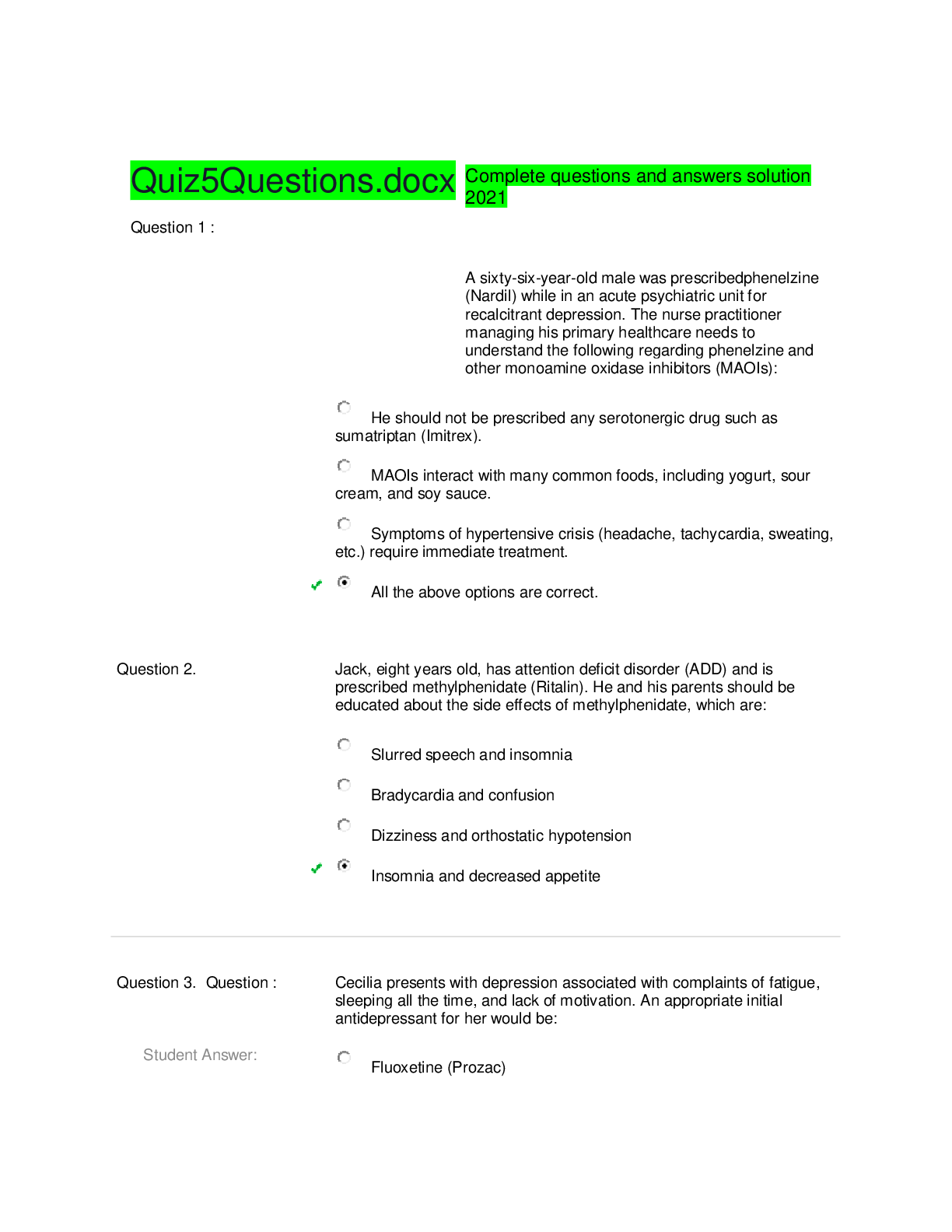
A sixty-six-year-old male was prescribedphenelzine (Nardil) while in an acute psychiatric unit for recalcitrant depression. The nurse practitioner managing his primary healthcare needs to understand the following regarding phenelzine and other monoamine oxidase inhibitors (MAOIs):
He should not be prescribed any serotonergic drug such as sumatriptan (Imitrex).
MAOIs interact with many common foods, including yogurt, sour cream, and soy sauce.
Symptoms of hypertensive crisis (headache, tachycardia, sweating, etc.) require immediate treatment.
All the above options are correct.
Question 2. Jack, eight years old, has attention deficit disorder (ADD) and is prescribed methylphenidate (Ritalin). He and his parents should be educated about the side effects of methylphenidate, which are:
Slurred speech and insomnia
Bradycardia and confusion
Dizziness and orthostatic hypotension
Insomnia and decreased appetite
Question 3. Question : Cecilia presents with depression associated with complaints of fatigue, sleeping all the time, and lack of motivation. An appropriate initial antidepressant for her would be:
Student Answer: Fluoxetine (Prozac)
Paroxetine (Paxil)
Amitriptyline (Elavil)
Duloxetine (Cymbalta)
Question 4. Jake, a forty-five-year-old patient with schizophrenia, was recently hospitalized for acute psychosis due to medication noncompliance. He was treated with intramuscular (IM) long-acting haloperidol. Besides being monitored for his schizophrenia symptoms, the patient should be assessed by his primary care provider:
For excessive weight loss
With the Abnormal Involuntary Movement Scale (AIMS) for extrapyramidal symptoms (EPS) symptoms
Monthly for tolerance to the haloperidol
Only by the mental health provider as most nurse practitioners in primary care do not care for mentally ill patients
Question 5. Monitoring for a child on methylphenidate for ADHD includes:
ADHD symptoms
Routine height and weight checks
Amount of methylphenidate being used
All of the above
Question 6. An appropriate drug for the treatment of depression with anxiety would be:
Alprazolam (Xanax)
Escitalopram (Lexapro)
Buspirone (Buspar)
Amitriptyline (Elavil)
Question 7. When prescribing Adderall (amphetamine and dextroamphetamine) to adults with ADHD, the nurse practitioner will need to monitor:
The blood pressure
Blood glucose levels
Urine ketone levels
Liver function
Question 8. Levetiracetam has known drug interactions with:
Oral contraceptives
Carbamazepine
Warfarin
Few, if any, drugs
Question 9. Cara is taking levetiracetam (Keppra) to treat seizures. Routine education for levetiracetam includes reminding her:
To not abruptly discontinue levetiracetam due to the risk of withdrawal seizures
To wear a sunscreen due to photosensitivity from levetiracetam
To get an annual eye exam while on levetiracetam
To report weight loss if it occurs
Question 10. A nineteen-year-old male was started on risperidone. Monitoring for risperidone includes observing for common side effects, including:
Bradykinesia, akathisia, and agitation
Excessive weight gain
Hypertension
Potentially fatal agranulocytosis
Question 11. An appropriate first-line drug to try for mild to moderate generalized anxiety disorder would be:
Alprazolam (Xanax)
Diazepam (Valium)
Buspirone (Buspar)
Amitriptyline (Elavil)
Question 12. One major drug used to treat bipolar disease is lithium. Because lithium has a narrow therapeutic range, it is important to recognize symptoms of toxicity, such as:
Orthostatic hypotension
Agitation and irritability
Drowsiness and nausea
Painful urination and abdominal distention
Question 13. A patient with anxiety and depression may BEST respond to:
Duloxetine (Cymbalta)
Fluoxetine (Prozac)
Oxazepam (Serax)
Buspirone (Buspar) and selective serotonin reuptake inhibitors (SSRI) combined
Question 14. Selma, who is overweight, recently started taking topiramate for seizures, and at her follow-up visit, you note she has lost 3 kg. The appropriate action would be:
Tell her to increase her caloric intake to counter the effects of the topiramate.
Consult with a neurologist as this is not a common adverse effect of topiramate.
Decrease her dose of topiramate.
Reassure her that this is a normal side effect of topiramate and continue to monitor her weight.
Question 15. Sarah, a forty-two-year-old female, requests a prescription for an anorexiant to treat her obesity. A trial of phentermine is prescribed. Prescribing precautions include understanding that:
Obesity is a contraindication to prescribing phentermine.
Anorexiants may cause tolerance and should only be prescribed for six months.
Patients should be monitored for postural hypotension.
Renal function should be monitored closely while the patient is on anorexiants.
Question 16. Patients should be instructed regarding the rapid onset of zolpidem (Ambien) because:
Zolpidem should be taken just before going to bed.
Zolpidem may cause a dry mouth and constipation.
Patients may need to double the dose for effectiveness.
Patients should stop drinking alcohol at least thirty minutes before taking zolpidem.
Question 17. In choosing a benzodiazepam to treat anxiety, the prescriber needs to be aware of the possibility of dependence. The benzodiazepam with the greatest likelihood of rapidly developing dependence is:
Chlordiazepoxide (Librium)
Clonazepam (Klonopin)
Alprazolam (Xanax)
Oxazepam (Serax)
Question 18. Common mistakes practitioners make in treating anxiety disorders include:
Switching medications after an eight-week trial to a twelve-week trial
Maximizing dosing of antianxiety medications
Encouraging exercise and relaxation therapy before starting medication
Thinking a partial response to medication is acceptable
Question 19. Judy is being prescribed phenytoin for seizures. Monitoring includes:
Assessing for phenytoin hypersensitivity syndrome three to eight weeks after starting treatment
Assessing for pedal edema throughout therapy
Assessing the heart rate at each visit and consider altering therapy if the heart rate is less than 60 bpm
Assessing for vision changes, such as red-green blindness, at least annually
Question 20. Cynthia is taking valproate (Depakote) for seizures and would like to get pregnant. What advice would you give her?
Valproate is safe during all trimesters of pregnancy.
She can get pregnant while taking valproate, but she should take adequate folic acid.
Valproate is not safe at any time during pregnancy.
Valproate is a known teratogen but may be taken after the first trimester if necessary.
[Show More]


 , Best ATI Exam Solution 2021, High Rated Solutions.png)


.png)









.png)