.PHARMACOTH C352 Contemporary Pharmacotherapeutics. Pharmacology Study Guide.
Pharmacotherapeutics
The treatment of pathologic conditions through the use of drugs
Pharmacokinetics
What the body does to the drug
...
.PHARMACOTH C352 Contemporary Pharmacotherapeutics. Pharmacology Study Guide.
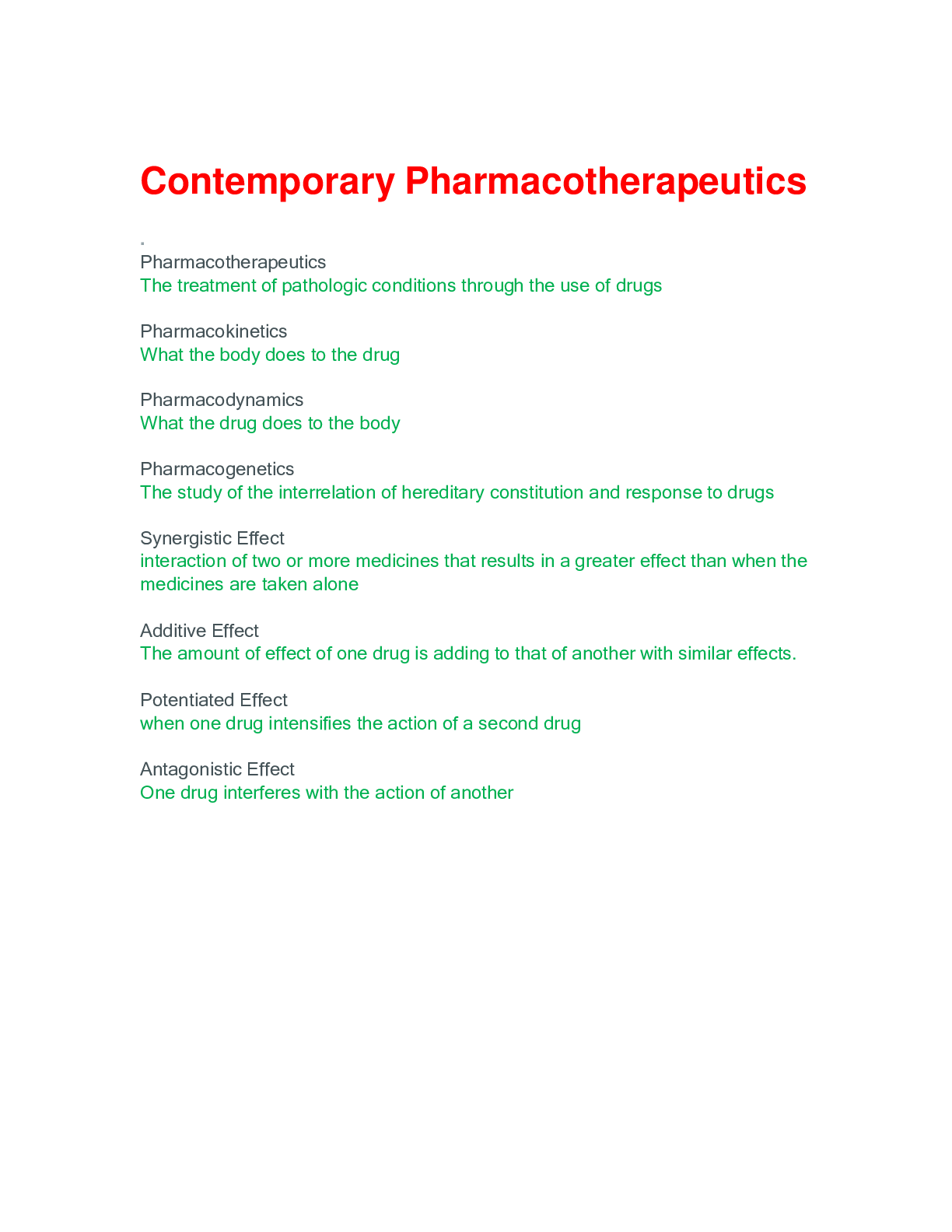
Pharmacotherapeutics
The treatment of pathologic conditions through the use of drugs
Pharmacokinetics
What the body does to the drug
Pharmacodynamics
What the drug does to the body
Pharmacogenetics
The study of the interrelation of hereditary constitution and response to drugs
Synergistic Effect
interaction of two or more medicines that results in a greater effect than when the medicines are taken alone
Additive Effect
The amount of effect of one drug is adding to that of another with similar effects.
Potentiated Effect
when one drug intensifies the action of a second drug
Antagonistic Effect
One drug interferes with the action of another
Browse diagrams
1. A nurse has been assigned to care for a 52-year-old attorney who has hypertension and
peptic ulcer disease. Before administering his medications, the nurse must complete an
initial assessment. Core patient variables will be obtained from which of the following?
(Select all that apply.)
A) The patient's interview
B) The patient's medical history
C) The patient's medical record
D) The patient's physical examination
E) The patient's health insurer
2. A 68-year-old female patient who was diagnosed with hypertension 2 weeks ago and
was prescribed a new hypertension medication has returned to the clinic for a follow-up
visit. The nurse notes that the patient's blood pressure is unchanged from her last clinic
visit. When the patient was asked if she was taking the new medication on a regular
basis, she stated, "I thought that I was supposed to take the new drug when I had a
pounding headache or was in a stressful situation, not all the time." An appropriate
nursing diagnosis for this patient would be which of the following?
A) Knowledge, deficient due to the lack of understanding of treatment regimen
B) Coping, ineffective due to forgetfulness
C) Confusion, acute concerning drug administration
D) Anxiety due to diagnosis of hypertension
Page 4
.
3. In order to promote therapeutic drug effects, the nurse should always encourage patients
to
A) take their medication with meals.
B) take their medication at the prescribed times.
C) increase medication dosages if necessary.
D) use alternative therapy to increase the effects of their medications.
4. A patient is treated with an antibiotic for an infection in his leg. After 2 days of taking
the antibiotic, the patient calls the clinic and reports that he has a rash all over his body.
The nurse is aware that a rash can be an adverse effect of an antibiotic and can be either
a biologic, chemical, or physiologic action of the drug, which is an example of
A) pharmacotherapeutics.
B) pharmacokinetics.
C) pharmacodynamics.
D) pharmacogenetics.
5. A nurse has been assigned the task of preparing educational materials for patients with
diabetes. The nurse has included the drug name, the reason the drug was prescribed, the
intended effect of the drug, along with important adverse effects that should be reported
to the nurse or the health care provider. Which of the following information is essential
to include in the educational materials?
A) Drug administration method
B) Core drug knowledge
C) Vital signs of the patient
D) Diagnosis and outcome identification mechanism
6. A 56-year-old female patient has been admitted to the hospital with chronic muscle
spasms and has been prescribed a new medication to treat the spasms. She has a poorly
documented allergy to eggs, synthetic clothes, and perfumes. What is the priority action
of the nurse to ensure that prescribed medication does not experience an allergic
reaction?
A) Call the prescriber immediately regarding her allergic reactions
B) Hold the medication for her muscle spasms until she can be treated for a possible
allergic reaction
C) Post an allergies notice on the front of the chart and document the allergies in the
appropriate area of the patient's record
D) Call the dietary staff and make sure that the patient is not served eggs for breakfast
Page 5
7. The nurse has been assigned a 49-year-old patient who has acute colitis, and the nurse
just completed gathering data concerning core drug knowledge and core patient
variables. To implement nursing management of drug therapy for this patient, the nurse
will then
A) evaluate the outcome of the drug therapy.
B) devise strategies to maximize the therapeutic effects of the drug.
C) implement planned nursing actions.
D) assess for data that will indicate interactions between core drug knowledge and
core patient variables.
8. Which of the following activities would the nurse expect to complete during the
evaluation phase of the nursing process in drug therapy?
A) Compare the outcome expected with the actual patient outcome
B) Reconsider core drug knowledge and core patient variables
C) Ask questions to prepare an effective patient education program
D) Establish a baseline for the patient's treatment and care
9. A nurse is caring for a postsurgical patient who has small tortuous veins and had a
difficult IV insertion. The patient is now receiving IV medications on a regular basis.
What is the best nursing intervention to minimize the adverse effects of this drug
therapy?
A) Monitor the patient's bleeding time
B) Check the patient's blood glucose levels
C) Record baseline vital signs
D) Monitor the IV site for redness, swelling, or pain
10. A patient has been prescribed several drugs and fluids to be given intravenously. Before
the nurse starts the intravenous administration, a priority assessment of the patient will
be to note the
A) heart rate.
B) body weight and height.
C) blood pressure.
D) skin surrounding the potential IV site
11. A nurse is performing an admission assessment of an elderly patient who is being
admitted to a medical ward from the emergency department. Which of the following is
an open-ended assessment question?
A) "Have you ever had a bad response to a drug that you've taken?"
B) "Does anyone in your immediate family have a history of drug allergies?"
C) "Are you comfortable with receiving needles?"
D) "What kind of reactions have you had to medications?"
12. The nurse's assessment of a community-dwelling adult suggests that the client may have
drug allergies that have not been previously documented. What statement by the client
would confirm this?
A) "I tend to get sick in the stomach when I take antibiotics."
B) "I've been told that aspirin might have caused my stomach bleed a few years back."
C) "I broke out in hives and got terribly itchy when I started a new prescription last
year."
D) "When I fell last year, the doctor said that it might have been because of my blood
pressure pills."
13. A nurse who provides care on a busy medical unit of a large hospital is constantly faced
with new drugs on patients' medication administration records. What strategy should the
nurse employ to foster up-to-date information about the nursing management of new or
uncommon drugs?
A) Focus on learning about a prototype drug that is characteristic of a larger drug class
B) Identify similarities between new drugs and older drugs that are commonly used on
the unit
C) Commit time and energy during each shift to learning about new drugs
D) Liaise with pharmacists and pharmacy technicians who work at the hospital
14. A patient who has been admitted to the hospital for a mastectomy has stated that she has
experienced adverse drug effects at various times during her life. Which of the
following strategies should the nurse prioritize in order to minimize the potential of
adverse drug effects during the patient's stay in the hospital?
A) Administer the patient's drugs in doses that are smaller and more frequent than
ordered
B) Monitor the patient vigilantly for signs and symptoms of potentially adverse drug
effects
C) Encourage the patient to bring herbal supplements and complementary remedies
with her to the hospital
D) Alter the administration of the patient's medications in favor of the intravenous,
rather than oral, route.
15. A surgical patient has been diagnosed with type 2 diabetes during his current admission
to the hospital. The nurses and other members of the care team have attempted to
engage the patient in education about his new diagnosis, the effects it will have on his
lifestyle and the medications that will be necessary to treat it. However, the patient is
unwilling to discuss these matters, usually citing fatigue or the desire to watch TV or
make phone calls. What potential nursing diagnosis should the nurse prioritize?
A) Ineffective coping
B) Knowledge deficit
C) Acute confusion
D) Anxiety
16. A physician has ordered subcutaneous injections of morphine, a narcotic, every 4 hours
as needed for pain for a motor vehicle accident victim. The nurse is aware that there is a
high abuse potential for this drug and that it is categorized as a
A) C-I drug.
B) C-II drug.
C) C-III drug.
D) C-IV drug.
17. A nurse working for a drug company is involved in phase III drug evaluation studies.
Which of the following might the nurse be responsible for during this stage of drug
development?
A) Working with animals who are given experimental drugs
B) Monitoring drug effects in patients who are selected to participate in a study, who
have the disease that the drug is meant to treat
C) Administering investigational drugs to patients
D) Informing healthy, young volunteer participants of possible risks that could occur
from taking an experimental drug
18. Which of the following would be the most user-friendly and appropriate source of drug
information for a nurse?
A) Drug Facts and Comparisons book
B) A nurse's drug guide
C) A drug package insert
D) The Physician's Drug Reference (PDR)
19. A nurse works in a private hospital and needs to administer some narcotic drugs to one of her patients. Which of the following should the nurse consider when administering narcotics to patients in a hospital setting? A) Narcotics are banned in private settings and cannot be used. B) Narcotics can be used in the hospital after obtaining written approval from the Joint Commission for Accreditation of Hospitals and Healthcare Organizations (JCAHO). C) Narcotics to be used in the hospital are dispensed only with a written prescription. D) Narcotics can be used in the hospital according to patient preferences.
C
20. A nurse who is responsible for administering medications should understand that the goals of the MedWatch program are to: (Select all that apply.)
A) Provide regular feedback about product safety issues. B) Accredit new medical facilities and hospitals. C) Facilitate the reporting of adverse reactions of drugs. D) Increase awareness of serious reactions caused by drugs or medical devices. E) Report medication errors that occur in hospitals.
A, C, D
21. A nurse is a member of a research team that is exploring unique differences in responses to drugs that each individual possesses, based on genetic make-up. This area of study is called:
A) pharmacotherapeutics. B) pharmacodynamics. C) pharmacoeconomics. D) pharmacogenomics.
22. Which of the following statements best defines how a chemical becomes termed a drug?
A) A chemical must have a proven therapeutic value or efficacy without severe toxicity or damaging properties to become a drug. B) A chemical becomes a drug when it is introduced into the body to cause a change. C) A chemical is considered a drug when the Food and Drug Administration (FDA) approves its release to be marketed. D) A chemical must have demonstrated therapeutic value to become a drug.
A
23. Which of the following serves to protect the public by ensuring the purity of a drug and its contents?
A) American Pharmaceutical Association B) United States Adopted Names Council C) Nursing drug guides D) Federal legislation
24. A nurse is providing a patient with a list of drugs as a part of the patient's plan of care. Which of the following drug nomenclatures should the nurse use to list the drugs?
A) The drugs' chemical names B) The drugs' generic names C) The drugs' trade names D) The drugs' biologic name
B
25. The medication nurse is in charge of transcribing drug orders and administering drugs to assigned patients. While preparing the drugs for administration, the nurse should always check:
A) For drug composition. B) The chemical, generic, and trade name of each drug. C) The drug name at least three times—before, during, and after obtaining each drug. D) The cost of each drug.
26. A nurse who provides care in a long-term care facility is documenting a new resident's medication regimen on the resident's intake admission. The nurse is documenting the generic, rather than proprietary, names of the resident's current drugs because:
A) There is a potential for confusion and miscommunication if proprietary names are used. B) Proprietary names of drugs can vary from state to state. C) Documentation of trade names for drugs requires permission from the manufacturer. D) Drugs with generic names are prescribed and used differently than proprietary drugs.
A
27. Federal legislation dictates a lengthy and rigorous process of testing for new drugs. What is the primary purpose of this testing process?
A) To protect state and federal departments from legal liability. B) To maximize autonomy and treatment options for citizens. C) To facilitate the efficiency of health care delivery. D) To ensure the safety of the public.
28. A nurse at a large, university hospital has been informed that a drug trial will be taking place that may involve several patients in the hospital over the next several months. What is the nurse's most likely role in this drug testing process?
A) Determining the clinical efficacy and safety of the drug. B) Suggesting potential improvements to the testing process. C) Administering the investigational drug to patients. D) Consulting on the methodology that has been chosen for testing the drug.
29. A nurse is performing discharge teaching with a patient who will be returning home shortly after being diagnosed with type 2 diabetes. The patient has stated that his intention to purchase his medications from an online pharmacy in an effort to save money. How should the nurse best respond to the patient's statement?
A) "Using an online pharmacy is an excellent way to reduce your drug costs." B) "If you do this, make sure that the pharmacy is physically located in the United States." C) "Be very careful when doing this, and make sure you're in close contact with your physician." D) "Actually, obtaining prescription drugs via the Internet has recently been made illegal."
30. A patient with a recent history of acute pain has been transferred to the intensive care unit after the nurse mistakenly administered hydromorphone rather than morphine. Which of the following statements best describes the legal responsibility of nurses when administering drugs?
A) Liability insurance protects nurses from litigation related to drug errors. B) Physicians are ultimately responsible for drug errors that occur in hospital settings. C) Nurses have an ethical, but not legal, responsibility to give drugs safely. D) Nurses are legally responsible for safe drug administration
31. Talwin given in combination with Vistaril diminishes the adverse effects of nausea caused by the Talwin. This drug interaction affecting the pharmacodynamics of the Talwin is:
A) an additive effect B) a synergistic effect C) a potentiated effect D) an antagonistic effect
32. On the 1 AM rounds, the nurse finds a patient awake and frustrated that she cannot go to sleep. The nurse administers an ordered hypnotic to help the patient sleep. Two hours later, the nurse finds the patient out of bed, full of energy and cleaning her room. The nurse evaluates the patient's response to the hypnotic as:
A) an allergic reaction B) an idiosyncratic response C) a synergistic effect D) a teratogenic effect
33. The nurse is caring for a patient receiving an aminoglycoside (antibiotic) that can be nephrotoxic. Which of the following will alert the nurse that the patient may be experiencing nephrotoxicity?
A) visual disturbances B) yellowing of the skin C) a decrease in urine output D) ringing noise in the ears
34. A nurse is caring for a patient who has recently moved from Vermont to south Florida. The patient has been on the same antihypertensive drug for 6 years and has had stable blood pressures and no adverse effects. Since her move, however, she reports "dizzy spells and weakness" and feels that the drug is no longer effective. The nurse suspects that the change in the effectiveness of the drug is related to:
A) The impact of the placebo effect on the patient's response. B) The accumulative effect of the drug if it has been taken for many years. C) The impact of the warmer climate on the patient's physical state. D) Problems with patient compliance with the drug regimen due to the move.
35. A nurse is instructing a patient concerning a newly prescribed drug. Which of the following should be included to help improve patient compliance and safety?
A) A list of pharmacies where the drug can be obtained. B) Measures to alleviate any discomfort associated with adverse effects. C) The cost of the brand drug compared with the generic form. D) Statistics related to phase III of testing for the prescribed drug
[Show More]


.png)