True or False: Because the genome is contained within an enclosed space, (much like the nucleus
of a cell) viruses are classified as eukaryotic Ans- False. Viruses are neither eukaryotic nor
prokaryotic
Describe the
...
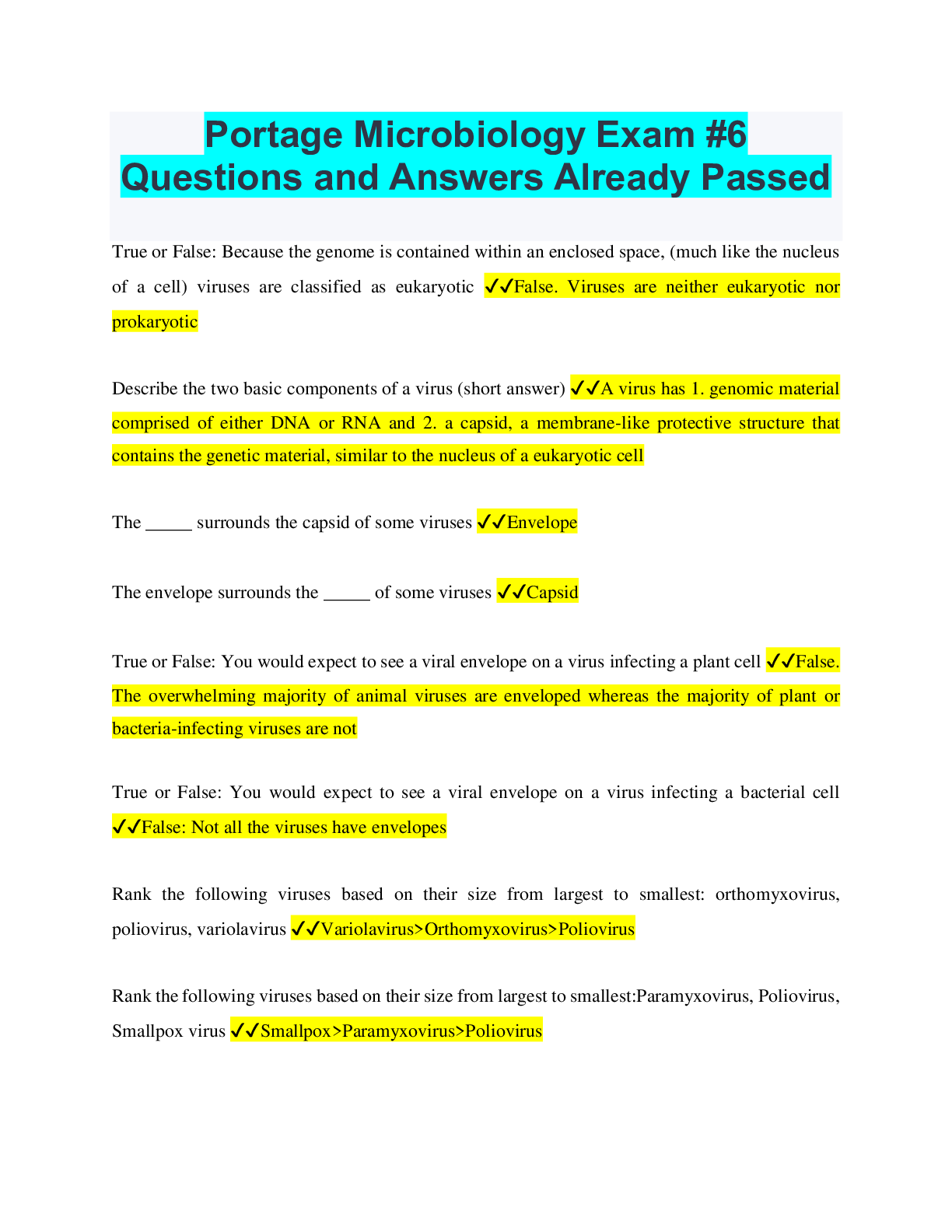
True or False: Because the genome is contained within an enclosed space, (much like the nucleus
of a cell) viruses are classified as eukaryotic Ans- False. Viruses are neither eukaryotic nor
prokaryotic
Describe the two basic components of a virus (short answer) Ans- A virus has 1. genomic
material comprised of either DNA or RNA and 2. a capsid, a membrane-like protective structure
that contains the genetic material, similar to the nucleus of a eukaryotic cell
The _____ surrounds the capsid of some viruses Ans- Envelope
The envelope surrounds the _____ of some viruses Ans- Capsid
True or False: You would expect to see a viral envelope on a virus infecting a plant cell AnsFalse. The overwhelming majority of animal viruses are enveloped whereas the majority of plant
or bacteria-infecting viruses are not
True or False: You would expect to see a viral envelope on a virus infecting a bacterial cell AnsFalse: Not all the viruses have envelopes
Rank the following viruses based on their size from largest to smallest: orthomyxovirus,
poliovirus, variolavirus Ans- Variolavirus>Orthomyxovirus>Poliovirus
Rank the following viruses based on their size from largest to smallest:Paramyxovirus,
Poliovirus, Smallpox virus Ans- Smallpox>Paramyxovirus>Poliovirus
True or False: Viral replication occurs after it attaches and enters the host cell Ans- True. The
viral genome is never replicated before attachment and entry
True or False: Highly infectious viruses undergo genome replication prior to viral attachment
and entry. Ans- False. The viral genome is never replicated before attachment and entry
regardless of its level of infectivity.
Place the following viral life cycle steps in order beginning with viral attachment and provide a
description of each step (short answer) Ans- Uncoating: the viral capsid disassembles
Release: New virus particles are produced and leave the cell
Replication: the viral genome is the 'blueprint' to make copies of itself
Attachment: viral receptors bind to host proteins on the surface of the cell
Entry: the virus fuses with the host membrane and enters the cell
New Infection: newly produced viruses that left the host cell now go on to infect new cells
A virus that infects bacteria is called a _____ and contains a _____ -side polygon capsid (fill in
the blank) Ans- Bacteriophage; 20-sided
True or False: Structurally bacteriophages are similar to viruses that infect animals Ans- False.
Bacteriophages have a distinct composition and structure
True or False. Structurally, bacteriophages are distinct from viruses that infect plant or animal
cells. Ans- True. Bacteriophages are structurally distinct from viruses that infect plant and
animals cells.
Identify the following components of a bacteriophage (picture) Ans- 1. Capsid
2. Collar
3. Tail
4. Base
5. Tail fibers
Describe the main differences between lytic and temperate phages (short answer) Ans- Lytic
bacteriophages replicate within the host bacteria until it ruptures, whereas temperate phages
primarily exist in a non-replicative state that does not kill the host cell
Lytic phages replicate all viral proteins needed for the assembly of new virus particles whereas
lysogenic phage genomes are integrated into the host genome but production of viral proteins is
suppressed
Based on the following image, would you expect the viral titer to be high or low? Why? (cloudy)
Ans- Low. As turbidity is a function of the number of intact bacterial cells present in the media,
the amount of virus contained within the above tube must be low. As the lytic continues more
and more bacterial cells will be destroyed, effectively clearing the media.
Which of the following cannot be spread via airborne particles
A. Measles
B. Mumps
C. Rubell
[Show More]