Alveolar air volume Ans- Amount of air that reaches alveoli for gas exchange (approx. 350 ml.
For adult male) Tidal volume minus dead space
Dead air space Ans- Anatomically: structures that hold air, but can't partici
...
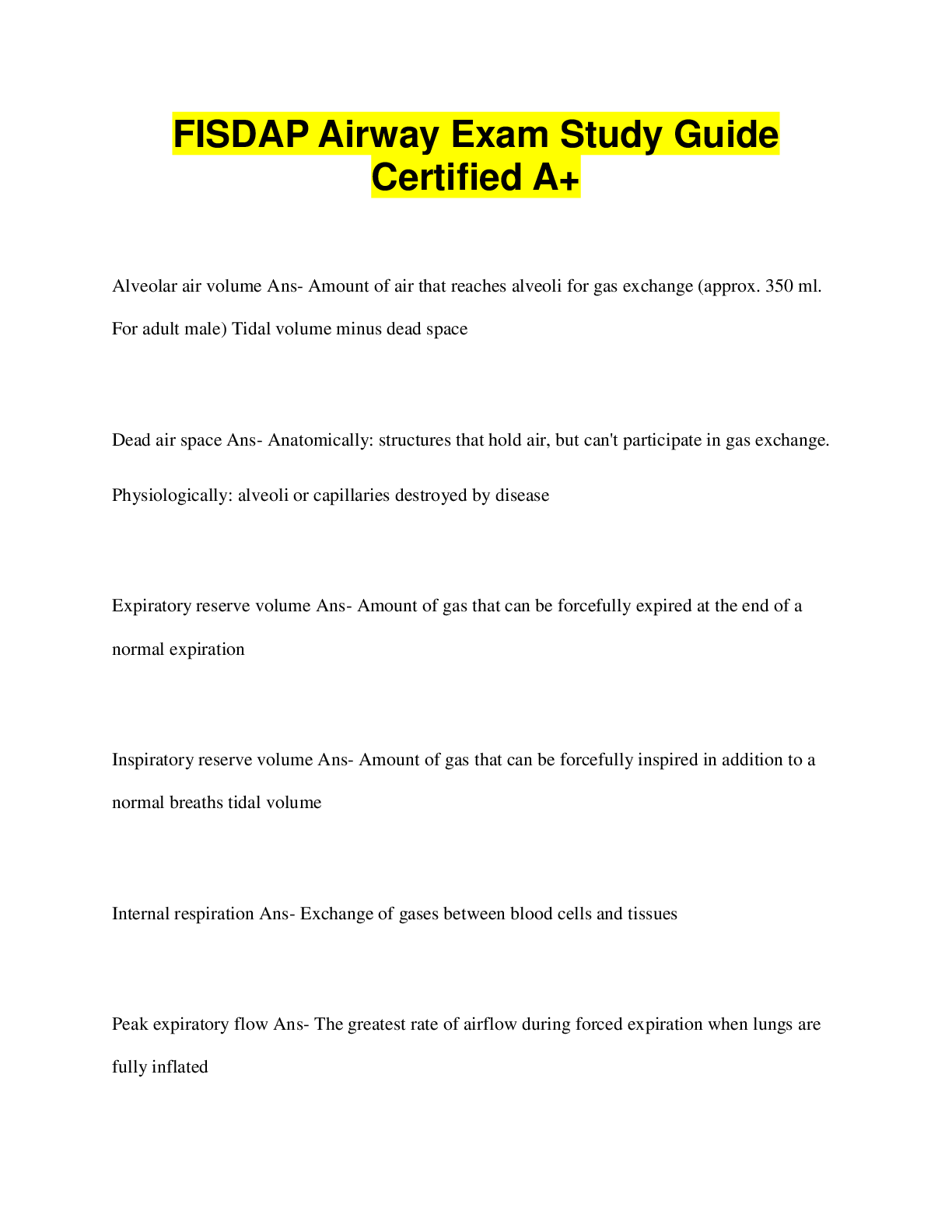
Alveolar air volume Ans- Amount of air that reaches alveoli for gas exchange (approx. 350 ml.
For adult male) Tidal volume minus dead space
Dead air space Ans- Anatomically: structures that hold air, but can't participate in gas exchange.
Physiologically: alveoli or capillaries destroyed by disease
Expiratory reserve volume Ans- Amount of gas that can be forcefully expired at the end of a
normal expiration
Inspiratory reserve volume Ans- Amount of gas that can be forcefully inspired in addition to a
normal breaths tidal volume
Internal respiration Ans- Exchange of gases between blood cells and tissues
Peak expiratory flow Ans- The greatest rate of airflow during forced expiration when lungs are
fully inflated
Residual volume Ans- After maximal forced exhalation, amount of air remaining not able to be
expelled
Tidal volume Ans- Amount of air in a respiratory cycle (500 ml, 5-7ml/kg)
Minute volume Ans- Amount of gas moved in and out of respiratory tract per minute
Air trapping Ans- A respiratory pattern associated with an obstruction in the pulmonary tree.
Rate increases to overcome resistance
Angle of Louis Ans- Angulation of the sternum that indicates the point where the second rib
joins the sternum. (manubriosternal junction)
Anoxia Ans- total lack of oxygen available to the tissues
Apnea Ans- Respiratory arrest
Atelectasis Ans- Abnormal condition characterized by collapse of alveoli, preventing exchange
of co2 and o2 in a part of the lungs
Barrier device Ans- Thin film of material placed on the patient's face used to prevent direct
contact with the patient's mouth during PPV
Carina Ans- Where the trachea divides into right and left bronchi
Ronchi Ans- Rattling or rumbling in the lungs. Inspiration and expiration. Fluid in larger airways
and may be cleared from a cough.
Stridor Ans- Harsh, high-pitched inspiratory sound best heard over the neck
Rattles (ronchi) Ans- Inflammation and mucus or fluid in larger airways heard on inspiration.
Associated with bronchitis or pneumonia
Crackles (rales) Ans- Wet lungs - sounds like hair rolled in finger tips. fluid in smaller airways,
crackling or popping sound on inspiration, sound that indicates presence of fluid in smaller
airways
Croup Ans- Viral infection in upper airway that sounds like a seal bark
Wheeze Ans- Whistling sound heard on inspiration or expiration in pharynx, trachea, bronchi
Biots respirations Ans- Irregular respirations and rate with periods of apnea from increased ICP,
brain damage at medulla, DKA, and OD'in
[Show More]