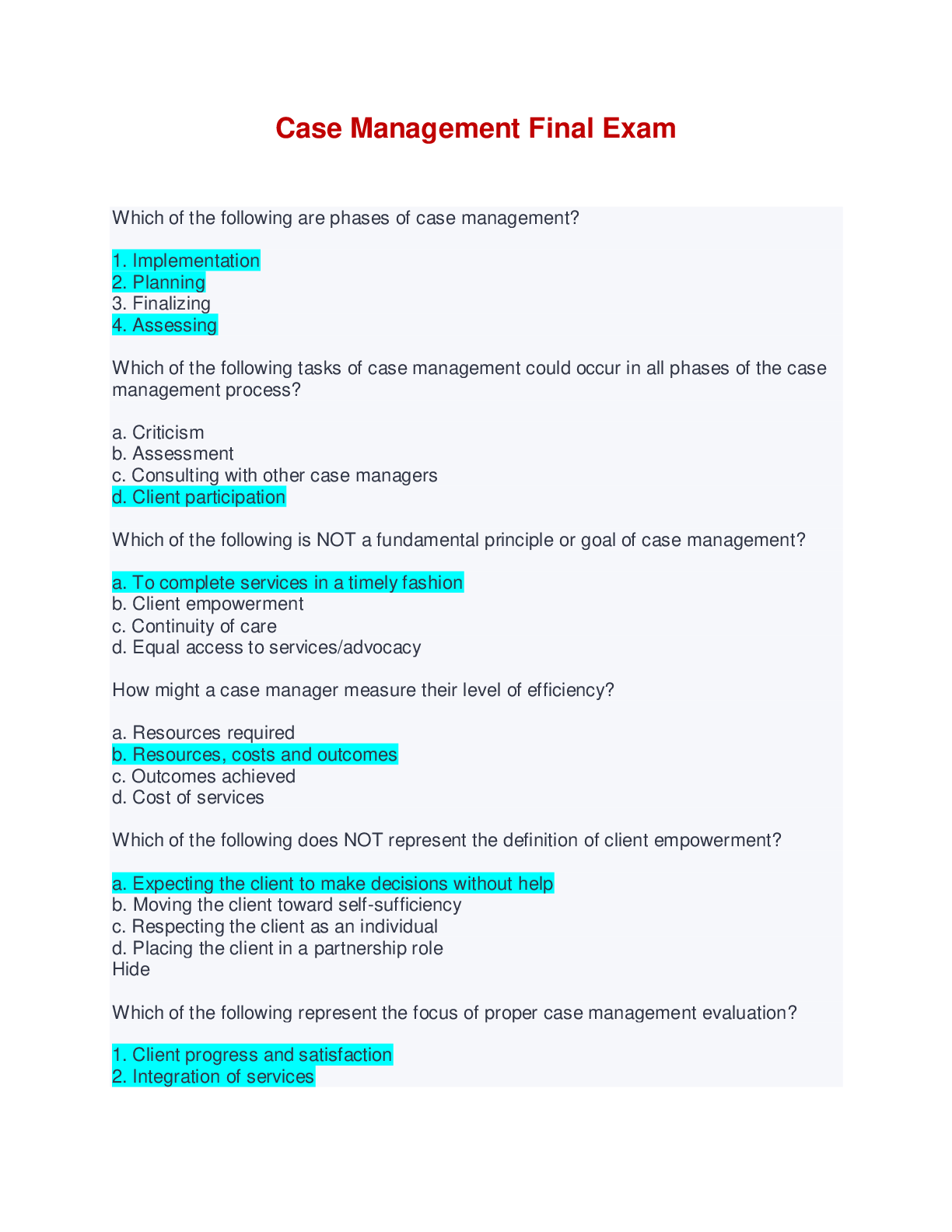
Case Management Final Exam - 181 Questions & Answers Which of the following are phases of case management? 1. Implementation 2. Planning 3. Finalizing 4. Assessing Which of the following tasks of case management could o
...
Case Management Final Exam - 181 Questions & Answers Which of the following are phases of case management? 1. Implementation 2. Planning 3. Finalizing 4. Assessing Which of the following tasks of case management could occur in all phases of the case management process? a. Criticism b. Assessment c. Consulting with other case managers d. Client participation Which of the following is NOT a fundamental principle or goal of case management? a. To complete services in a timely fashion b. Client empowerment c. Continuity of care d. Equal access to services/advocacy How might a case manager measure their level of efficiency? a. Resources required b. Resources, costs and outcomes c. Outcomes achieved d. Cost of services Which of the following does NOT represent the definition of client empowerment? a. Expecting the client to make decisions without help b. Moving the client toward self-sufficiency c. Respecting the client as an individual d. Placing the client in a partnership role Hide Which of the following represent the focus of proper case management evaluation? 1. Client progress and satisfaction 2. Integration of services 3. Relevance for the client 4. Quality of services Which of the following is NOT a skill necessary for contemporary case managers? a. Networking b. Referral c. Independence d. Teamwork The role of the government in the lives of clients is an important aspect of case management. TRUE OR FALSE True The word "manage" in case management can be seen as connoting a. control b. service c. quality d. ownership The dual role of case management does NOT include which of the following? a. Directing service providers b. Linking services c. Monitoring services d. Providing direct services Case management is defined and mandated through federal regulation. TRUE OR FALSE TRUE According to your text, case management today is more a part of ________ than ever before. a. eligibility criteria b. administrative tasks c. service delivery d. financial resources One aspect of quality care implies a commitment that respects the rights of the client and demands accountability on the part of human service professionals. TRUE OR FALSE TRUE Evaluation in case management takes place _________. a. at the beginning of the process b. at the end of the process c. three times during the process d. throughout the process Client empowerment in case management means expecting clients to take care of many responsibilities on their own. TRUE OR FALSE FALSE What did Ozarin (1978) define as the three elements for case management success? 1. Responsibility 2. Continuity 3. Communication 4. Accountability The purpose of managed care is to authorize the type of service and the length of time service is provided as well as ____________. a. to help the client through crisis b. to provide clients with their providers of choice c. to help providers communicate with clients d. to monitor the quality of care Social diagnosis, developed by Mary Richmond, later came to be known as _________. a. social casework b. sociology c. quality of care d. medical diagnosis What basic principle of current case management was particularly emphasized by the Rehabilitation Act of 1973? a. Accountability b. Documentation c. Client involvement d. Responsibility Which of the following represent models of managed care? 1. PPO 2. POS 3. HPO 4. HMO Which of the following are requirements for obtaining the Certified Social Work Case Manager (C-SWMC) designation? 1. A baccalaureate degree in social work from an accredited university 2. A passing score on the International Association of Social Workers Case Management Examination 3. Membership in the National Association of Social Workers section for case managers 4. Documentation of at least 3 years and 4500 hours of paid, supervised, post-BSW professional experience in an organization or agency that provides case management services The Rehabilitation Act of 1973 addressed client involvement. TRUE OR FALSE TRUE Which of the following changes to case management did NOT result from the shift to managed care? a. Increased demand for case management services b. Decreased interest in pursuing case management services c. New models of case management d. New definitions of service delivery The prevalence of managed care is now commonly regarded as being connected to the rising cost and decreasing quality of health care and mental health care. TRUE OR FALSE TRUE Which of the following definitions do NOT describe managed care? a. The inclusion of quality assurance practices, such as agreements for prior authorization and audits of performance b. The policy of restricting clients' access to providers such as physicians and other health professionals c. An organizational structure that uses prepayment rather than fee-for-service payment d. The policy of allowing clients freedom of choice with a wide range of service providers The POS is the most structured and controlled managed care model and offers customers the least choice. TRUE OR FALSE FALSE The PPO managed care model is characterized by ________. a. contracts established with providers of medical care b. the benefit contract provides significantly better benefits for services received from providers. c. covered persons are allowed benefits for nonparticipating providers' services d. all of the above The professionalization of case management is characterized by a focus on national credentialing. TRUE OR FALSE
[Show More]




![Preview of eBook ISE [PDF] Strategic Management 6th Edition By Frank T. Rothaermel](https://browseimages.nyc3.digitaloceanspaces.com/paper-images/2025/Sep/12/lqDWNrui2025-09-12-04-1468c373e65a000.png)