HSM 310 Week 8 Final Exam
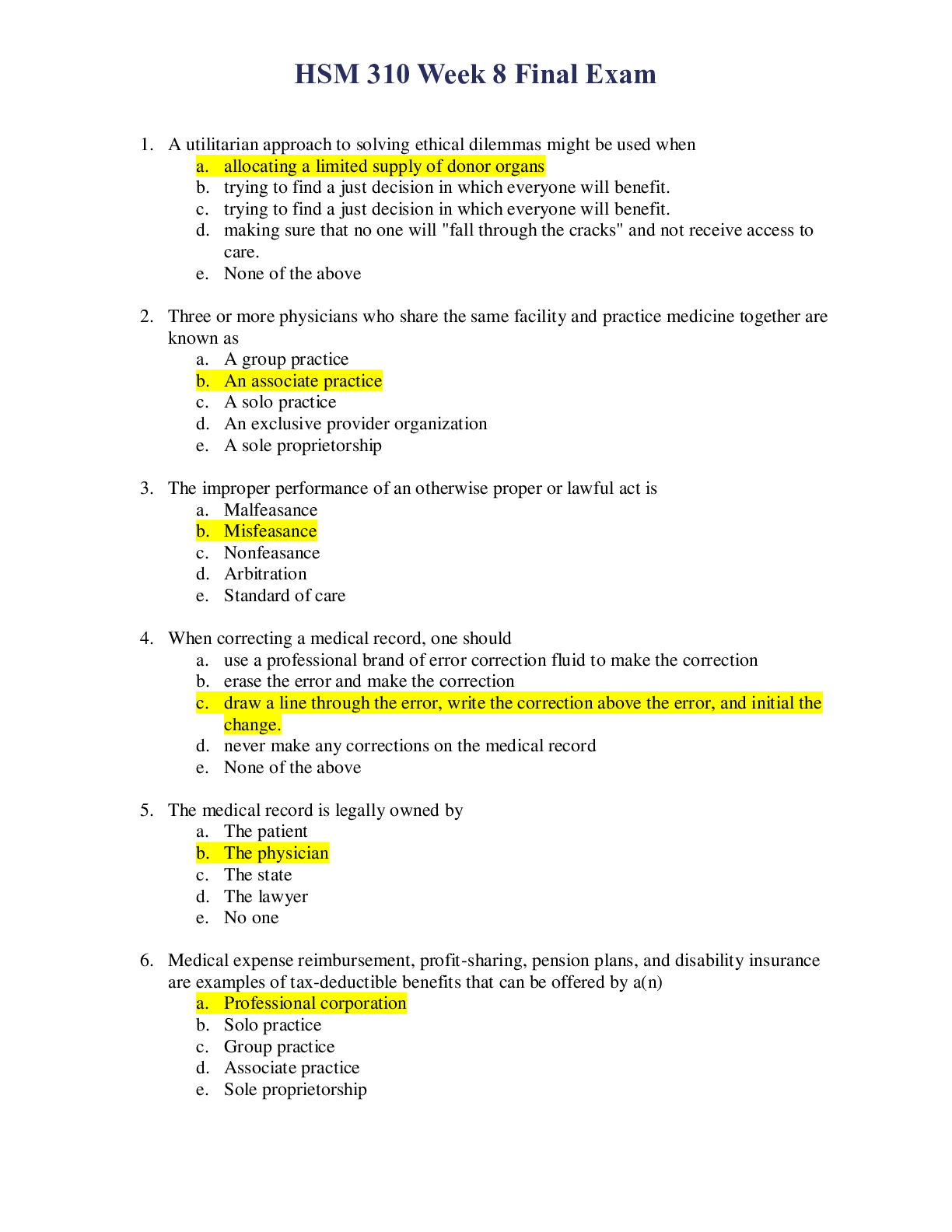
1. A utilitarian approach to solving ethical dilemmas might be used when
allocating a limited supply of donor organs.
trying to find a just decision in which everyone will benefit.
finding a
...
HSM 310 Week 8 Final Exam
1. A utilitarian approach to solving ethical dilemmas might be used when
allocating a limited supply of donor organs.
trying to find a just decision in which everyone will benefit.
finding a decision based on a sense of duty toward another person.
making sure that no one will "fall through the cracks" and not receive access to care.
None of the above
2. A type of managed care that combines the concepts of an HMO and PPO is a(n)
modified health maintenance organization.
managed care association.
health maintenance-provider organization.
preferred provider association.
exclusive provider organization.
3. The standard of proof generally used in a civil case is
evidence beyond a reasonable doubt.
res ipsa loquitur.
preponderance of evidence.
probable cause.
None of the above
4. When correcting a medical record, one should
use a professional brand of error correction fluid to make the correction.
erase the error and make the correction.
draw a line through the error, write the correction above the error, and initial the change.
never make any corrections on the medical record.
None of the above
5. Ownership of the medical record usually remains with the
the patient.
the physician.
the state.
the lawyer.
no one.
6. What specialist uses inaudible sound waves to outline shapes of tissues and organs?
Electrocardiograph technologist
X-ray technologist
Phlebotomist
Ultrasound technologist
Social worker
7. A miscarriage is the same thing as
an induced abortion.
a spontaneous abortion.
a drug-induced abortion.
a conscience clause.
eugenics.
8. A physician's failure to act as any ordinary and prudent physician within the same community would act is
neglect of duty.
res ipsa loquitur.
dereliction.
A and C only
A, B, and C
9. The Uniform Determination of Death Act
provides a definition of active euthanasia.
provides a definition of brain death.
is also called the doctrine of double effect.
mandates that everyone entering a nursing home must provide a written document stating the care he or she wishes to receive.
discusses the treatments that might be used for a comatose patient.
10. Terms referring to heart function include
respiratory.
comatose.
hypothermia.
cardiac/cardiopulmonary.
None of the above
11. Another term meaning death is
comatose.
expired.
proxy.
terminally ill.
hypothermia.
12. The Karen Ann Quinlan case involved
mercy killing.
removal of hydration from a comatose patient.
removal of a respirator from a comatose patient.
a heart transplant.
a court order for a surgical procedure on an incompetent patient.
13. Medicaid provides coverage to
low-income individuals.
aged and younger individuals.
institutionalized individuals.
All of the above
14. An illegal act is almost always considered to be
hidden.
unethical.
performed with the full knowledge of the healthcare worker.
obvious.
All of the above
15. Bioethics refers to
moral dilemmas related to the practice of medicine.
ethics focused on individual rights only.
moral conduct based on emotions.
None of the above
16. Ethics is based solely on
how you feel.
your emotions.
the sincerity of your beliefs.
your religious viewpoints.
None of the above
17. Common law is established by
statutes.
a judge.
the Constitution.
a previous court decision.
B and D
18. In order to obtain a judgment for negligence, the patient must show
direct or proximate cause.
duty.
damages.
dereliction, or neglect of duty.
All of the above
19. Signs of abuse include
poor growth.
lack of hygiene.
malnutrition.
bite marks.
All of the above
20. Medical records
provide a record from birth to death.
provide statistics on health matters.
are legal documents.
All of the above
21. Medicare and Medicaid records should be retained for
1 year.
5 years.
10 years.
None of the above
22. An example of a clearinghouse is
PHI.
a skilled nursing facility.
a billing service.
a government regulation.
EIN.
23. The current laws relating to artificial insemination
do not forbid artificial insemination.
state that the donor father must provide a portion of the child’s support.
provide for the records that relate to the donor to remain open.
clarify the child’s legitimacy.
all of the above.
24. Genetic testing of the newborn is required by law for
Tay-Sachs disease.
phenylketonuria.
retinoblastoma.
Down syndrome.
Cooley’s anemia.
25. In this disease a child may have a sloping forehead, flat nose, low-set eyes, and general dwarfed physical growth. More commonly seen when the mother is over 40. Not all forms of this disease is hereditary.
Down syndrome.
Huntington’s disease.
cystic fibrosis.
rubella.
retinoblastoma.
26. Monetary awards by a court to a person who has been harmed in an especially malicious or willful way are known as what type of damages?
Nominal
Liable
Punitive
Compensatory
Arbitration
27. A condition in which a patient understands the risks involved by not having a surgical procedure or treatment performed is known as
standard of care.
informed consent.
implied consent.
advance directive.
agent.
28. A double-blind test means that
neither the patient nor the researcher knows who is getting the treatment.
the participants are visually impaired.
the results will not be gained from an objective method for testing.
the control group will eventually benefit from being in the experiment.
there is an unethical practice taking place.
29. Taking away a license to practice medicine is called
revocation.
censure.
expulsion.
a and c only.
a, b, and c.
30. Medical issues relating to bioethics include
harvesting embryos.
DRGs.
withdrawing treatment.
HMOs.
a and c only.
[Show More]


.png)