Test Bank for Human Resource Management Gaining A Competitive Advantage 9th Edition Noe, Hollenbeck.Chapter 02
Strategic Human Resource Management
True / False Questions
1. The goal of strategic management in an organ
...
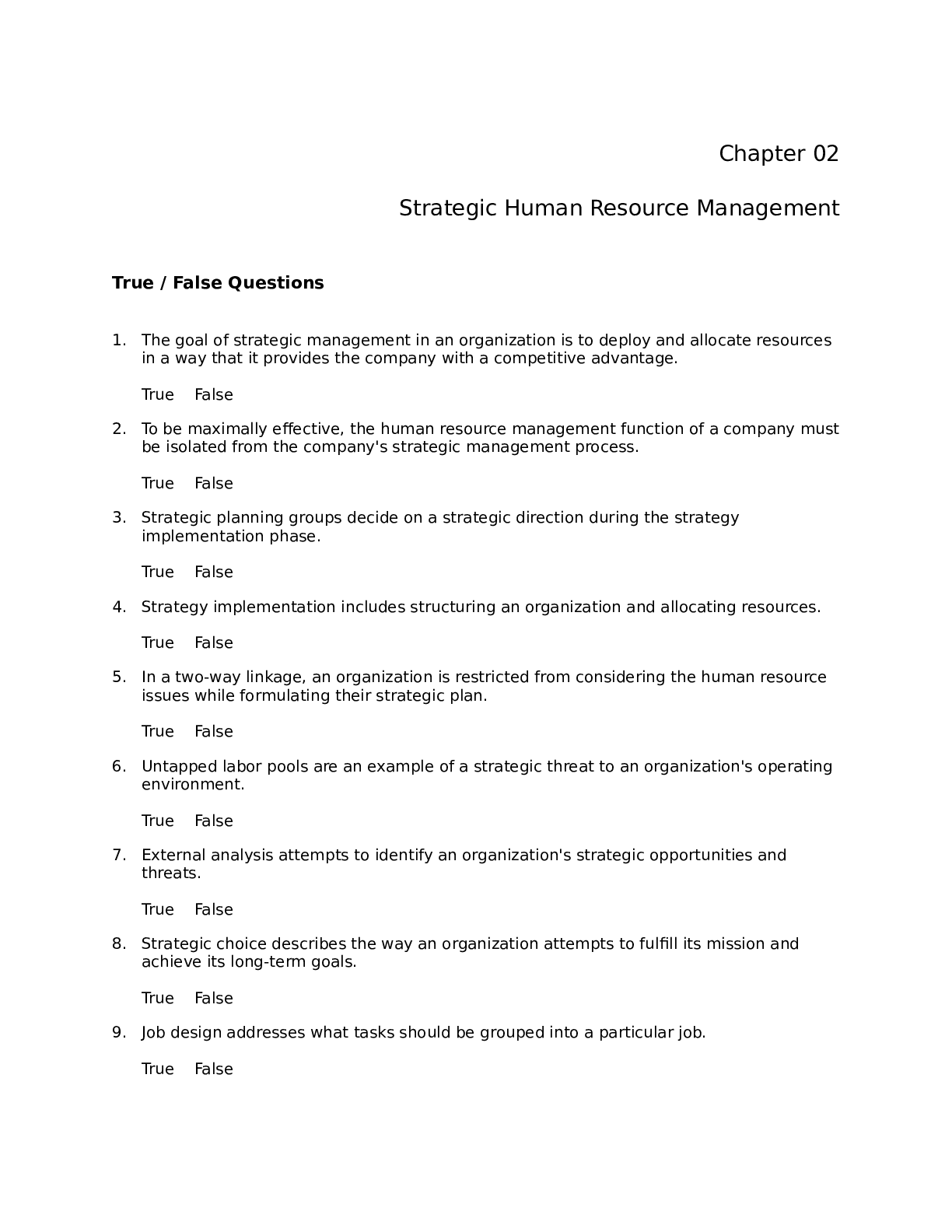
Test Bank for Human Resource Management Gaining A Competitive Advantage 9th Edition Noe, Hollenbeck.Chapter 02
Strategic Human Resource Management
True / False Questions
1. The goal of strategic management in an organization is to deploy and allocate resources
in a way that it provides the company with a competitive advantage.
True False
2. To be maximally effective, the human resource management function of a company must
be isolated from the company's strategic management process.
True False
3. Strategic planning groups decide on a strategic direction during the strategy
implementation phase.
True False
4. Strategy implementation includes structuring an organization and allocating resources.
True False
5. In a two-way linkage, an organization is restricted from considering the human resource
issues while formulating their strategic plan.
True False
6. Untapped labor pools are an example of a strategic threat to an organization's operating
environment.
True False
7. External analysis attempts to identify an organization's strategic opportunities and
threats.
True False
8. Strategic choice describes the way an organization attempts to fulfill its mission and
achieve its long-term goals.
True False
9. Job design addresses what tasks should be grouped into a particular job.
True False
10. The strategy a company is pursuing does not have an impact on the types of employees
that it seeks to recruit and select.
True False
11. Training refers to a planned effort to facilitate the learning of job-related knowledge,
skills, and behavior by employees.
True False
12. Companies that are not diversified use objective measures of performance to evaluate
managers.
True False
13. Executives who have extensive knowledge of the behaviors that lead to effective
performance tend to focus on evaluating the objective performance results of their
subordinate managers.
True False
14. By tying pay to performance, a company can elicit specific activities and levels of
performance from employees.
True False
15. Concentration strategies require that an organization bring radical change to the current
skills that exist in the organization.
True False
16. An overall cost leadership strategy is achieved primarily by offering unique product
features.
True False
17. Companies engaged in a cost strategy require employees to have reduced concern for
quantity and a short-term focus.
True False
18. Companies engaged in cost strategies develop internally consistent pay systems with
negligible pay differentials between superiors and subordinates.
True False
19. Employees in companies with a differentiation strategy need to have only a moderate
concern for quantity.
True False
20. Differentiation companies will have compensation systems that are geared toward
internal rather than external equity.
True False
[Show More]









.png)

.png)