Security Program Integration
Professional Certification (SPIPC)
Questions and Answers Graded A+
What is the purpose of the asset assessment
step of the risk management process? ✔✔• Identify assets requiring protectio
...
Security Program Integration
Professional Certification (SPIPC)
Questions and Answers Graded A+
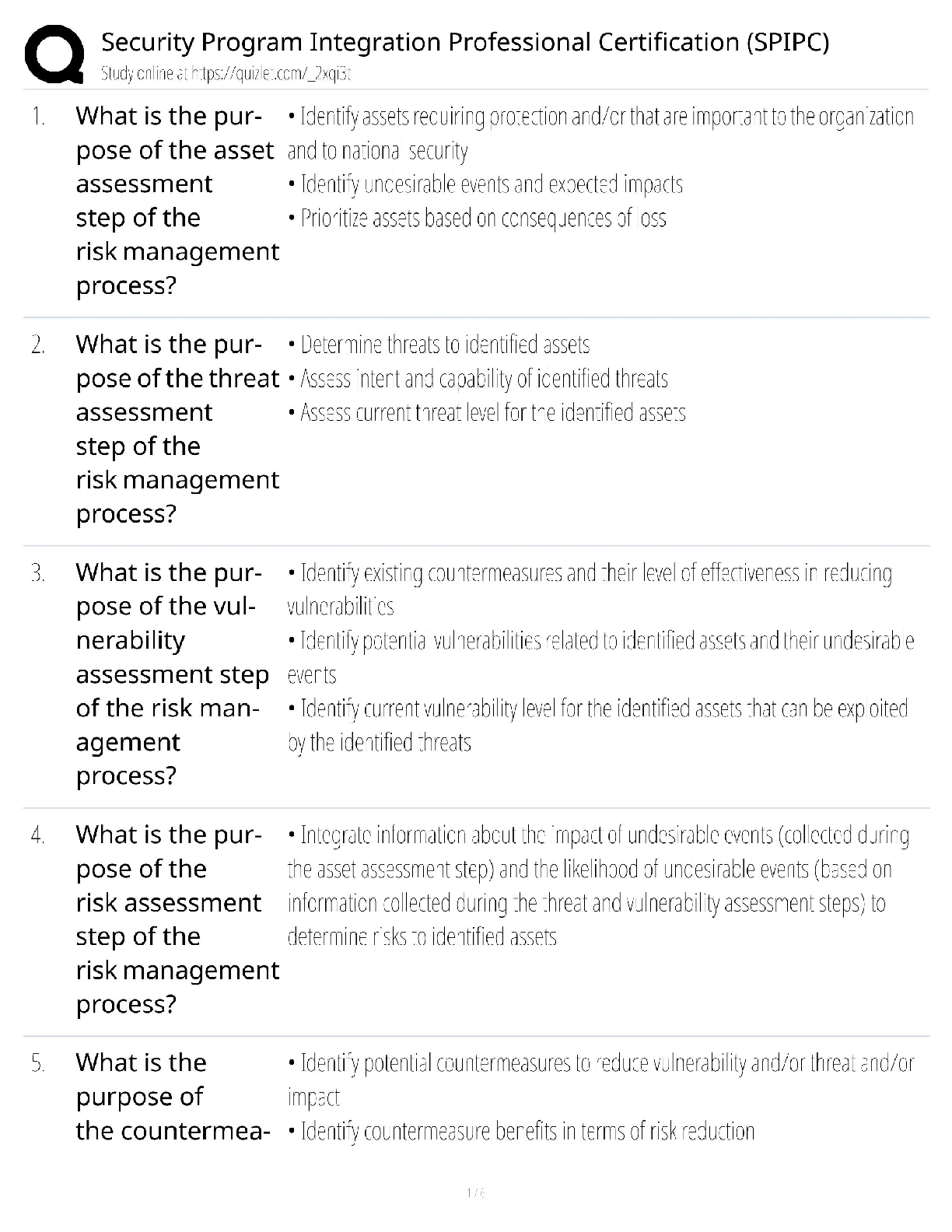
What is the purpose of the asset assessment
step of the risk management process? ✔✔• Identify assets requiring protection and/or that are
important to the organization and to national security
• Identify undesirable events and expected impacts
• Prioritize assets based on consequences of loss
What is the purpose of the threat assessment
step of the risk management process? ✔✔• Determine threats to identified assets
• Assess intent and capability of identified threats
• Assess current threat level for the identified assets
What is the purpose of the vulnerability
assessment step of the risk management
process? ✔✔• Identify existing countermeasures and their level of effectiveness in reducing
vulnerabilities
• Identify potential vulnerabilities related to identified assets and their undesirable events
• Identify current vulnerability level for the identified assets that can be exploited by the
identified threats
What is the purpose of the risk assessment step of the risk management process? ✔✔• Integrate
information about the impact of undesirable events (collected during the asset assessment step)
and the likelihood of undesirable events (based on information collected during the threat and
vulnerability assessment steps) to determine risks to identified assets
What is the purpose of the countermeasure determination step of the risk management process?
✔✔• Identify potential countermeasures to reduce vulnerability and/or threat and/or impact
• Identify countermeasure benefits in terms of risk reduction
• Identify countermeasure costs
• Conduct cost/benefit analysis
• Prioritize options and prepare recommendation for decision maker
What is the primary benefit of conducting the risk management process? ✔✔• National-level
security policy endorses a holistic risk management approach, allowing decision makers to
effectively allocate resources that provide the necessary security to assets that match the threat to
those assets
What are the primary costs of conducting the risk management process? ✔✔• Time and effort
necessary to execute the five steps of the risk management process
What are the potential challenges security practitioners may face when enacting the risk
management process? ✔✔• Availability of information necessary to accurately determine the
likelihood and impact of undesirable events
Where can we get information to evaluate an organization's compliance with security policies?
✔✔• Self-inspections
Where can we get information to evaluate the effectiveness of an organization's security
program? ✔✔• Incident reports
• Regressive analysis
• SME interviews (individuals involved in protecting Classified Military Information (CMI))
• Security planning documents
• Surveys and audits
• Information Systems (IS) Certification and Accreditation documentation
• Facility certification and accreditation documentation
Given the incident, what is an example of an organization complying with security policy, but
the measure(s) it implemented appear to be ineffective? ✔✔• The appropriate signage and
notices are posted in appropriate areas, but are potentially ineffective considering a history of
uncleared personnel gaining access to restricted areas.
How do security policies and programs contribute to managing risks to Department of Defense
(DoD) assets? ✔✔• Security policies manage risks to DoD assets by specifying baseline
requirements for protecting categories of DoD assets, and by identifying who is responsible and
accountable for executing those requirements.
• Security programs manage risks to DoD assets by administering those security policies and
ensuring hose baseline requirements are being executed per policy.
What is the purpose of the Planning, Programming, Budgeting, and Execution (PPB&E)
process? ✔✔• The PPB&E process is how DoD allocates its resources. It is how DoD and its
contractors manage to stay within their fiscal budget while following Secretary of Defense
(SECDEF) policy, strategy, and goals.
What are the major outcomes of the Planning stage of the PPB&E process? ✔✔• Office of the
Secretary of Defense •• (OSD) and Joint Staff collaboratively articulate resource-informed
national defense policies and military strategy - the Strategic Planning Guidance (SPG).
• The SPG serves as input to an enhanced planning process. This process results in a set of
budget conscious priorities for program development - the Defense/Joint Programming Guidance
(DPG).
• The Joint Planning Guidance (JPG) serves as the link between the planning and programming
phases of the PPB&E process.
What are the major outcomes of the Programming stage of the PPB&E process?
✔✔Programming
• In this PPB&E phase, each DoD department and agency develops a POM (Program Objective
Memorandum) that describes, in detail, their proposed budget for the next six years. Each POM
balances program budgets as set in the DPG.
• OSD and Joint Staff then review each POM and integrate them all into an overall coherent
Defense program. OSD and Joint Staff also propose alternatives and/or marginally adjust
budgets to address shortfalls or any issues with any portion of any POM.
• SECDEF then settles any unresolved issues and writes them up in a Program Decision
Memorandum (PDM).
What are the major outcomes of the Budgeting stage of the PPB&E process? ✔✔• Budgeting
happens at the same time as programming.
• Each DoD department and agency submits a budget estimate along with its POM.
• Each DoD department and agency also translates its budget estimate for the next two years into
the Congressional appropriation structure format, and then submits it.
• Under Secretary of Defense (Comptroller) and Office of Management and Budget (OMB)
analysts review the submissions to ensure program funding matches current policy, they are
priced right, and are justified to Congress.
• Budget review hearings are conducted to address analysts' questions.
• After budget review hearings, each analyst then prepares a Program Budget Decision (PBD) for
each program that proposes financial adjustments to address issues or problems identified during
the hearing.
• The PBD then goes to SECDEF for a decision. The decision goes in an updated budget
submission to OMB.
• Finally, the overall DoD budget is provided as part of the President's Budget request to
Congress.
What are the major outcomes of the Execution stage of the PPB&E process? ✔✔• The execution
review occurs at the same time as the program and budget reviews.
• The review provides feedback to OSD about the effectiveness of the budget.
• Program metrics developed throughout the process are used to measure actual output versus
expected performance. If the program misses its metrics, then the execution review may lead to
recommendations to adjust the budget or program so it does make those goals.
What is the relationship between the PPB&E process, the President's budget submission to
Congress, and Congress's Appropriations process? ✔✔• The Department submits a two-year •
The Department submits a two-year budget estimate to OMB that becomes part of the President's
budget request to Congress for even-numbered fiscal years (e.g., the President's Budget
submitted to Congress in March 2015 contained the Department's budget estimates and
justification for FY 2016 and FY 2017).
• In practice, Congress does not actually provide the Department with a two-year appropriation.
It only appropriates funds for the first year. An amended budget justification must be submitted
for the second year of the original two-year request so Congress will appropriate funds for that
second year.
What roles do the Quadrennial Defense Review (QDR), POM, and Future Years Defense
Program (FYDP) play in the PPB&E process? ✔✔• The QDR is a legislatively-mandated review
of DoD strategy and priorities. It sets the long-term course for the DoD by assessing threats and
challenges the nation faces and rebalancing DoD's strategies, capabilities, and forces to address
today's conflicts and tomorrow's threats. The QDR serves as input to the development of the
DPG during the PPB&E planning phase.
• The POM allows each DoD department and agency to describe, in detail, its proposed budget
for the next six years. It serves as input to the Department's overall budget request, provided to
Congress as part of the President's budget request. The POM is one of the primary outcomes of
the PPB&E programming phase.
• The FYDP summarizes forces, resources, and equipment associated with DoD programs for six
years (the current two budgeted years plus four additional years). It is updated twice during the
PPB&E cycle: Once to reflect the services combined in the POM submission, and again to reflect
the President's Budget submitted to Congress.
Describe what occurs during the even 8. Describe what occurs during the even and odd years of
the five-year PPB&E process. ✔✔• During "on years" (even FY), the Department submits a twoyear budget estimate to OMB, which becomes part of the President's budget request to Congress.
• During the "off years" (odd FY), the Department submits an amended budget justification for
the second year of the original two-year request to Congress.
How do you get information about resources necessary to implement the Area Commander's
decision into the PPB&E process? ✔✔• Through the POM.
[Show More]
.png)

.png)