NSG 6420 Week 5 Midterm (Questions and Answers)
...some answers are missing.....
A 22-year-old female comes to your office with complaints of right lower quadrant abdominal pain, which has been worsening over the last
...
NSG 6420 Week 5 Midterm (Questions and Answers)
...some answers are missing.....
A 22-year-old female comes to your office with complaints of right lower quadrant abdominal pain, which has been worsening over the last 24 hours. On examination of the abdomen, there is a palpable mass and rebound tenderness over the right lower quadrant. The clinician should recognize the importance of
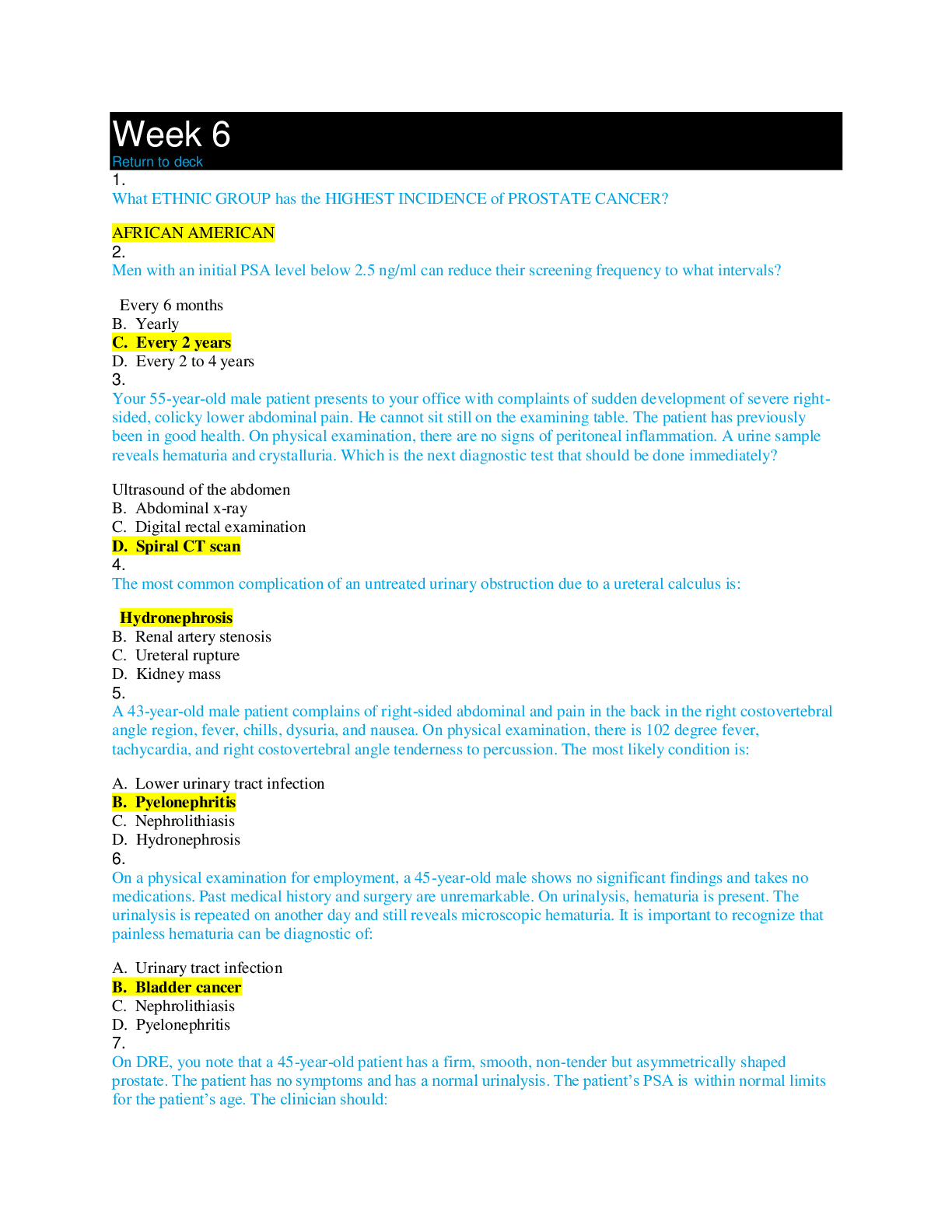
Digital rectal examination
Endoscopy
Pelvic examination
UrinalysisDefinition
2.
Which of the following clinical reasoning tools is defined as evidence-based resource based on mathematical modeling to express the likelihood of a condition in select situations, settings, and/or patients?
Clinical practice guideline
Clinical decision rule
Clinical algorithm
Clinical recommendation
3.
A common auscultatory finding in advanced CHF is
S3 gallop rhythm
4.
Mr. Keenan is a 42-year-old man with a mild history of GERD and a remote history of an appendectomy, presenting with an acute onset of significant right upper-quadrant abdominal pain and vomiting. His pain began after a large meal, was unrelieved by a proton-pump inhibitor, was unlike his previous episodes of heartburn, but upon questioning, reports milder, prodromal episodes of similar post-prandial pain. His pain seems to radiate to his back. Despite a family history of cardiac disease, he reports no classic anginal signs or chest pain. He furthermore denies respiratory or pleuritic signs and denies fever, night sweats, and unintended weight loss. Finally, there are no dermatologic signs, nor genitourinary symptoms.
The chosen imaging study reveals: “GB normal in size without wall-thickening, but with 5-6 stones with shadowing. Common bile duct not dilated. Liver is homogenous and normal in size. Pancreas and kidneys are normal.” What is the most effective therapeutic/management option at this point?
chole
5.
A patient complains of fever, fatigue, and pharyngitis. On physical examination there is pronounced cervical lymphadenopathy. Which of the following diagnostic tests should be considered?
Mono spot
Strep test
Throat culture
All of the above
6.
Which of the following is not a contributing factor to the development of esophagitis in older adults?
7.
Essential parts of a health history include all of the following except:
8.
What test is used to confirm the diagnosis of appendicitis?
9.
The first assessment to complete related to the eyes is
Eye lids
Visual acuity
Extraocular movements
Peripheral vision
10.
The best way to diagnose structural heart disease/dysfunction non-invasively is
Chest X-ray
EKG
CORRECT Echocardiogram
Heart catheterization
11.
Which of the following is considered a “red flag” when diagnosing a patient with pneumonia
Fever of 102
Infiltrates on chest X-ray
Pleural effusion on chest X-ray
Elevated white blood cell count
12.
In a patient presenting with suspected recurrence of diverticulitis, abdominal pain usually presents where in the abdomen?
Left upper quadrant
Right upper quadrant
Left lower quadrant
Right lower quadrant
13.
Mr. A presents to your office complaining of chest pain, mid-sternal and radiating to his back. He was mowing his lawn. He reports the pain lasting for about 8 minutes and went away after sitting down. What is his most likely diagnosis based on his presenting symptoms
Acute MI
GERD
Pneumonia
Angina
[Show More]