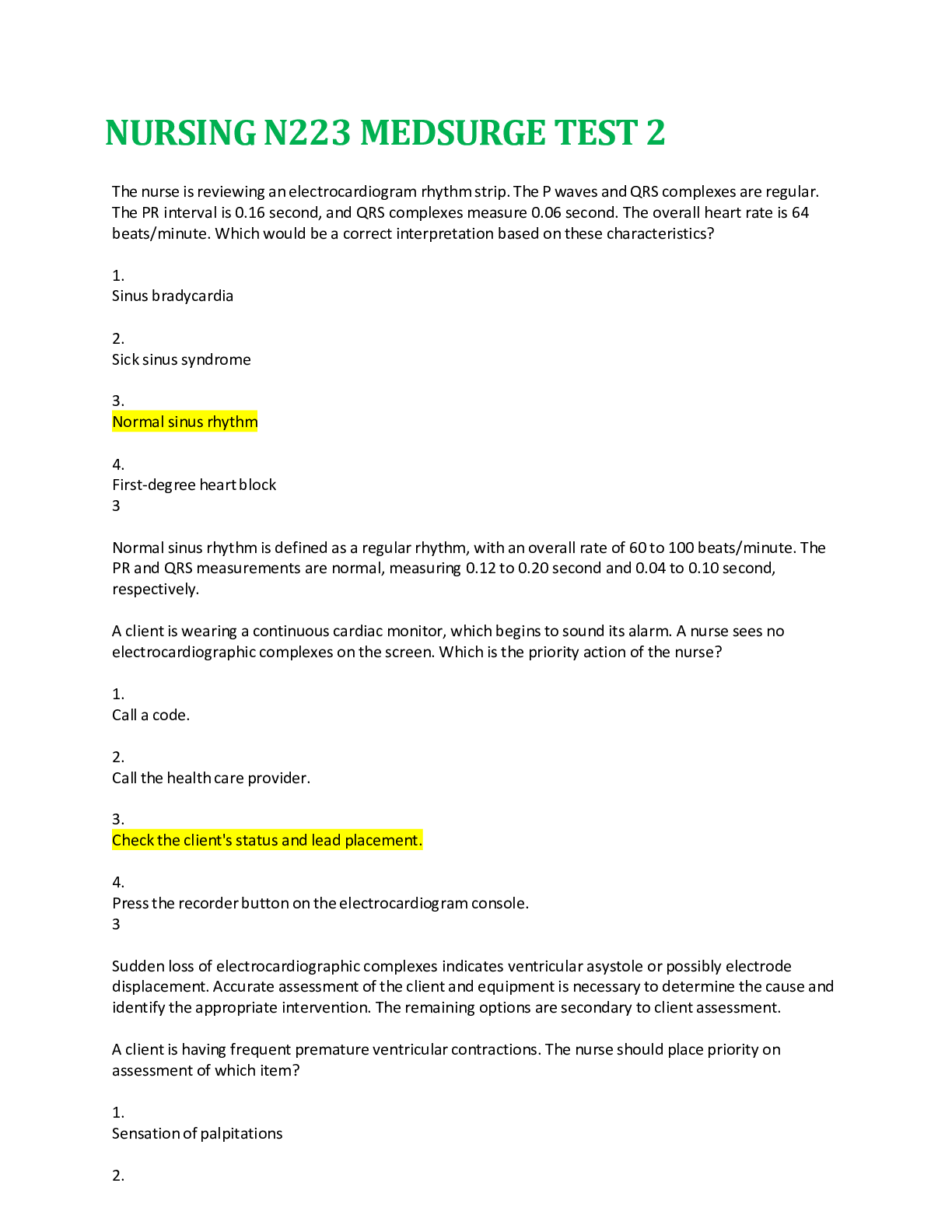
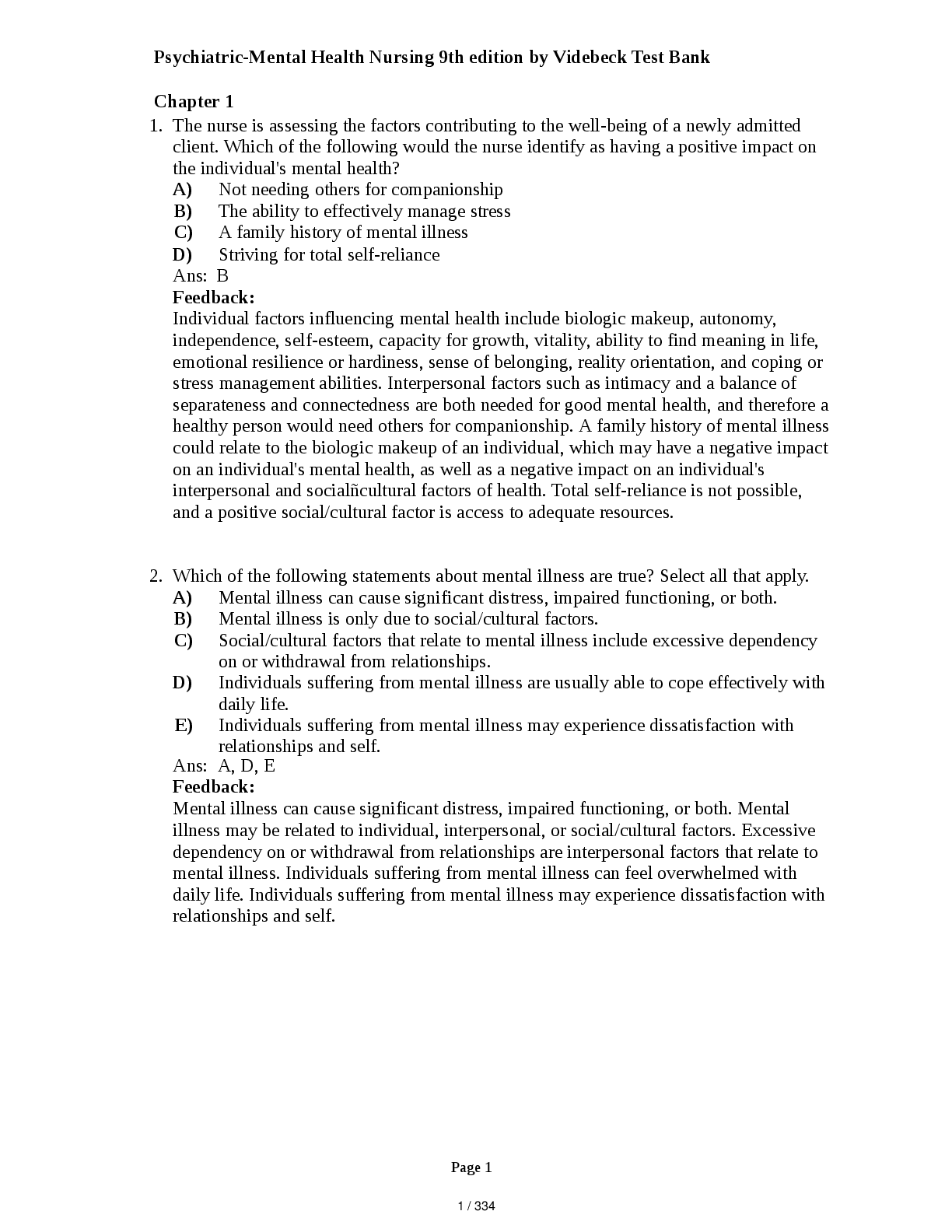
The nurse is reviewing an electrocardiogram rhythm strip. The P waves and QRS complexes are regular. The PR interval is 0.16 second, and QRS complexes measure 0.06 second. The overall heart rate is 64 ... beats/minute. Which would be a correct interpretation based on these characteristics? 1. Sinus bradycardia 2. Sick sinus syndrome 3. Normal sinus rhythm 4. First-degree heart block 3 Normal sinus rhythm is defined as a regular rhythm, with an overall rate of 60 to 100 beats/minute. The PR and QRS measurements are normal, measuring 0.12 to 0.20 second and 0.04 to 0.10 second, respectively. A client is wearing a continuous cardiac monitor, which begins to sound its alarm. A nurse sees no electrocardiographic complexes on the screen. Which is the priority action of the nurse? 1. Call a code. 2. Call the health care provider. 3. Check the client's status and lead placement. 4. Press the recorder button on the electrocardiogram console. 3 Sudden loss of electrocardiographic complexes indicates ventricular asystole or possibly electrode displacement. Accurate assessment of the client and equipment is necessary to determine the cause and identify the appropriate intervention. The remaining options are secondary to client assessment. A client is having frequent premature ventricular contractions. The nurse should place priority on assessment of which item? 1. Sensation of palpitations 2. Causative factors, such as caffeine 3. Precipitating factors, such as infection 4. Blood pressure and oxygen saturation 4 Premature ventricular contractions can cause hemodynamic compromise. Therefore, the priority is to monitor the blood pressure and oxygen saturation. The shortened ventricular filling time can lead to decreased cardiac output. The client may be asymptomatic or may feel palpitations. Premature ventricular contractions can be caused by cardiac disorders, states of hypoxemia, or by any number of physiological stressors, such as infection, illness, surgery, or trauma, and by intake of caffeine, nicotine, or alcohol. The nurse is evaluating a client's response to cardioversion. Which observation would be of highest priority to the nurse? 1. Blood pressure 2. Status of airway 3. Oxygen flow rate 4. Level of consciousness 2 Nursing responsibilities after cardioversion include maintenance first of a patent airway, and then oxygen administration, assessment of vital signs and level of consciousness, and dysrhythmia detection. A client's electrocardiogram strip shows atrial and ventricular rates of 110 beats/minute. The PR interval is 0.14 second, the QRS complex measures 0.08 second, and the PP and RR intervals are regular. How should the nurse correctly interpret this rhythm? 1. Sinus dysrhythmia 2. Sinus tachycardia 3. Sinus bradycardia 4. Normal sinus rhythm 2 Sinus tachycardia has the characteristics of normal sinus rhythm, including a regular PP interval and normal-width PR and QRS intervals; however, the rate is the differentiating factor. In sinus tachycardia, the atrial and ventricular rates are greater than 100 beats/minute. The nurse is assessing the neurovascular status of a client who returned to the surgical nursing unit 4 hours ago after undergoing aortoiliac bypass graft [Show More]
Last updated: 3 years ago
Preview 1 out of 83 pages
Buy this document to get the full access instantly
Instant Download Access after purchase
Buy NowInstant download
We Accept:
Can't find what you want? Try our AI powered Search
Connected school, study & course
About the document
Uploaded On
Jan 31, 2021
Number of pages
83
Written in
All
This document has been written for:
Uploaded
Jan 31, 2021
Downloads
0
Views
49
Scholarfriends.com Online Platform by Browsegrades Inc. 651N South Broad St, Middletown DE. United States.
We're available through e-mail, Twitter, and live chat.
FAQ
Questions? Leave a message!
Copyright © Scholarfriends · High quality services·