Evidence-Based Practice in Nursing & Healthcare: A Guide to Best Practice 3rd edition by Bernadette Melnyk PhD RN CPNP/NPP FAAN, Ellen Fineout-Overholt PhD RN FNAP FAAN
Education > QUESTIONS & ANSWERS > RICA subtest 3 questions and answers graded A+ (All)
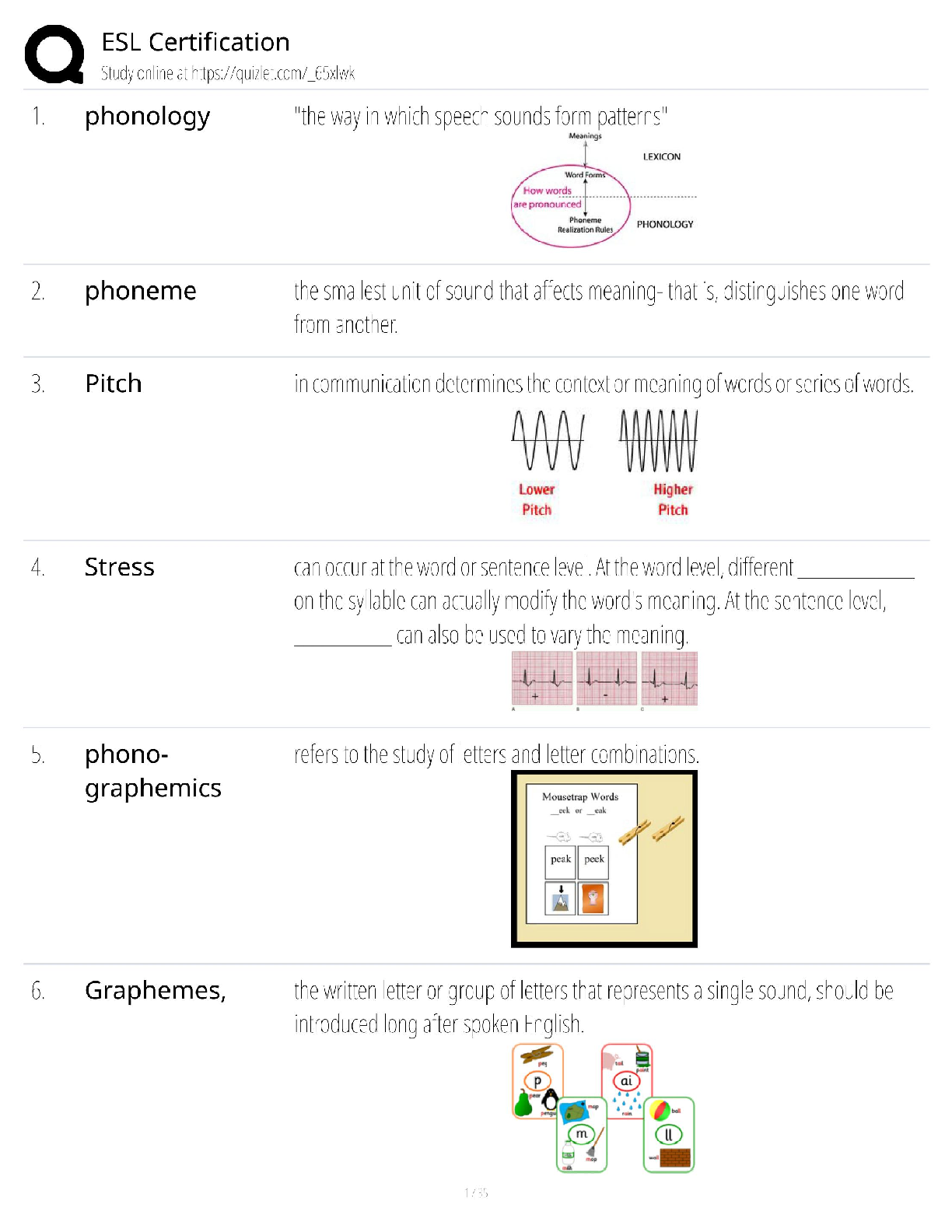
RICA subtest 3 questions and answers graded A+ Phonological Awareness C3: Phonological and Phonemic Awareness ✔✔Knowledge that oral English is composed of smaller units Phonemic Awareness C3 ... : Phonological and Phonemic Awareness ✔✔The ability to hear, identify,and manipulate the individual sounds, phonemes, in oral language. Phonics C3: Phonological and Phonemic Awareness ✔✔the study of the sounds of the letters of the alphabet Alphabetic Principle C3: Phonological and Phonemic Awareness ✔✔States that speech sounds are represented by letters Phonemes C3: Phonological and Phonemic Awareness ✔✔The smallest unit of speech Grapheme C3: Phonological and Phonemic Awareness ✔✔The English letters that represent phoneme ex. bat, the phoneme is /b/ the grapheme is b. ex. duck, the phoneme /k/ the grapheme is ck. Onset and Rime C3: Phonological and Phonemic Awareness ✔✔In a syllable, the onset is the initial consonant or consonants, and the rime is the vowel and any consonants that follow it (e.g., the word sat, the onset is "s" and the rime is "at". In the word flip, the onset is "fl" and the rime is "ip"). Phonograms C3: Phonological and Phonemic Awareness ✔✔rimes that have the same spelling. word families. (cat, bat, sat) The role of phonological awareness in reading development C3: Phonological and Phonemic Awareness ✔✔*The acquisition of phonemic awareness is predictive with the success in learning to read. *Phonemic awareness is the foundation for understanding the sound-symbol relationships of English. How to teach phonological awareness (5) C3: Phonological and Phonemic Awareness ✔✔1. Word awareness: children being aware that sentences are composed of words. 2. Syllable awareness: More difficult for children to understand, try clapping as they say each syllable. 3. Word blending: Take two single syllable words and combine them to make a compound word. ex. cow and boy = cowboy. 4. Syllable blending: Take two syllables and blend together. ex. sis-ter = sister 5. Onset and rime blending: what do we get if we /b/ and ank together? bank How to teach phonemic awareness C3: Phonological and Phonemic Awareness ✔✔1. Sound isolation: children are given a word and are asked what sound is at the beginning, middle and end. 2. Sound identity: teacher will put together words that have the same beginning, middle or end sound but nothing else. ex. light, lake, low 3. Sound blending: isolated every sound. ex. /b/ /a/ /t/ 4. Sound substitution: ex. cat, sub the c with b = bat 5. Sound deletion: works best with consonant blends. ex. snail, take away s = nail. 6. Sound segmentation: children must isolate and identify the sounds in spoken words. Meeting the needs of all learners: Struggling learners C3: Phonological and Phonemic Awareness ✔✔1. Focus on key skills, especially blending and segmenting 2. Reteaching skills that are lacking. ex. changing pace of lesson, changing mode of delivery, providing additional scaffolding, using different materials. 3. Using a variety of concrete examples to explain a concept or a task. 4. Providing additional practice Meeting the needs of all learners: English learners C3: Phonological and Phonemic Awareness ✔✔The biggest hurdle is to hear and manipulate sounds that are not phonemes in their first language. Some phonemes are the same in both languages, if students has acquired those in native language it will help with learning English. Those phonemes that are not transferable, teacher spent time explicitly teaching them. Meeting the needs of all learners: Advanced learners C3: Phonological and Phonemic Awareness ✔✔Two ways to differentiate for advanced learners: 1.) increase the pace of instruction. Less time on lesson and less modeling and fewer chances to practice 2.) building on and extending current skills. Fewer lessons on phonemic awareness and more on component of the reading/language arts program at a faster pace. How to Assess Phonemic Awareness C3: Phonological and Phonemic Awareness ✔✔1. Entry level assessment: used to determine level of phonological awareness, including phonemic awareness. EX. word awareness, how many words are in this sentence. 2. Progressing-monitoring assessment: important to monitor a student's proficiency both during in an individual lesson and in the middle of a 4/5 unit lesson plan. This will allow teachers to make two important decisions. a.) which individual students need more help b.) whether at the class level, it is time to stop and reteach the entire class something. 3. Summative assessment: occur at the end on instruction and tells teacher if the standard has not been met, been met or exceeded. How to analyze, interpret and use results C3: Phonological and Phonemic Awareness ✔✔ Concepts about print C4: Concepts about print, letter, recognition, and. the alphabetic principle ✔✔basic principles about how letters, words and sentences are represented in written language. Should be learned by the time student leaves kindergarten. 1.) awareness of the relationship between spoken and written language and understanding that print carries meaning. 2.) letter, word and sentence representation 3.) the directionality of print and the ability to track print into connected text 4.) book handling skills Letter recognition C4: Concepts about print, letter, recognition, and. the alphabetic principle ✔✔the ability to identify both the uppercase and lower case letters when a teacher says the name of letter. Ex. Point to the A. The clue is auditory and the child's actions is physical. Letter naming C4: Concepts about print, letter, recognition, and. the alphabetic principle ✔✔is the reserve task, the ability to say the name of a letter when the teacher points to it. Letter formation C4: Concepts about print, letter, recognition, and. the alphabetic principle ✔✔The ability to write the uppercase and lowercase letters legibly. When talking about letter recognition, it is important to note that we are teaching the names of the letters, not the sounds letters make. Alphabetic principle C4: Concepts about print, letter, recognition, and. the alphabetic principle ✔✔That in English speech sounds are represented by letters. Simply put letters represent sounds. What are the concepts of print? C4: Concepts about print, letter, recognition, and. the alphabetic principle ✔✔1.) Awareness of the relationship between spoken and written English and an understanding that print carries meaning. 2.) Letter, word, and sentence representation 3.) The directionality of print and the ability to track print 4.) Book-handling skills How to teach the concepts of print C4: Concepts about print, letter, recognition, and. the alphabetic principle ✔✔1.) Reading aloud to students. 2.) The shared book experience 3.) Language experience approach 4.) Environmental print 5.) Print-rich environment 6.) Explicit (Direct) teaching of concepts and print How to teach the concepts of print: Reading aloud to students C4: Concepts about print, letter, recognition, and. the alphabetic principle ✔✔will teach kids that print carries meaning. Will also help them recognize the covers of books. How to teach the concepts of print: Shared book experience C4: Concepts about print, letter, recognition, and. the alphabetic principle ✔✔ How to teach the concepts of print: Language experience approach C4: Concepts about print, letter, recognition, and. the alphabetic principle ✔✔The LEA is intended to develop and support the child's reading and writing abilities. Children share an experience, such as a field trip to the zoo, they then dictate that experience to an adult. Together child and adult read the text. Bound the child's experience in a book. Class experiences can be collected by comments and placed on a chart around the room so the students can see. Repeated experiences will help children acquire the big idea. How to teach the concepts of print: Environmental Print C4: Concepts about print, letter, recognition, and. the alphabetic principle ✔✔Refers to the printed messages that people encounter in ordinary everyday life. How to teach the concepts of print: Print rich environment C4: Concepts about print, letter, recognition, and. the alphabetic principle ✔✔Classroom should be print rich. Plenty of examples everywhere. Word Identification C5 ✔✔Ability to read aloud or decode words correctly. Does NOT mean knowing the word's meaning. word recognition C5 ✔✔making a connection between the word being pronounced and its meaning Word recognition: Phonics C5 ✔✔Phonics instruction: helps children learn the correct association between sounds and the symbols of a language. Word recognition: Sight words C5 ✔✔words students should be able to identify as a whole unit, without breaking down by phonics. 4 types. 1.) High frequency words: that appear most frequent i printed text children read. 2.) irregular words: such as dove and great 3.) Words that children want to know, usually because children want them in their writing, ex. dinosaur 4.) Words that are introduced in content-area lessons in social studies and science. ex. insect and butterfly Word recognition: Morphological Clues C5 ✔✔In addition to phonics and sight words children can use morphological clues to decode words. Morphology is the study of word formation. Children use morphological clues ti identify words when they rely on the root word, prefixes and suffixes. Structural Analysis C5 ✔✔the process of using prefixes, suffixes and root words to identify words. Syllabic Analysis C5 ✔✔Process of recognizing words by analyzing the syllables in a word Word recognition: Context Clues C5 ✔✔Fourth Strategy: In many instances children can identify words by the words surrounding the unknown word. Stages of Spelling Development C5 ✔✔1. Precommunicative 2. Semiphonetic 3. Phonetic 4. Transitional 5. Conventional Precommunicative Stage C5 ✔✔First transitional spelling stage from invented to conventional. The child uses letters from the alphabet, but without any letter-sound correspondence. Semiphonetic Stage C5 ✔✔The child begins to understand letter-sound correspondence--that sounds are assigned to letters. At this stage, the child often employs rudimentary logic, using single letters, for example, to represent words, sounds, and syllables (e.g., U for you). Phonetic Stage C5 ✔✔The child uses a letter or group of letters to represent every speech sound that they hear in a word. Although some of their choices do not conform to conventional English spelling, they are systematic and easily understood. Examples are KOM for come and EN for in. Transitional stage C5 ✔✔Knows most of the orthographic patterns of English. All sounds have letters, and for the most part the child chooses the correct letter or combination of letters to represent the sounds. Transitional spelling is easy to read. Conventional Stage C5 ✔✔Child spells almost all words correctly. The only mistakes are made when child tries to spell new words with irregular spelling. [Show More]
Last updated: 2 years ago
Preview 1 out of 13 pages
.png)
Buy this document to get the full access instantly
Instant Download Access after purchase
Buy NowInstant download
We Accept:

.png)
RICA BUNDLED EXAMS QUESTIONS AND ANSWERS (CERTIFIED SOLUTIONS)
By Nutmegs 2 years ago
$25
23
Can't find what you want? Try our AI powered Search
Connected school, study & course
About the document
Uploaded On
Mar 14, 2023
Number of pages
13
Written in
All
This document has been written for:
Uploaded
Mar 14, 2023
Downloads
0
Views
132
Scholarfriends.com Online Platform by Browsegrades Inc. 651N South Broad St, Middletown DE. United States.
We're available through e-mail, Twitter, Facebook, and live chat.
FAQ
Questions? Leave a message!
Copyright © Scholarfriends · High quality services·



.png)