NCOA DLC 2.0 Problem Solving Final
Test 1 Already Passed
refers to the processes used to plan, monitor, and access one's understanding and performance.
✔✔Metacognition
The key to metacognition is asking yourself ____
...
NCOA DLC 2.0 Problem Solving Final
Test 1 Already Passed
refers to the processes used to plan, monitor, and access one's understanding and performance.
✔✔Metacognition
The key to metacognition is asking yourself _______ questions. ✔✔self-reflective
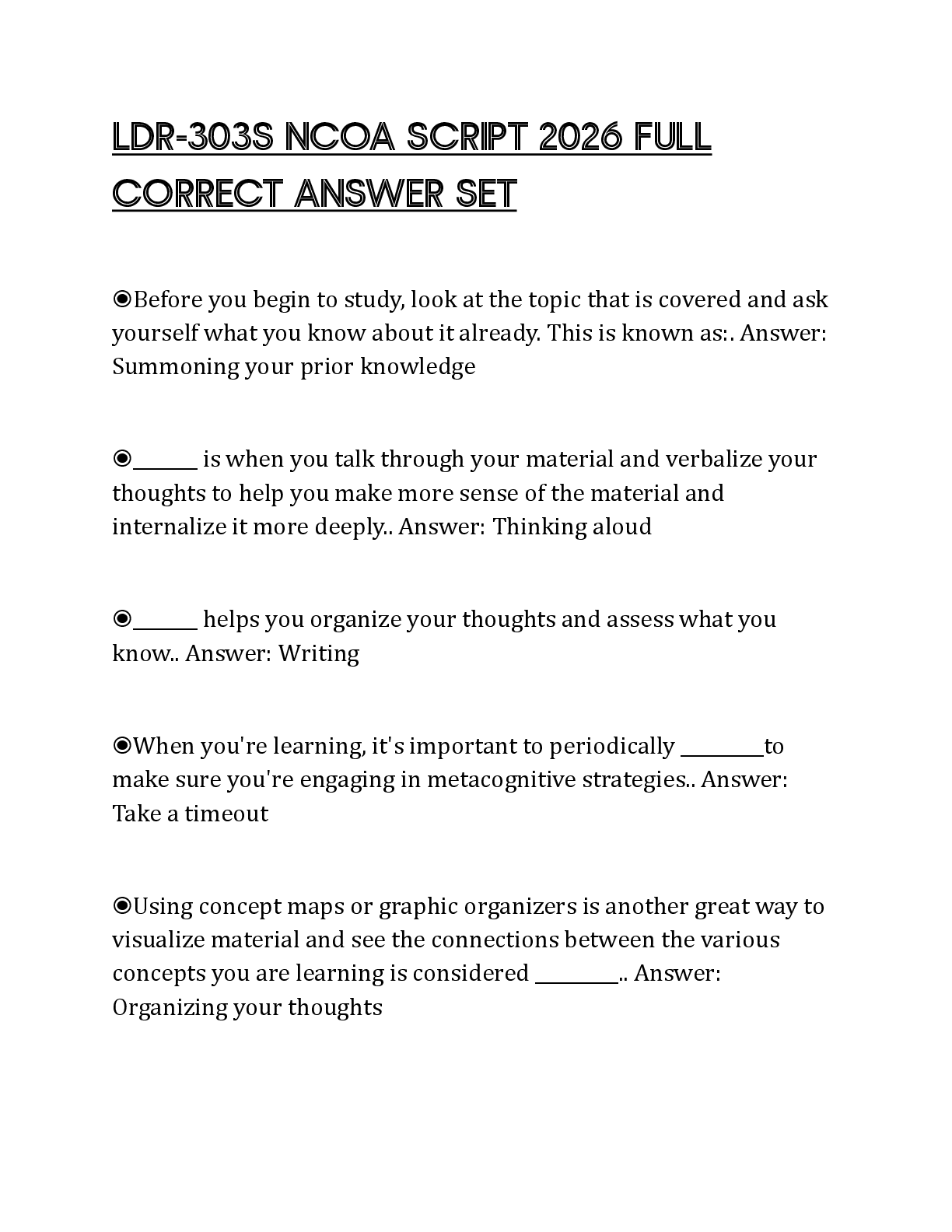
Before you begin to study or attend a lecture, look at the topic that is covered, and ask yourself
what you know about it already. This is known as: ✔✔prior knowledge
Talk through your material and verbalize your thoughts to help make more sense of the material
and internalize it. ✔✔Think aloud
Helps you Take the time to be introspective and honest with yourself about your comprehension.
✔✔Asking yourself questions
This technique ensures that you are actively engaging with the material as you are reading and
taking notes. ✔✔Taking notes from memory
___________ can help you organize your thoughts and assess what you know? ✔✔Writing
Using concept maps or graphic organizers is another great way to visualize material and see the
connections between the various concepts you are learning ✔✔Organize your thoughts
When you're learning, it's important to periodically ____________ to make sure you're engaging
in metacognitive strategies. ✔✔take a timeout
Methods such as (e.g., thinking aloud, using writing, taking notes from memory) can help when
you are .______________ ✔✔testing yourself
_________is a structured way to identify the type of problem you're dealing with and
suggestions on how to approach them. ✔✔The Cynefin Framework
The Cynefin framework for problem solving is composed of ✔✔Four Domains
In this domain, there may be multiple right answers, many of which may be excellent.
✔✔Complicated Domain
In this domain of "known knowns" (there are things that you definitely know, or are easily
knowable), decisions are unquestioned because all parties share a common understanding of the
issue or problem. ✔✔Simple Domain
Leaders must act, sense , and respond in this domain. ✔✔Chaotic Domain
In this complex domain, leaders must: ✔✔Probe, sense, and respond.
Leaders must sense, analyze, and respond in this domain. ✔✔Complicated Domain
The domain of novel practices is: ✔✔Chaotic Domain
In this domain, problems require straightforward management and monitoring. ✔✔Simple
Domain
This is the domain of known unknowns ✔✔Complicated Domain
In this domain, it is identified that there are things we dont know that we dont know?
✔✔Complex Domain
_________ is the process or art of finding a solution to a problem. ✔✔Problem Solving
___________ is the process of describing and interpreting a stated problem to arrive at a problem
statement—define the actual problem ✔✔Problem framing
_________ are inevitable when participants bring their differing expertise and experience to a
problem. ✔✔Different perspectives
The ________ aids in determining the cause-effect relationships in a problem or a failure event
✔✔5 Y Method
The diagram used to depict the relationship between specific categories of process inputs and the
undesirable output. This technique aids in identifying potential causes of a problem is
__________. ✔✔Fishbone diagram
When _______________, the first thing to keep in mind is...the more the better. ✔✔generating
solutions
___________ is a useful technique to use for making a decision. It's particularly powerful where
you have a number of good alternatives to choose from, and many different factors to take into
account. ✔✔Decision Analysis Matrix Tool
A ____________ is a tendency, inclination, or prejudice toward or against something or
someone. ✔✔bias
The key to successful implementation is ________. ✔✔Planning and Preparation
You should identify whether or not the results being achieved are fixing the problem, and if not,
______________ is required. ✔✔Monitoring
A technique designated to stimulate a chain reaction of ideas relating to a problem.
✔✔Brainstorming
Structured, unstructured, and silent approaches are all _________. ✔✔brainstorming session
techniques
________ is a communication process involving 2 or more people/groups where the parties have
a degree of difference in positions, interests, goals, values, or beliefs or the parties strive to reach
an agreement on issues or course of action. ✔✔Negotiation
The foundation of relationships with others and faith in a system is called____________.
✔✔Trust
When you trust the person or group with whom you are engaged in negotiations, you believe the
__________ they present is truthful and accurate. ✔✔Information
____________ Power is made up of referent, information, and Expert. ✔✔Personal
Coercive, reward, connection, and legitimate power are _________ powers. ✔✔Position
Defining the problem and identifying possible resources are all _______________ to potentially
solve a problem. ✔✔Options
Knowing the _________, the _______, and the _________ is critical in determining how to
negotiate. ✔✔Who, stakes, and situation
Depending on the stakes and situation, the approach places more importance on the outcome,
solution, or resolution ✔✔Task orientation
The _________ strategy depends heavily on each party's collaborative efforts and desire to
achieve a mutually satisfactory outcome. ✔✔Cooperative Negotiation Stradegy
A _________ is an alternative that, should negotiations fail, you are willing and able to execute
without the opposite's negotiator participation or permission. ✔✔BATNA
The capacity of parties to decide in its best interest to negotiate an agreement rather than to
continue a dispute. ✔✔Readiness
________ means that it is good timing to negotiate. ✔✔Ripeness
__________ negotiations are usually over a single-issue and considered win-lose.
✔✔Distributive
The type of negotiation that does not see resources as necessarily fixed and should be
approached as a win-win situation is ________. ✔✔Integrative
This approach centers on the relationship that exists between the individuals or groups involved.
✔✔People orientation
This type of vital decision making tool that operates in the background of your mind. ✔✔System
1 thinking
NCOs better resolve problems by visualizing information given, details, and situations from
different points of view using: ✔✔Analytical thinking
This type of thinking is reflective thinking, is broad and informed problem-solving and deliberate
decision making. ✔✔System 2 thinking
This type of thinking is employed in complex, challenging, and often stressful situations and
requires deliberate practice and repetition. ✔✔Adaptive Thinking
Keeping an open mind, employing active listening and encouraging fresh perspectives to
generate new and improved systems, process., and solutions as part of: ✔✔Creative Thinking
The creation of the wheel, telephone, automobile, and internet are all types of: ✔✔Innovative
Thinking
A goal of deliberate practice is to develop habits that operate expertly and automatically through:
✔✔Repetition
Providing feedback and constructive criticism to a learner at regular intervals is characterized as
this type of deliberate practice. ✔✔Focused Feedback
New and better ideas that may dismantle the existing structure of the organization is:
✔✔Revolutionary Innovation
Innovations focused on identifying areas that represent something "distinctly new and improved"
are: ✔✔Evolutionary Innovations
Cutting costs, reducing cycle time, and improving quality are examples of: ✔✔Efficiency
Innovations
What's the type of thinking involved in solving problems, formulating inferences, calculating
likelihoods, and making decisions. ✔✔Critical thinking
Reactive thinking is known as? ✔✔System 1 thinking
What are the 5 W's used in analytical thought are? ✔✔Who, what, when, where, and why?
What is a diagram that begins with central topics usually placed in the middle, with sub topics
and relevant details branching from the topic? ✔✔Mind-mapping
The domain of good practice ✔✔Simple Domain
In the simple domain, leaders must: ✔✔Sense, categorize, and respond.
The domain of of good practice is: ✔✔Complicated Domain
The domain of emergent practices is: ✔✔Complex domain
What is the the best outcome each negotiator hopes to achieve from a negotiated agreement?
✔✔Aspiration point
[Show More]
.png)






.png)

 Career Information with Complete Solution.png)