AORN PERIOP 101 Questions and
answers. 100% Accurate, graded A+
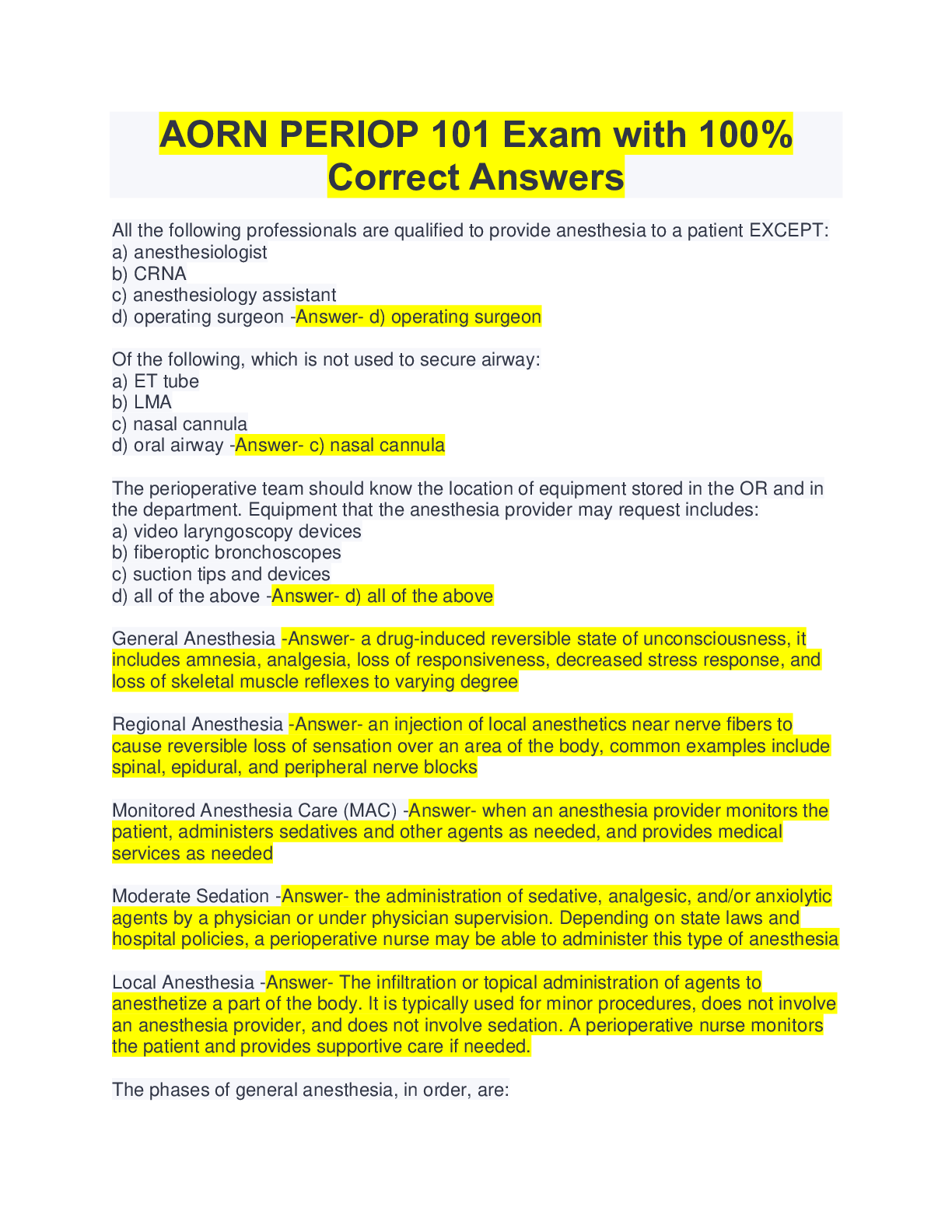
All the following professionals are qualified to provide anesthesia to a patient EXCEPT:
a) anesthesiologist
b) CRNA
c) anesthesiology assistant
d)
...
AORN PERIOP 101 Questions and
answers. 100% Accurate, graded A+
All the following professionals are qualified to provide anesthesia to a patient EXCEPT:
a) anesthesiologist
b) CRNA
c) anesthesiology assistant
d) operating surgeon - ✔✔d) operating surgeon
Of the following, which is not used to secure airway:
a) ET tube
b) LMA
c) nasal cannula
d) oral airway - ✔✔c) nasal cannula
The perioperative team should know the location of equipment stored in the OR and in the department.
Equipment that the anesthesia provider may request includes:
a) video laryngoscopy devices
b) fiberoptic bronchoscopes
c) suction tips and devices
d) all of the above - ✔✔d) all of the above
General Anesthesia - ✔✔a drug-induced reversible state of unconsciousness, it includes amnesia,
analgesia, loss of responsiveness, decreased stress response, and loss of skeletal muscle reflexes to
varying degree
Regional Anesthesia - ✔✔an injection of local anesthetics near nerve fibers to cause reversible loss of
sensation over an area of the body, common examples include spinal, epidural, and peripheral nerve
blocks
Monitored Anesthesia Care (MAC) - ✔✔when an anesthesia provider monitors the patient, administers
sedatives and other agents as needed, and provides medical services as needed
Moderate Sedation - ✔✔the administration of sedative, analgesic, and/or anxiolytic agents by a
physician or under physician supervision. Depending on state laws and hospital policies, a perioperative
nurse may be able to administer this type of anesthesia
Local Anesthesia - ✔✔The infiltration or topical administration of agents to anesthetize a part of the
body. It is typically used for minor procedures, does not involve an anesthesia provider, and does not
involve sedation. A perioperative nurse monitors the patient and provides supportive care if needed.
The phases of general anesthesia, in order, are:
a) induction, maintenance, emergence
b) emergence, maintenance, induction
c) maintenance, emergence, induction
d) induction, emergence, maintenance - ✔✔a) induction, maintenance, emergence
Propofol - ✔✔IV induction agent
etomidate - ✔✔IV induction agent
methohexitol - ✔✔IV induction agent
IV induction agent - ✔✔ketamine
sevoflurane with or without nitric oxide - ✔✔inhaled induction agent
Succinylcholine - ✔✔short-acting muscle relaxant
cisatracurium - ✔✔intermediate-acting muscle relaxant
atracurium - ✔✔intermediate-acting muscle relaxant
rocuronium - ✔✔intermediate-acting muscle relaxant
vecuronium - ✔✔intermediate-acting muscle relaxant
pancuronium - ✔✔long-acting muscle relaxant
isoflurane - ✔✔used for inhalation maintenance
desflurane - ✔✔used for inhalation maintenance
total iv anesthesia (TIVA) - ✔✔a technique for maintaining anesthesia using infusions of short-acting IV
agents without inhalation anesthetics. Propofol and remifentanil are often used for TIVA.
Reversal agent for succinylcholine - ✔✔none!
neostigmine - ✔✔reversal for muscle relaxant (except succinylcholine)
edrophonium - ✔✔reversal for muscle relaxant (except succinylcholine)
sugammadex - ✔✔reversal agent for rocuronium, vecuronium, and pancuronium
flumazenil - ✔✔reversal agent for benzos (midazolam)
naloxone - ✔✔reversal agent for narcotics (fentanyl)
which of the following type of airway maintenance usually requires muscle relazants?
a) spontaneous respiration
b) mask ventilation
c) laryngeal mask airway
d) endotracheal intubation - ✔✔d) endotracheal intubation
When should cricoid pressure be released?
a) if the patient coughs
b) when the patient loses consciousness
c) if the anesthesia provider cannot see the vocal cords
d) after the cuff of the ET tube is inflated and the position is confirmed - ✔✔d) after the cuff of the ET
tube is inflated and the position is confirmed
lidocaine - ✔✔local anesthetic
bupivacaine - ✔✔local anesthetic
ropivacaine - ✔✔local anesthetic
tetracaine - ✔✔for long-acting spinal anesthesia
epinephrine (anesthesia) - ✔✔added to increase density and duration of a regional block
bicarbonate (anesthesia) - ✔✔sometimes added to reduce the acidity of the local anesthetic and speed
the onset of the block
Spinal Anesthesia - ✔✔the subarachnoid space is entered and local anesthetic is injected directly into
the spinal canal, pt sitting or lateral
Epidural Anesthesia - ✔✔the anesthesia care provider finds the space between the ligamentum flavum
and dura, this space is identified by a loss of resistance as the needle is advanced, a single dose of
anesthetic can be injected, or a catheter can be placed
IV regional anesthesia (Bier Block) - ✔✔used for procedures on hand, wrist, or forearm (double
tourniquet method)
Local Anesthetic System Toxicity (LAST) - ✔✔can occur if unsafe amount of local anesthetic enters
bloodstream, can occur slowly as med is absorbed over time, or quickly if accidentally injected into
blood vessel
CAN PROGRESS TO SEIZURES AND CARDIAC OR RESP ARREST
Symptoms of LAST - ✔✔-ringing in ears
-tingling lips
-metallic taste in mouth
-dizziness
Sedation can be used with any of the following types of anesthesia except:
a) regional anesthesia
b) monitored anesthesia care
c) general anesthesia
d) local anesthesia - ✔✔d) local anesthesia
Malignant Hyperthermia (MH) - ✔✔a rare but potentially life-threatening complication of anesthesia,
triggered by inhaled general anesthetic agents and the muscle relaxant succinylcholine
Complications of MH - ✔✔it can lead to cardiac arrest, brain damage, organ failure, and death
increased end-tidal CO2 - ✔✔most specific sign of MH
Dantrolene - ✔✔drug used to treat MH
Hypothermia - ✔✔a core body temperature <36c (<96.8F)
Which of the following is associated with increased risk for hypothermia?
a) female sex
b) higher than normal body weight
c) hyperthyroid
d) hypertension - ✔✔a) female sex
Identify the active warming devices
a) circulating water garments
b) cotton blankets
c) forced-air warming devices
d) increased ambient room temperature
e) surgical drapes
d) warmed IV fluids - ✔✔a) circulating water garments
c) forced-air warming devices
d) increased ambient room temperature
f) warmed IV fluids
Which of the following would be an appropriate action for the perioperative nurse when assisting with
anesthesia?
a) administer the muscle relaxant reversal agent if needed?
b) apply cricoid pressure if needed during intubation
c) document anesthetic agents used, dose, route, and time
d) extubate the patient - ✔✔b) apply cricoid pressure if needed during intubation
Which of the following is NOT included in basic monitoring of the patient for anesthesia?
a) pulse oximetry
b) ECG
c) arterial line
d) blood pressure - ✔✔c) arterial line
Which drug is used to reverse valium and midazolam?
a) neostigmine
b) pancuronium
c) flumazenil
d) succinylcholine - ✔✔c) flumazenil
[Show More]