By: Anthony T. Villegas R.N.
Overview of structures and functions:
NERVOUS SYSTEM
• The functional unit of the nervous system is the nerve cells or neurons
• The nervous system is composed of the ff:
Central Ner
...
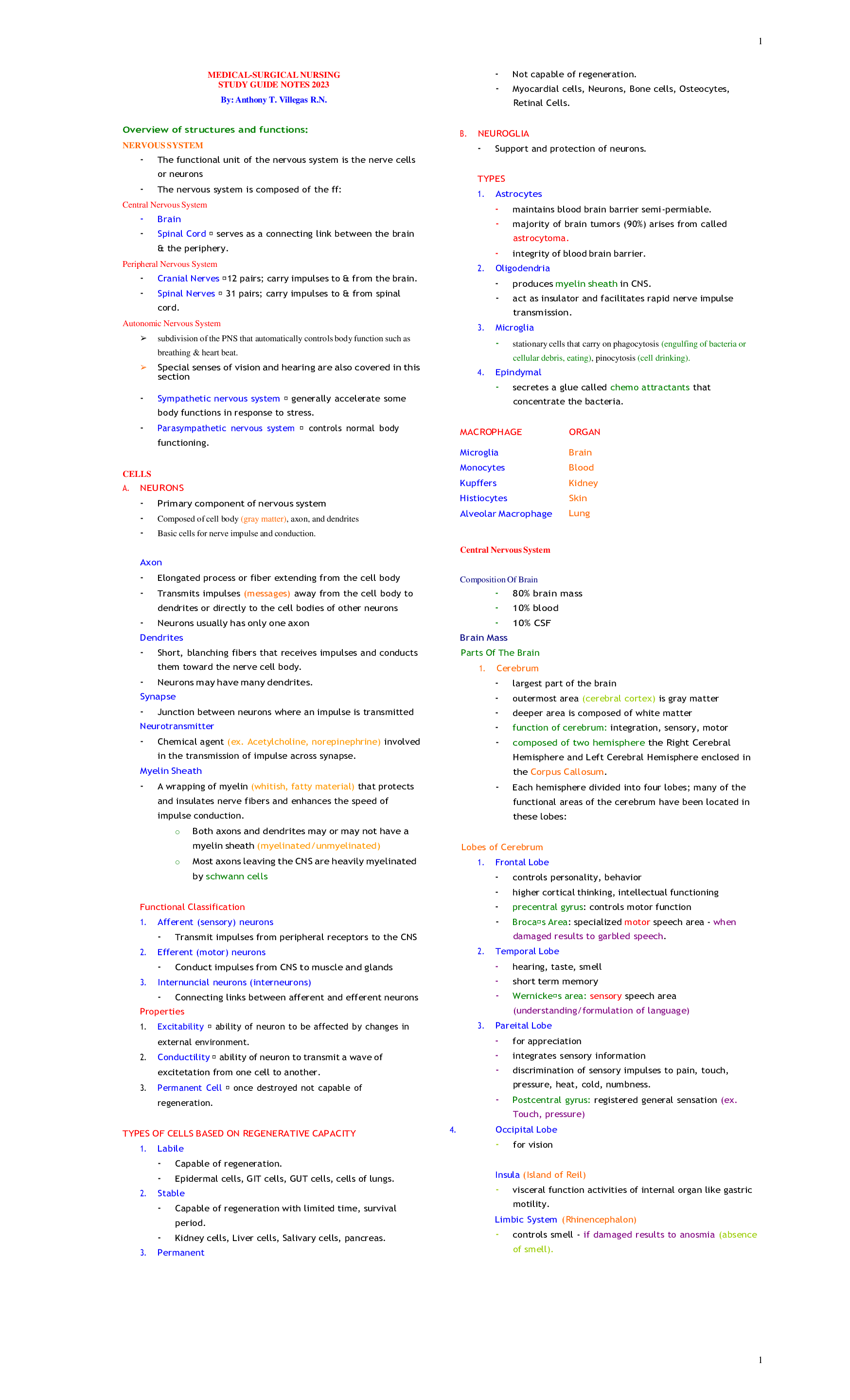
By: Anthony T. Villegas R.N.
Overview of structures and functions:
NERVOUS SYSTEM
• The functional unit of the nervous system is the nerve cells or neurons
• The nervous system is composed of the ff:
Central Nervous System
• Brain
• Spinal Cord serves as a connecting link between the brain & the periphery.
Peripheral Nervous System
• Cranial Nerves 12 pairs; carry impulses to & from the brain.
• Spinal Nerves 31 pairs; carry impulses to & from spinal cord.
Autonomic Nervous System
➢ subdivision of the PNS that automatically controls body function such as breathing & heart beat.
➢ Special senses of vision and hearing are also covered in this section
• Sympathetic nervous system generally accelerate some body functions in response to stress.
• Parasympathetic nervous system controls normal body
functioning.
• Not capable of regeneration.
• Myocardial cells, Neurons, Bone cells, Osteocytes, Retinal Cells.
B. NEUROGLIA
• Support and protection of neurons.
TYPES
1. Astrocytes
• maintains blood brain barrier semi-permiable.
• majority of brain tumors (90%) arises from called astrocytoma.
• integrity of blood brain barrier.
2. Oligodendria
• produces myelin sheath in CNS.
• act as insulator and facilitates rapid nerve impulse transmission.
3. Microglia
• stationary cells that carry on phagocytosis (engulfing of bacteria or cellular debris, eating), pinocytosis (cell drinking).
4. Epindymal
• secretes a glue called chemo attractants that concentrate the bacteria.
MACROPHAGE ORGAN
CELLS
A. NEURONS
• Primary component of nervous system
• Composed of cell body (gray matter), axon, and dendrites
• Basic cells for nerve impulse and conduction.
Axon
• Elongated process or fiber extending from the cell body
Microglia Monocytes Kupffers Histiocytes
Alveolar Macrophage
Central Nervous System
Composition Of Brain
Brain Blood Kidney Skin Lung
• Transmits impulses (messages) away from the cell body to dendrites or directly to the cell bodies of other neurons
• Neurons usually has only one axon Dendrites
• Short, blanching fibers that receives impulses and conducts them toward the nerve cell body.
• Neurons may have many dendrites. Synapse
• Junction between neurons where an impulse is transmitted Neurotransmitter
[Show More]