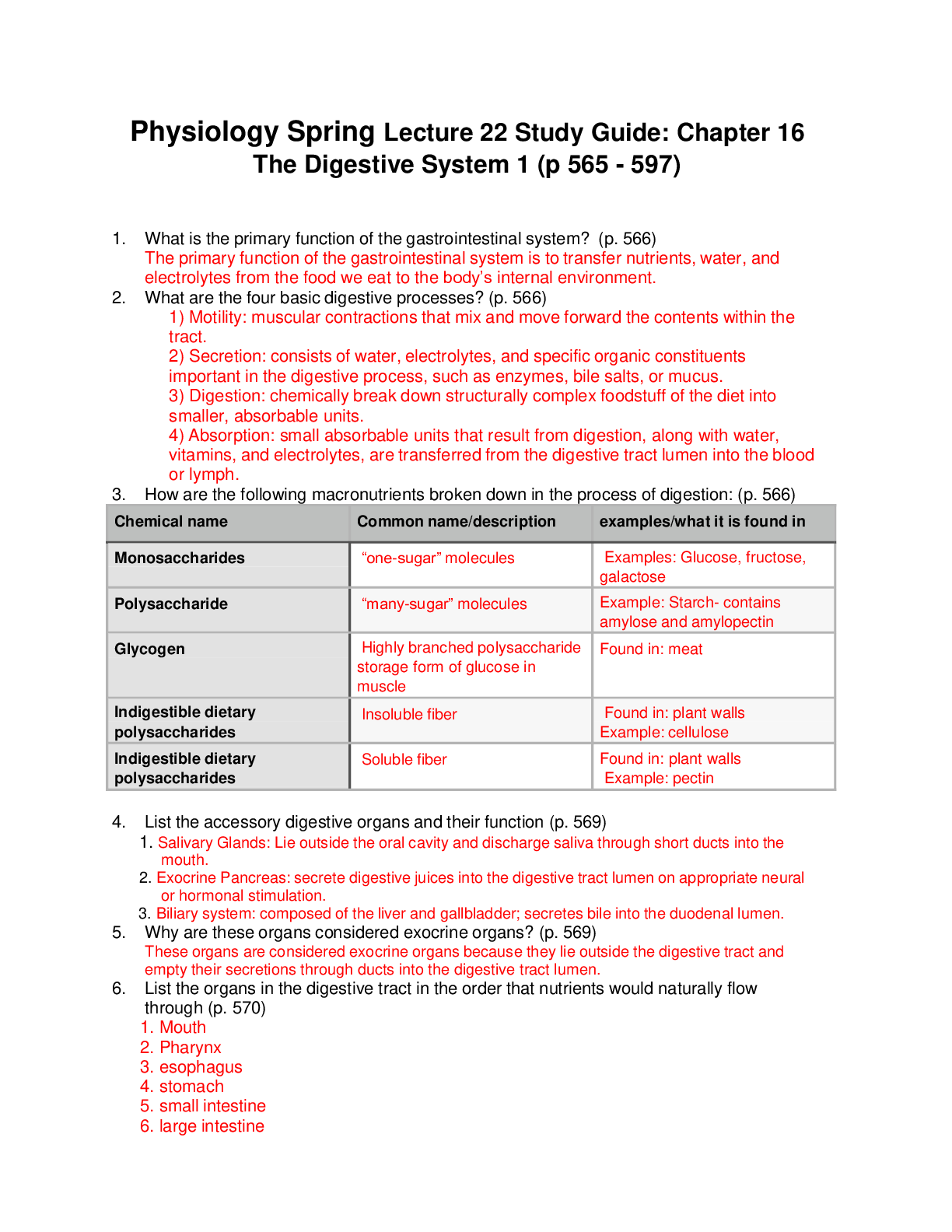
Health Care > EXAM > Physiology Spring Lecture 22 Study Guide: Chapter 16 The Digestive System 1 (p 565 - 597) (All)
Physiology Spring Lecture 22 Study Guide: Chapter 16 The Digestive System 1 (p 565 - 597)
Document Content and Description Below
Last updated: 3 years ago
Preview 1 out of 12 pages
Instant download
Buy this Document to get the Full Access Instantly
Provided by Students Who Aced it
We Verify Document Content to Gurantee Accuracy
Reviews( 0 )
Document information
Connected school, study & course
About the document
Uploaded On
Mar 22, 2023
Number of pages
12
Written in
All

Additional information
This document has been written for:
Uploaded
Mar 22, 2023
Downloads
0
Views
64
Document Keyword Tags
Recommended For You
Get more on EXAM »
Test Bank Lowdermilk: Maternity & Women’s Health Care Chapter...

Community Health Chapter 16. Review Questions with accurate an...
Test Bank Medical-Surgical Nursing 7th Edition by Linton Chapt...

Test bank for Medical-Surgical Nursing 10th Edition By Lewis,...
.png)
ESSENTIAL CELL BIOLOGY, FOURTH EDITION CHAPTER 16: CELL SIGNAL...

Liberty University - BUSI 681 Quiz 8 - BO1 LUO Quiz 8 - Chapte...
NR 331 Test 1 Practice Questions Chapter 16-19, 26-29, 32 Qu...
BIOS 1404 Chapter 16 Questions and Answers (Verified Answers...
BIOS 105 Chapter 16 Questions and Answers (Verified Answers)

Instructor Manual For Business Foundations A Changing World 13...

St. Johns University - ACC 624 Chapter 16 Connect Home Work

NURS 6501 / NURS6501: Advanced Pathophysiology - Chapter 16 St...

NR566 / NR 566: Advanced Pharmacology for Care of the Family W...
CHEM 2325 Introductory Organic Chemistry Chapter 16 – Aromat...