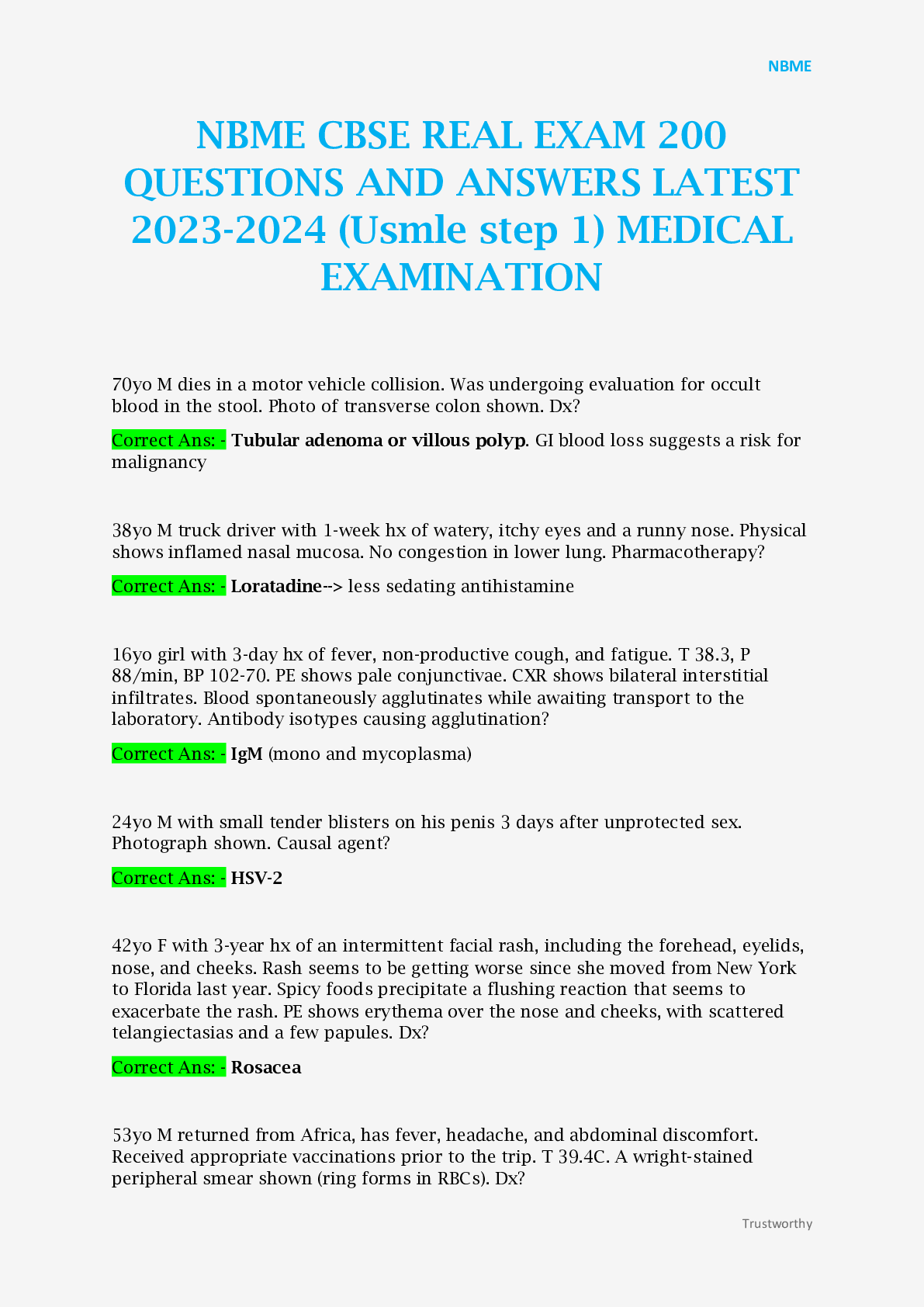
ATLS Practice 2023 Questions With All Correct Answers
Which of the following findings would be a reason to interrupt the primary survey?
A. Airway obstruction
B. Gasping respirations
C. Impaled object in abdomen
D.
...
ATLS Practice 2023 Questions With All Correct Answers
Which of the following findings would be a reason to interrupt the primary survey?
A. Airway obstruction
B. Gasping respirations
C. Impaled object in abdomen
D. Very weak pulse
{{Correct Ans- A. Airway obstruction
Changes in which of the following is most useful to follow in the child with head injury?
A. Frequency of vomiting
B. Level of consciousness
C. Reflexes
D. Sensory exam
{{Correct Ans- B. Level of consciousness
Weakness, fast pulse, and normal blood pressure suggest what condition?
A. Compensated hypovolemic shock
B. Decompensated neurogenic shock
C. Late burn shock
D. Late hemorrhagic shock
{{Correct Ans- A. Compensated hypovolemic shock
Which one of the following mnemonics can be used to help predict which patients might potentially have difficult bag mask ventilation?
A. MMAP
B. IPPV
C. RSI
D. BOOTS
{{Correct Ans- D. BOOTS
*B*=Beard
*O*=Obese
*O*=Old age
*T*=Toothless
*S*=Snoring
A 23 year old female has won the "Let's-see-who-can-lean-the-farthest-backward-over- the-second-story-balcony-railing" contest. You arrive to find her boyfriend standing over her, holding two beers, as she lies on the grass under the balcony. She opens her eyes to voice, her skin is normal in color, respirations about 16 and unlabored, pulse 54 and a little weak at the wrist, with no external bleeding. She has flat neck veins, a normal chest and abdomen and a stable pelvis. First responders who arrived just before you, tell you that her pulse ox reading is 94 and her blood pressure is 74/30. What type of shock is present?
A. Hypovolemic shock
B. Relative hypovolemic (high-space) shock
C. Mechanical (obstructive) shock
D. Cardiogenic shock
{{Correct Ans- B. Relative hypovolemic (high-space) shock
As intracerebral pressure rises, after an isolated head injury, what does the systolic blood pressure do?
A. Stays the same
B. Decreases
C. Increases
D. Changes randomly
{{Correct Ans- C. Increases
[Show More]


![Preview of AORN PERIOP 101 FINAL EXAM 2026 QUESTIONS AND VERIFIED ANSWERS [LATEST UPDATE]](https://browseimages.nyc3.digitaloceanspaces.com/paper-images/2026/04/07/sGJvJ3aH2026-04-07-04-5869d464cbba16f.png)