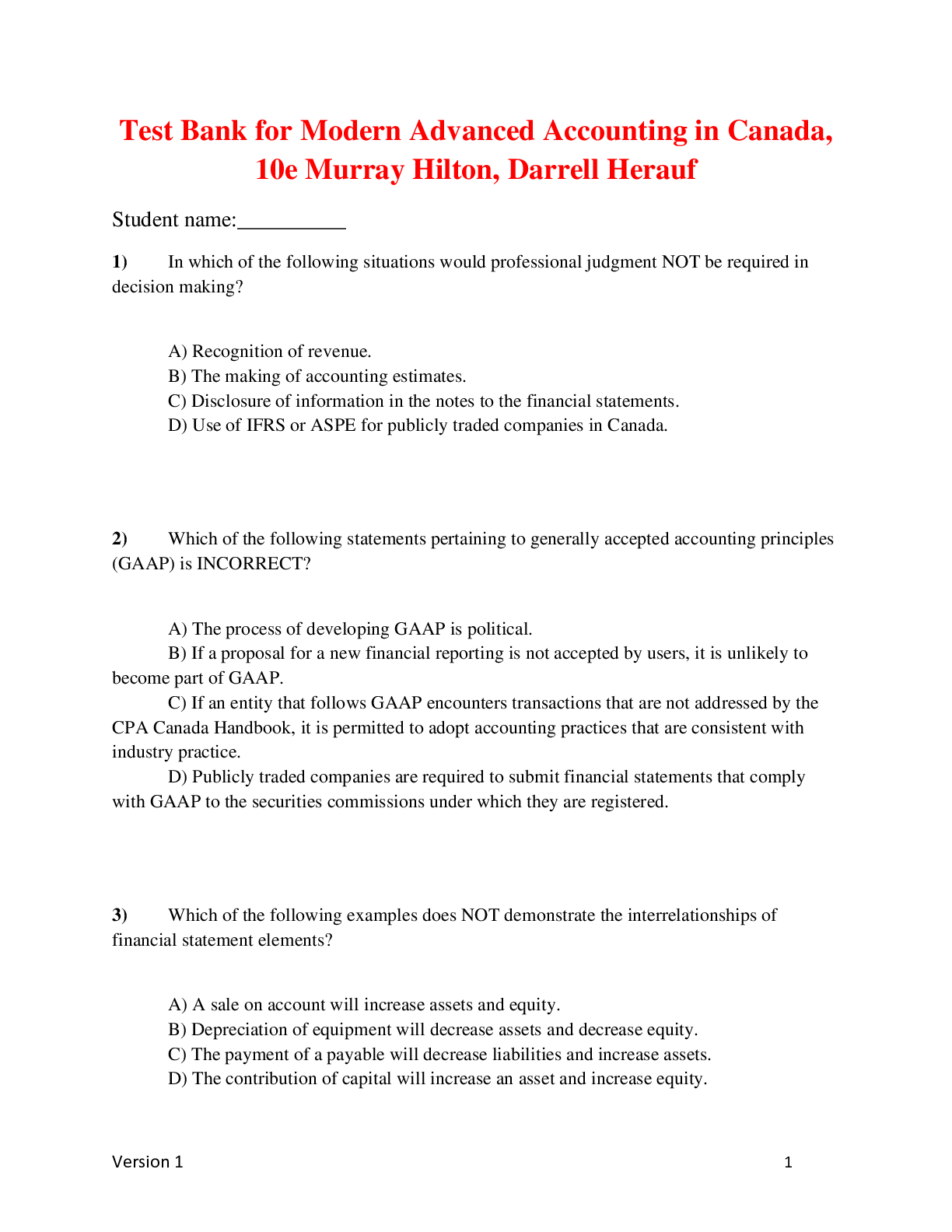
COMPLETE - Elaborated Test Bank for Modern Advanced Accounting in Canada ED.9 by Darrell Herauf & Murray Hilton ALL Chapters Included and Updated for 2023
COMPLETE - Elaborated Test Bank for Modern Advanced Accounting i
...
COMPLETE - Elaborated Test Bank for Modern Advanced Accounting in Canada ED.9 by Darrell Herauf & Murray Hilton ALL Chapters Included and Updated for 2023
COMPLETE - Elaborated Test Bank for Modern Advanced Accounting in Canada ED.9 by Darrell Herauf & Murray Hilton
CHAPTER 1 Conceptual and Case Analysis Frameworks for Financial Reporting
CHAPTER 2 Investments in Equity Securities
CHAPTER 3 Business Combinations
CHAPTER 4 Consolidation of Non-Wholly Owned Subsidiaries
CHAPTER 5 Consolidation Subsequent to Acquisition Date
CHAPTER 6 Intercompany Inventory and Land Profits
CHAPTER 7 (A) Intercompany Profits in Depreciable Assets (B) Intercompany Bondholdings
CHAPTER 8 Consolidated Cash Flows and Changes in Ownership
CHAPTER 9 Other Consolidation Reporting Issues
CHAPTER 10 Foreign Currency Transactions
CHAPTER 11 Translation and Consolidation of Foreign Operations
CHAPTER 12 Accounting for Not-for-Profit and Public Sector Organizations
MULTIPLE CHOICE. Choose the one alternative that best completes the statement or answers the question.
1) Which of the following would NOT be a reason to obtain a greater understanding of accounting
practices in other nations?
A) Departures from the historical cost principle may be possible in other nations.
B) Financial results are disclosed in different currencies.
C) Income-smoothing may have affected a foreign subsidiary's results; such smoothing practices
are not permitted in North America.
D) One needs to be aware of differing disclosure requirements from nation to nation, as this
impacts the preparation of financial statements.
Answer: B
2) Which of the following would be most affected by financial statements being prepared under
different accounting principles?
A) Reduced comparability. B) Increased complexity.
C) Reduced reliability. D) Inaccurate asset valuations.
Answer: A
3) The CPA Canada Handbook -- Accounting is the handbook of Canadian accounting standards. Why
do companies in Canada ensure that their financial reporting is consistent with Canadian GAAP?
A) Their bank requires them to do so.
B) Compliance with the CPA Canada Handbook - Accounting pronouncements is usually required
by many legal statutes.
C) Reporting under the CPA Canada Handbook - Accounting is required by public companies'
boards of directors.
D) Their auditors require them to do so.
Answer: B
4) Which decision has Canada made with respect to financial reporting for private enterprises?
A) To adopt the IFRS standards for small and medium-sized enterprises.
B) To look to US GAAP for standards.
C) To retain the current standards.
D) To develop and maintain its own standards for private enterprises.
Answer: D
5) Starting in 2011, what is the definition of a private enterprise (PE) under Canadian GAAP?
A) A corporation that has less than 500 shareholders and is not listed on a stock exchange.
B) A corporation that has no public shareholders.
C) A corporation which is not profit oriented.
D) A profit oriented enterprise that has none of its issued and outstanding financial instruments
traded in a public market and does not hold assets in a fiduciary capacity for a broad group of
outsiders as one of its primary businesses.
Answer: D
1
6) Which enterprises must report under IFRS in Canada?
A) Public companies, private companies and not-for-profit organizations.
B) All corporations, government agencies and private companies.
C) Public companies and private companies whose shareholders' equity is in excess of
$500,000,000 at any particular year end.
D) Publicly accountable enterprises.
Answer: D
7) What approach did Canada first decide to take with respect to convergence with IFRS?
A) Harmonization of CPA Canada Handbook with IFRS.
B) Substituting IFRS for Canadian GAAP when approved by the IASB.
C) Reviewing them with all publically accountable entities to see which ones would be acceptable.
D) Adopting some but not necessarily all IFRSs by reviewing them on a case by case basis.
Answer: A
8) What choice(s) do private enterprises have in their financial reporting in Canada?
A) They may adopt accounting principles that are appropriate to the circumstances.
B) They may elect to continue with differential reporting.
C) They have no choice at all; they will need to report under IFRS.
D) They may elect to report under either IFRS or ASPE.
Answer: D
9) For which of the following types of organizations does the CPA Canada Handbook not provide
specific accounting standards?
A) Proprietorships. B) Private enterprises.
C) Publicly accountable enterprises. D) Not-for-profit organizations.
Answer: A
10) Which of the following is NOT a reason why a Canadian private company would elect to report
under IFRS?
A) It is likely to be less expensive than reporting under ASPE.
B) The company seeks comparability with public companies of a similar size.
C) The company is a subsidiary of a Canadian public company.
D) The company is planning to go public in the near future.
Answer: A
11) The current ratio measures:
A) profitability of assets. B) solvency.
C) liquidity. D) profitability of owners' investment.
Answer: C
12) The formula for the current ratio is:
A) current assets / current liabilities B) net income / shareholders' equity
C) total debt / shareholders' equity D) current assets - current liabilities
Answer: A
2
13) The debt-to-equity ratio measures:
A) profitability of owners' investment. B) liquidity.
C) solvency. D) profitability of assets.
Answer: C
SHORT ANSWER. Write the word or phrase that best completes each statement or answers the question.
14) One of the underlying assumptions of the Historical Cost Principle is that a stable unit of measure
(currency) should be used for Financial Reporting. Is this always the case?
Answer: The Historical Cost Principle is not very useful when inflation rates are high. As a result of the
eroding purchase power associated with periods of high inflation, many countries have had to
experiment with price-level adjustments. These adjustments often include asset revaluations to
reflect their current values.
3
15) X Inc. and Y Inc. are virtually identical companies with identical cost structures and very similar
business practices operating in the same lines of business. X Inc. is a public company based in
Canada and follows IFRS while Y Inc. is a private enterprise based in Canada and follows ASPE.
The following were the condensed income statements for both companies for the last year before
both adopted IFRS.
X Inc. Y Inc.
Sales: $1,000,000 $2,000,000
Less:
Cost of Goods Sold $500,000 $1,600,000
Gross Margin $500,000 $400,000
Administrative Expenses $200,000 $300,000
Net Income: $300,000 $100,000
Required:
Given the information provided, what are some possible causes for the differing results of these
companies?
Answer: There could be many possible explanations for these differing results. Y Inc.'s net income is
$100,000, compared to X Inc.'s $300,000. Conversely, Y Inc.'s sales are twice those of X Inc.
What is particularly noteworthy is Y Inc.'s 20% gross margin compared to X Inc.'s 50% gross
margin. This could be due to the accelerated depreciation on Y Inc.'s property, plant and
equipment or provisions made for future maintenance costs.
Smoothing practices may have been applied to reduce Y Inc.'s income, and of course, its tax
liability. Y Inc.'s income may have been further reduced by higher estimates (for example: bad
debt expense, warranty costs and so forth) which are not necessarily be indicative of economic
conditions.
Note: Once again, the above analysis is not necessarily exhaustive. Students may be able to
identify other valid differences.
16) Briefly discuss the anticipated changes to accounting standards in Canada over the next few years.
Answer: 1. The format and structure of financial statements may change to present a cohesive
relationship between the various statements;
2. The Conceptual Framework will be revised to create a sound foundation for future
accounting standards that are principles based, internally consistent, and internationally
converged. Relevance and faithful representation will be the fundamental qualitative
characteristics of financial information. The definitions of assets and liabilities may change to
focus more on rights and obligations to eliminate the reference to past events. When and how
to use various measurement bases may be clarified.
4
17) What disclosure requirements must be met when a Canadian company adopts IFRS for the first
time?
Answer: 1. The company must reconcile its equity reported under the previous GAAP to its equity in
accordance with IFRS for both the date of transition to IFRS and the end of the latest period
reported under the previous GAAP.
2. The company must reconcile its total comprehensive income in accordance with IFRS to that
reported in the latest statements prepared under the previous GAAP.
3. The company must provide sufficient detail to enable users to understand the material
adjustments to the statement of financial position, the statement of comprehensive income and
the statement of cash flows.
18) List some of the key differences between IFRS and ASPE.
Answer: Some key differences between IFRS and ASPE are:
> disclosure
> impaired loans
> property, plant, and equipment revaluation option
> asset impairment (test for impairment if indicator requires, and subsequent reversal of
impairment loss)
> development costs
> post-employment benefits (recognition of actuarial gains/losses)
> income taxes
> interest capitalization
> compound financial instruments
> preferred shares in tax planning arrangements
> value of conversion option for convertible bonds
(See Exhibit 1.1 "Some Key Differences between IFRS and ASPE" for a full list and a
description of the difference.)
5
MULTIPLE CHOICE. Choose the one alternative that best completes the statement or answers the question.
1) Which of the following types of share investment does NOT qualify as a strategic investment?
A) Controlled investments. B) Joint Control investments.
C) Investments without significant influence. D) Significant influence investments.
Answer: C
2) A significant influence investment is one that:
A) allows the investor to exercise significant influence over the strategic and operating policies of
the Associate.
B) allows the investor to exercise significant influence over the strategic operating and financing
policies of the Associate.
C) allows the investor to exercise significant influence over only the operating policies of the
Associate.
D) allows the investor to exercise significant influence over only the financing policies of the
Associate.
Answer: B
3) What is the dominant factor used to distinguish portfolio investments from significant influence
investments?
A) The percentage of equity held by the investor.
B) Use of the Equity Method to account for and report the investment.
C) The investor's intention to establish or maintain a long-term operating relationship with the
investee.
D) Use of the Cost Method to account for and report the investment.
Answer: C
4) Which of the following statements is TRUE under IFRS 9?
A) Other Comprehensive Income (OCI) is included in Retained Earnings.
B) Unrealized gains and losses on equity investments may be included in Other Comprehensive
Income (OCI) only if a decision to do so is made when the investment is acquired.
C) All unrealized gains and losses on equity investments flow through Other Comprehensive
Income (OCI).
D) Unrealized gains and losses on fair value through profit and loss (FVTPL) securities are
included in Other Comprehensive Income.
Answer: B
5) Gains and losses on fair value through profit or loss (FVTPL) securities:
A) are included in net income only when realized.
B) are never recorded until the securities are sold.
C) are included in net income, regardless of whether they are realized or not.
D) are included in net income only when the investment has become permanently impaired.
Answer: C
1
6) How are realized gains from the sale of investments accounted for at fair value through Other
Comprehensive Income (FVTOCI) accounted for under IFRS 9?
A) They are transferred to Retained Earnings without going
[Show More]