Page 1
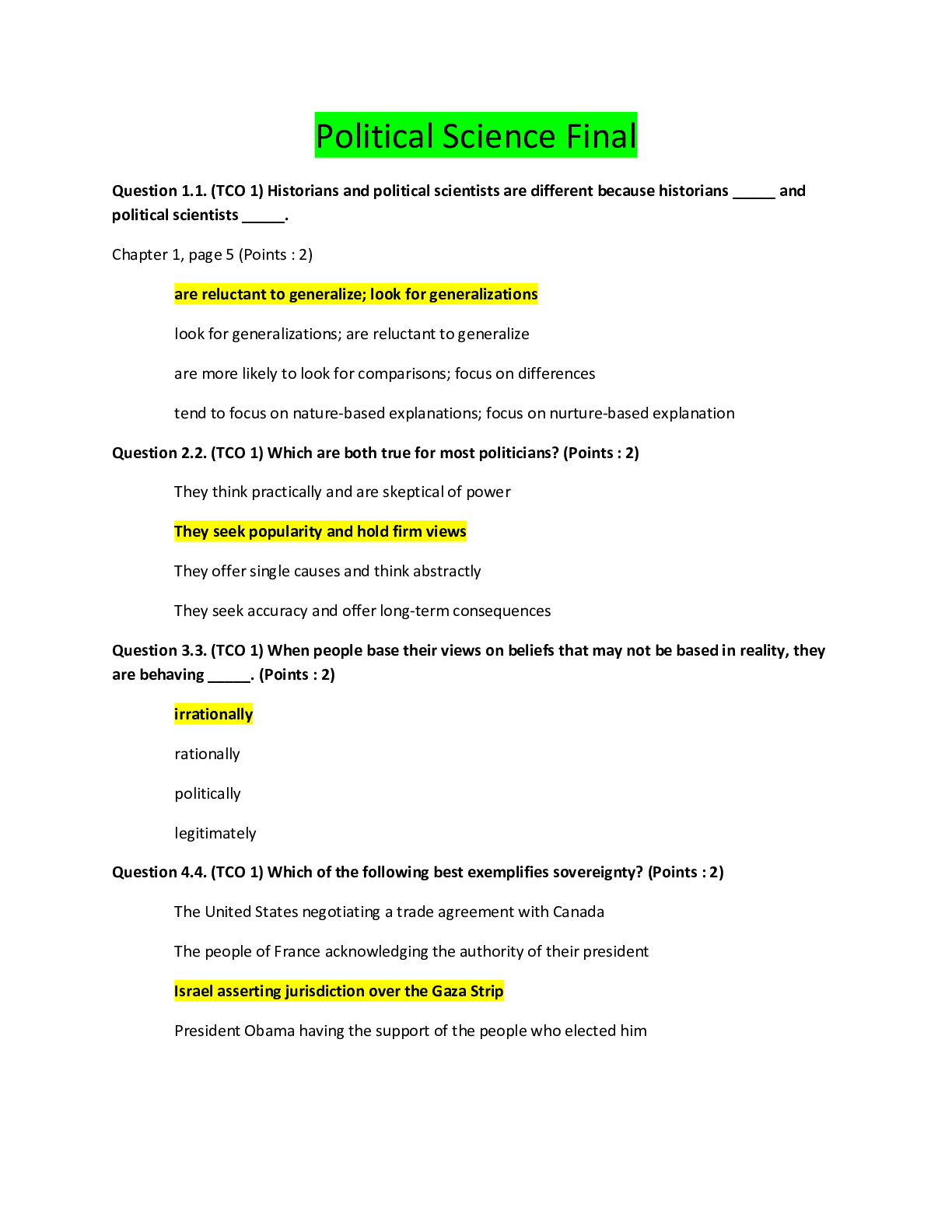
1. (TCO 1) Historians and political scientists are different because historians and political scientists . Chapter 1, page 5 (Points : 2)
2. (TCO 1) The notion that politicians think practically and po
...
Page 1
1. (TCO 1) Historians and political scientists are different because historians and political scientists . Chapter 1, page 5 (Points : 2)
2. (TCO 1) The notion that politicians think practically and political scientists think abstractly is indicative of which of the following? (Points : 2)
3. (TCO 1) Voting for someone who is charismatic but whose policies might not benefit you would be considered
behavior. (Points : 2)
4. (TCO 1) is the use of public office for private gain.(Points : 2)
5. (TCO 1) The notion that we acknowledge the rightful roles of our leaders or our laws is known as . (Points : 2)
6. (TCO 1) Relating concepts in a way that connects them in an empirical manner is the basis of building (Point . 2)
7. (TCO 1) The term for measuring with numbers is . (Points : 2)
8. (TCO 4) The English common law stressed the rights of free and equal men and was developed on the basis of precedent set by earlier judges, known today as . (Points : 2)
9. (TCO 4) Which of the following issues is a civil concern? (Points : 2)
10. (TCO 4) The concept of judicial review falls under which article of the U.S. Constitution?(Points : 2)
A
11. (TCO 4) Who nominates and approves federal judges in the U.S. court system? (Points : 2)
12. (TCO 4) Which of the following was an argument against granting the U.S. Supreme Court the power of judicial review? (Points : 2)
13. (TCO 4) Examine the ideal role of American judges. (Points : 2)
Judges should intervene frequently, interpreting the law according to their expertise and ensuring a fair trial.
Judges should act as umpires, passively watching the legal drama and ruling only on disputed points of procedure.
Judges should not intervene unless attorneys object, at which point they may either overrule or sustain the objection.
Judges should take an active role, questioning witnesses, eliciting evidence, and commenting on procedure.
14. (TCO 4) In Lombard v. Louisiana (1963), the Warren Court supported , ruling that blacks who had refused to leave a segregated lunch counter could not be prosecuted. (Points : 2)
15. (TCO 5) Why do the responsibilities of legislative and executive powers often overlap?(Points : 2)
16. (TCO 5) How often does the cabinet change in a parliamentary system? (Points : 2)
17. (TCO 5) Because of the separation of powers inherent in a presidential system, some scholars think that executivelegislative is common in systems like that used in the United States. (Points : 2)
18. (TCO 5) Who directly calls forth the leader of the largest party to take office with a cabinet and become the prime minister? (Points : 2)
[Show More]