Indipendent Learning Centre BIOLOGY SBI4U Exam A combination of the Industrial Revolution and Green Revolution contributed to the
dramatic increase of the world population. Over the last 150-200 years they brought in
...
Indipendent Learning Centre BIOLOGY SBI4U Exam A combination of the Industrial Revolution and Green Revolution contributed to the
dramatic increase of the world population. Over the last 150-200 years they brought in
medicinal advancements and agricultural advancements, this led to lower mortality rates
and higher birth rates.
2. DE = N/SE
= 470/430-120
=470/310
= 1.5161 Therefore, there are 1.5 rabbits per km2.
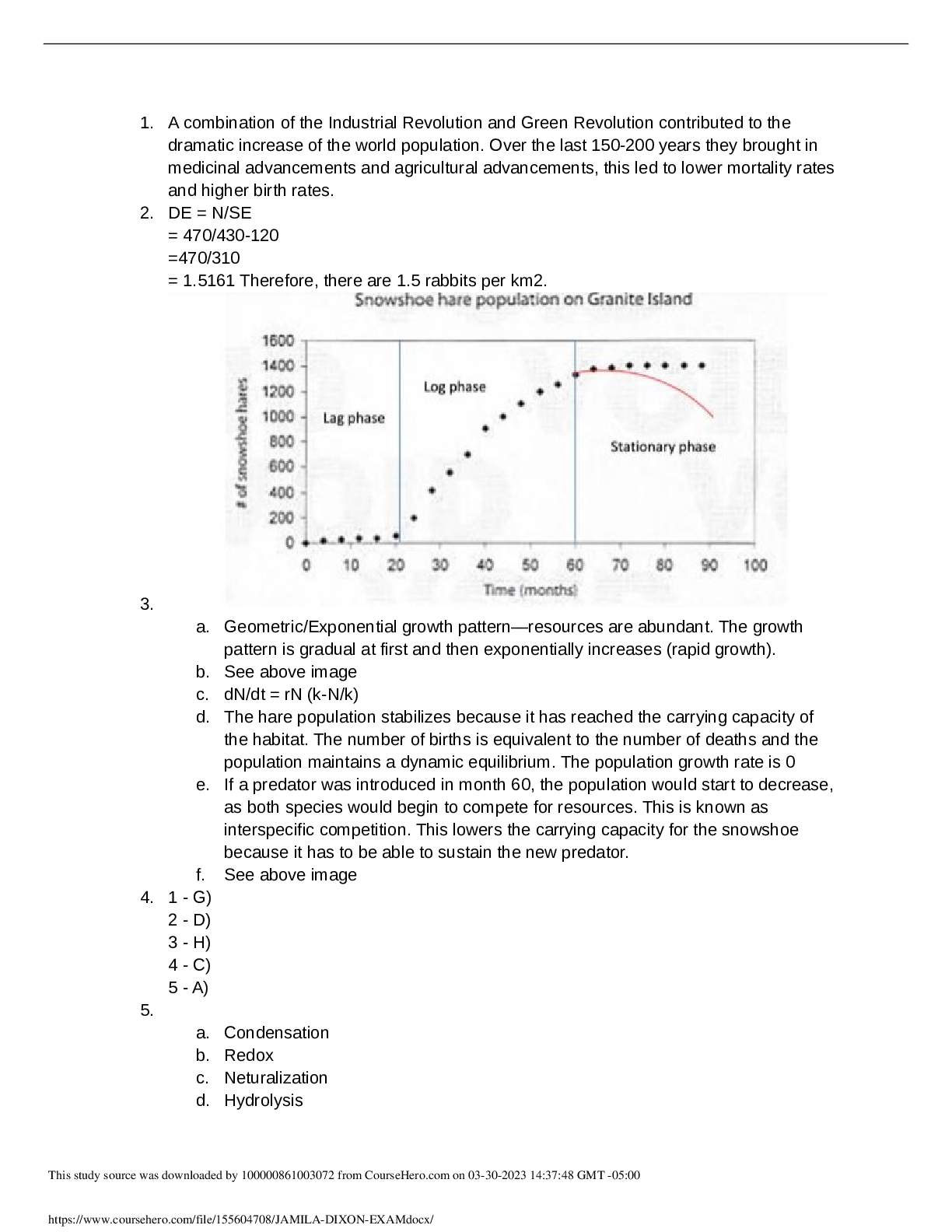
3.
a. Geometric/Exponential growth pattern—resources are abundant. The growth
pattern is gradual at first and then exponentially increases (rapid growth).
b. See above image
c. dN/dt = rN (k-N/k)
d. The hare population stabilizes because it has reached the carrying capacity of
the habitat. The number of births is equivalent to the number of deaths and the
population maintains a dynamic equilibrium. The population growth rate is 0
e. If a predator was introduced in month 60, the population would start to decrease,
as both species would begin to compete for resources. This is known as
interspecific competition. This lowers the carrying capacity for the snowshoe
because it has to be able to sustain the new predator.
f. See above image
4. 1 - G)
2 - D)
3 - H)
4 - C)
5 - A)
5.
a. Condensation
b. Redox
c. Neturalization
d. Hydrolysis
6. A hydrogen bond is a dipole-dipole attraction between molecules. It is formed between
the electropositive hydrogen dipoles and electronegative dipoles of fluorine, oxygen and
nitrogen.
7. Both are forms of passive transport that require no energy for the movement of
molecules from an area of high concentration to low concentration. Facilitated diffusion
occurs when molecules enter cells with the help of transport proteins. Some molecules
are too big and hydrophilic to travel through the lipid portion of the cell membrane.
Osmosis is the diffusion of water across a selectively permeable membrane. There are 3
categories of osmosis that include isotonic, hypertonic, and hypotonic. The water
molecules move from a region of higher water and lower solute concentration to a region
of lower water and higher solute concentration.
8. The celery walls are dry and have low water concentration. Salt water is hypertonic to
the celery's cell. This hypertonic environment causes water to migrate out of the celery
by osmosis and make it wilt. It should be placed in fresh pure water, a hypotonic
solution, so water moves into the celery's walls by osmosis causing them to expand and
become stiff. Therefore, placing the celery in pure water would be the better option to
make it crispier and attract water to the interior of the celery cells.
[Show More]