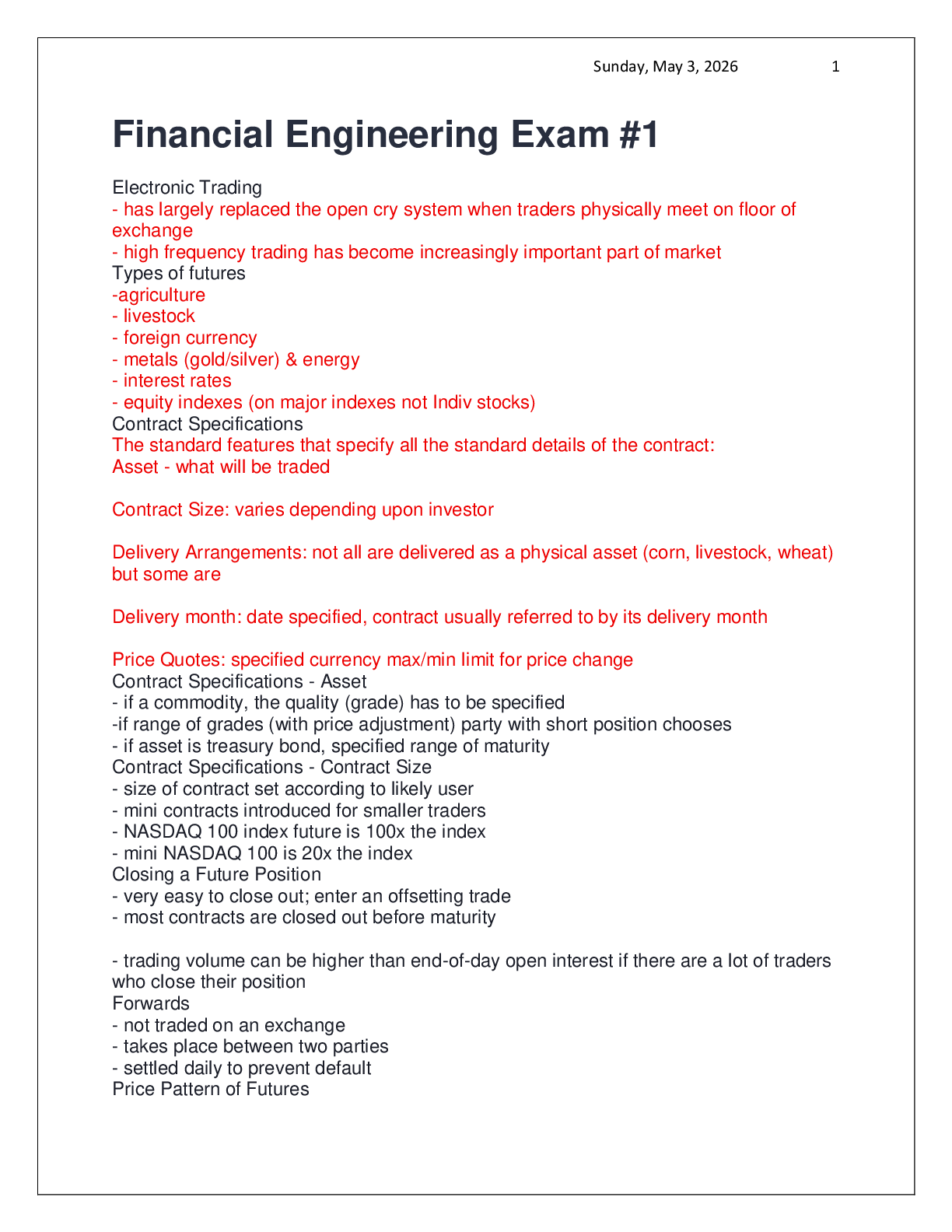
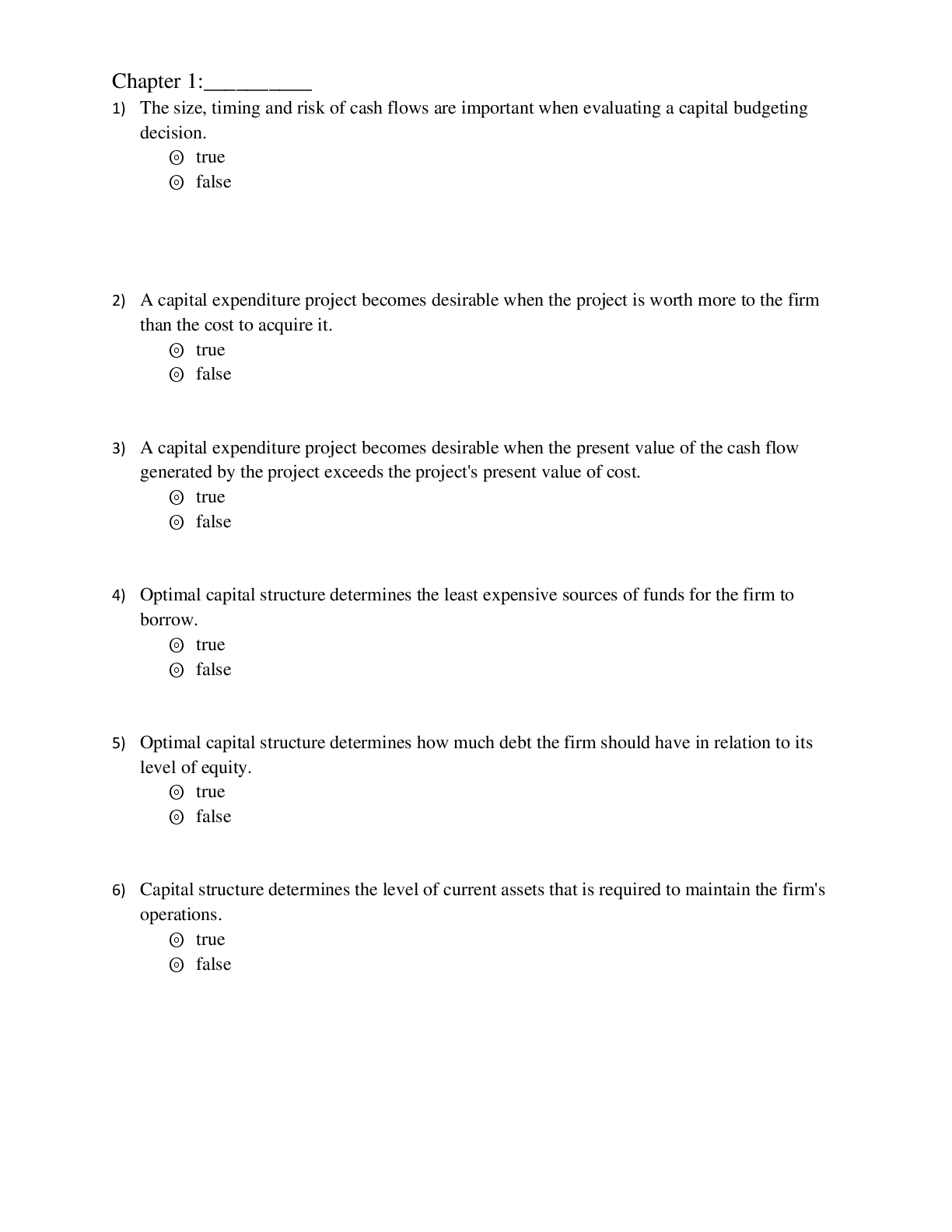
FINANCE 3013 Final Chapters 1-13, 23 QUIZZES Quizzes 1.2 The Four Types of Firms P 1-1 (book/static) What is the most important difference between a corporation and all other organizational forms? ... P 1-2 (book/static) What does the phrase limited liability mean in a corporate context? P 1-3 (book/static) Which organizational forms give their owners limited liability? P 1-4 (book/static) What are the main advantages and disadvantages of organizing a firm as a corporation? The advantages are: P 1-5 (book/static) Explain the difference between an S and a C corporation. P 1-6 (similar to) You are a shareholder in a C corporation. The corporation earns $2.27 per share before taxes. Once it has paid taxes it will distribute the rest of its earnings to you as a dividend. Assume the corporate tax rate is 35% and the personal tax rate on (both dividend and non-dividend) income is 30%. How much is left for you after all taxes are paid? P 1-7 (similar to) You are a shareholder in an S corporation. The corporation earns $2.23 per share before taxes. As a pass through entity, you will receive $2.23 for each share that you own. Your marginal tax rate is 30%. How much per share is left for you after all taxes are paid? 1.3 The Financial Manager P 1-8 (book/static) What is the most important type of decision that the financial manager makes? P 1-9 (book/static) Why do all shareholders agree on the same goal for the financial manager? 1.4 The Financial Manager’s Place in the Corporation P 1-10 (book/static) Corporate managers work for the owners of the corporation. Consequently, they should make decisions that are in the interests of the owners, rather than in their own interests. What strategies are available to shareholders to help ensure that managers are motivated to act this way? P 1-11 (book/static) Recall the last time you ate at an expensive restaurant where you paid the bill. Now think about the last time you ate at a similar restaurant, but your parents paid the bill. Did you order more food (or more expensive food) when your parents paid? Explain how this relates to the agency problem in corporations. P 1-12 (book/static) Suppose you are considering renting an apartment. You, the renter, can be viewed as an agent while the company that owns the apartment can be viewed as the principal. What agency conflicts do you anticipate? Suppose, instead, that you work for the apartment company. What features would you put into the lease that would give the renter incentives to take good care of the apartment? P 1-13 (book/static) You are the CEO of a company and you are considering entering into an agreement to have your company buy another company. You think the price might be too high, but you will be the CEO of the combined, much larger company. You know that when the company gets bigger, your pay and prestige will increase. What is the nature of the agency conflict here and how is it related to ethical considerations? 1.5 The Stock Market P 1-14 (book/static) You are a financial manager in a public corporation. One of your engineers says that they can increase the profit margin on your flagship product by using a lower quality vendor. However, the product is likely to fail more often and will generally not last as long. Will taking your engineer's suggestion necessarily make shareholders better off? Why or why not? Will taking your engineer's suggestion necessarily make shareholders better off? Why or why not? P 1-15 (book/static) You sit on the board of a public corporation. Your CEO has proposed taking steps to offset the carbon impact of your company's manufacturing process. Doing so will add to the company's overall expenses. Your CEO argues, however, that this action will actually increase the stock price, maximizing shareholder wealth. Why might socially-responsible activities also be value-maximizing? Why might socially-responsible activities also be value-maximizing? P 1-16 (book/static) What is the difference between a public and private corporation? The shares of a public corporation are traded on an exchange (or "over the counter" in an electronic trading system) while the shares of a private corporation are not traded on a public exchange. P 1-17 (book/static) What is the difference between a primary and a secondary market? P 1-18 (book/static) How are limit orders and market orders different? P 1-19 (book/static) Explain why the bid-ask spread is a transaction cost. P 1-20 (book/static) What are the tradeoffs in using a dark pool? P 1-21 (book/static) The following quote on Yahoo! stock appeared on April 11, 2016, on Yahoo! Finance. If you wanted to buy Yahoo!, what price would you pay per share? How much would you receive per share if you wanted to sell Yahoo!? [Show More]
Last updated: 3 years ago
Preview 1 out of 298 pages
Buy this document to get the full access instantly
Instant Download Access after purchase
Buy NowInstant download
We Accept:
Can't find what you want? Try our AI powered Search
Connected school, study & course
About the document
Uploaded On
Feb 04, 2021
Number of pages
298
Written in
All
This document has been written for:
Uploaded
Feb 04, 2021
Downloads
0
Views
68
Scholarfriends.com Online Platform by Browsegrades Inc. 651N South Broad St, Middletown DE. United States.
We're available through e-mail, Twitter, and live chat.
FAQ
Questions? Leave a message!
Copyright © Scholarfriends · High quality services·