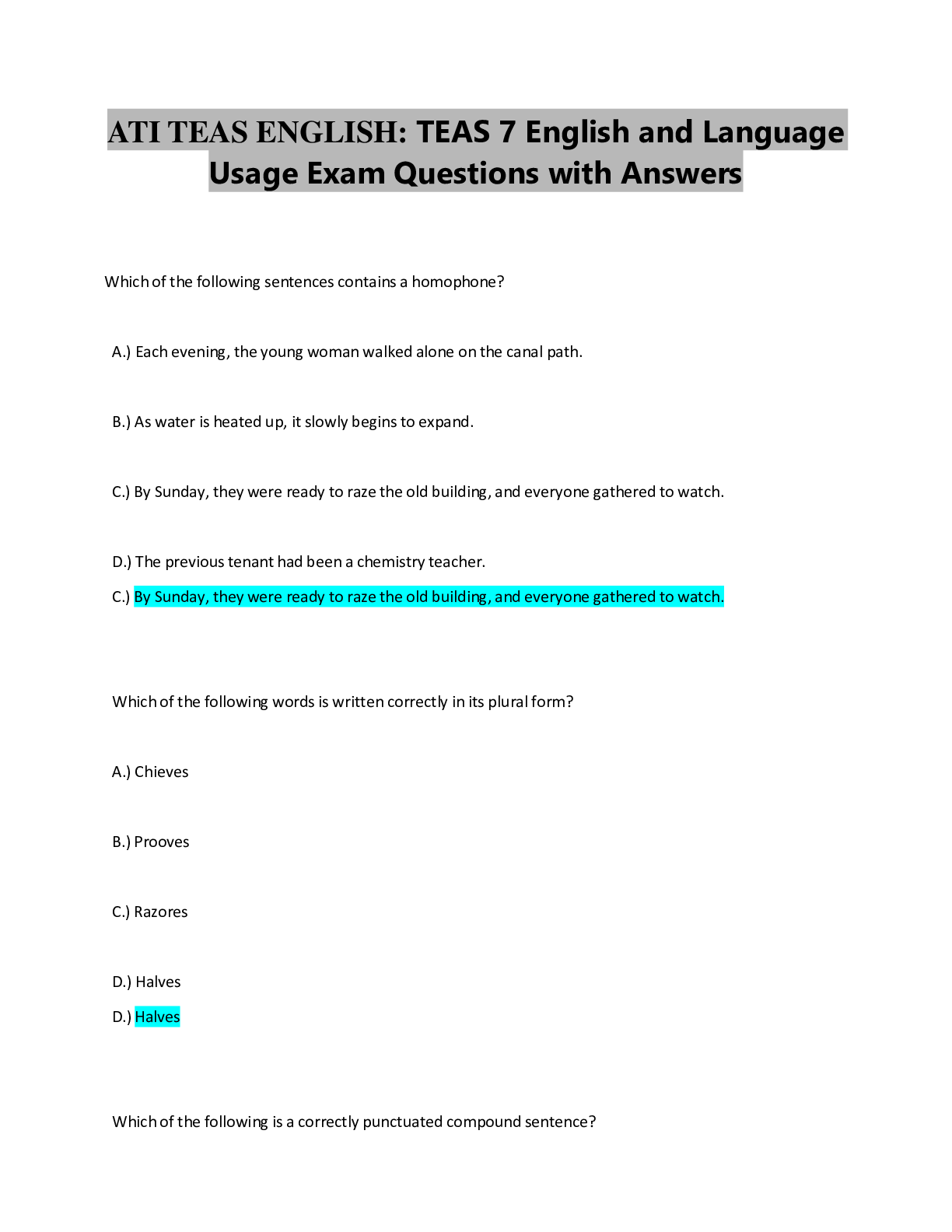
The term PSAP stands for Public Safety Access Point
(Ans- False, Public Safety Answering Point
Professionalism is defined by who you are, what you do, and how others perceive you
(Ans- True
Ethics involves an i
...
The term PSAP stands for Public Safety Access Point
(Ans- False, Public Safety Answering Point
Professionalism is defined by who you are, what you do, and how others perceive you
(Ans- True
Ethics involves an individuals personal, professional, and organizational rules of conduct
(Ans- True
The three primary fields of public safety communications are law enforcement, fire service, and emergency management
(Ans- False, They are Law Enforcement, Fire Services, and EMS (Emergency Medical Services)
The term vital services defines the primary functions or tasks of public safety communications systems
(Ans- True
Telephone books, maps, and cross reference directories are examples of PSAP informational resources
(Ans- True
A policy is a guide to action and a procedure is a guide to thinking
(Ans- False, A policy is a guide to thinking and a procedure is a guide to action
All non verbal communication requires face to face communication
(Ans- False
A question that can't be answered yes or no is an open ended question (Ans- True
Restating a speakers main points in your own words is applying the active listening technique
(Ans- False
Repeating in a short declarative statement the emotions or feelings the speaker is communicating is applying the active listening technique of paraphrasing
(Ans- False
An observation is based on assumptions and an inference is based on facts.
(Ans- False, An observation is based on facts and an inference is based on assumptions
Good customer service means treating callers with dilligence, consideration, and respect
(Ans- True
Emergency calls only come in on emergency lines
(Ans- False
Giving legal advice and/or personal opinions is part of a telecommunicators job
(Ans- False
It's okay for a telecommunicator to rely on memory during info gathering (Ans- False
An accurate description of weapons is critical info for response units
(Ans- True
The ALI is the calling party's telephone number and the ANI is the calling party's address and dispatch info.
(Ans- False, ALI is location and ANI is number
E911 systems enhance basic 911 systems by automatically providing the callers telephone number and physical address
(Ans- True
Cordless telephones are considered part of the wireless telephone systems (Ans- False
911 calls are selectively routed to the correct PSAP based on the MSAG (Ans- True
The four basic operational methods for call routing are direct dispatch, call transfer, call relay, and call referral
(Ans- True
PBX pinpoints the exact location of the caller.
(Ans- False, usually used in large building and gives a vague location
Wireless E911 phase one provides the estimated location latitude and longitude of the calling phone
(Ans- False
Hand set based wireless location technology provides a location on GPS satellites
(Ans- True
Emergency VoIP calls may come in over administrative lines
(Ans- True
A silent open line call must be considered a potential TTY call until proven otherwise
(Ans- True
[Show More]



![Preview of AORN PERIOP 101 FINAL EXAM 2026 QUESTIONS AND VERIFIED ANSWERS [LATEST UPDATE]](https://browseimages.nyc3.digitaloceanspaces.com/paper-images/2026/04/07/sGJvJ3aH2026-04-07-04-5869d464cbba16f.png)