NUR 6435 SB STUDY GUIDE
1.
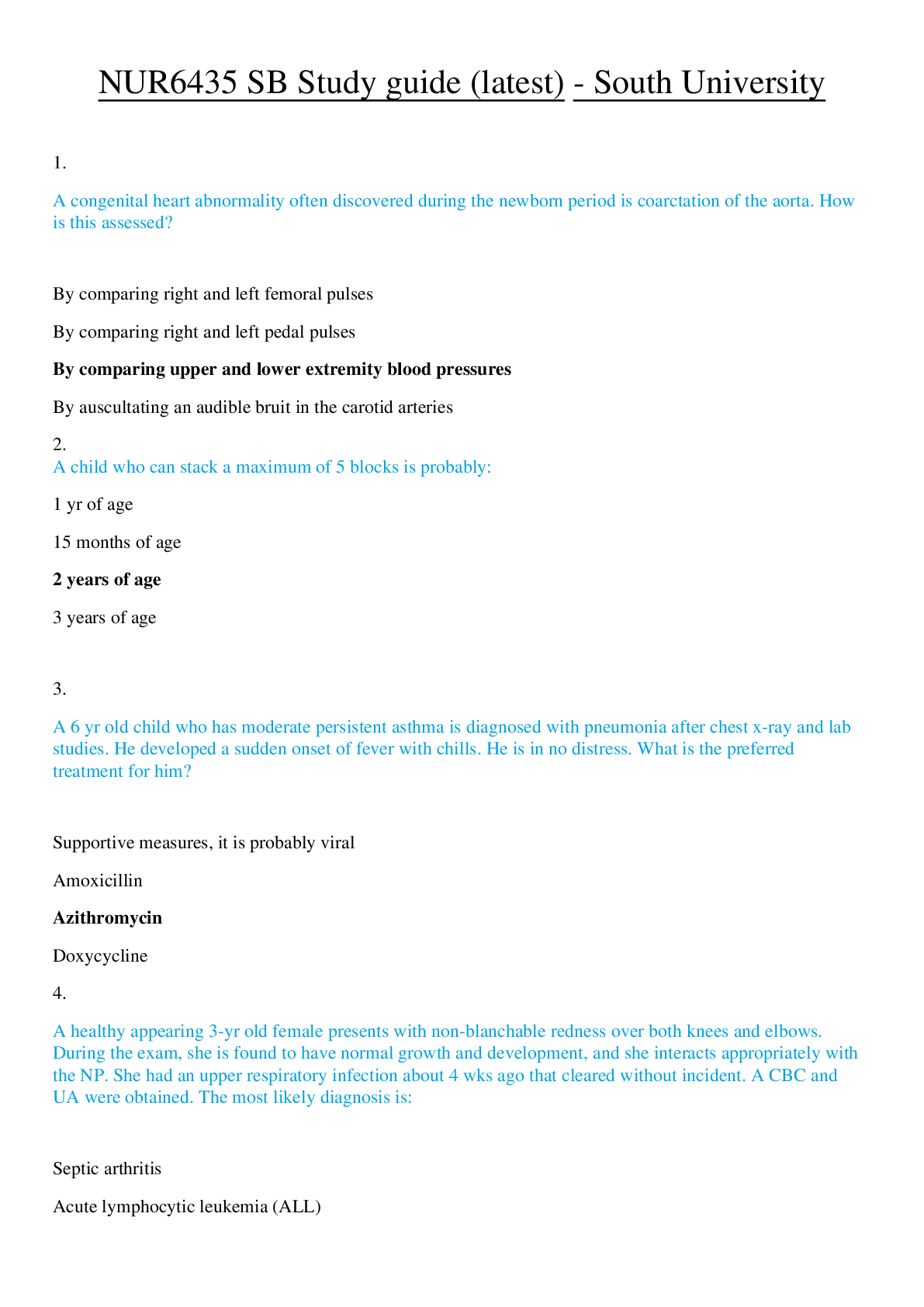
A congenital heart abnormality often discovered during the newborn period is coarctation of the aorta. How is this assessed?
By comparing right and left femoral pulses
By comparing right
...
NUR 6435 SB STUDY GUIDE
1.
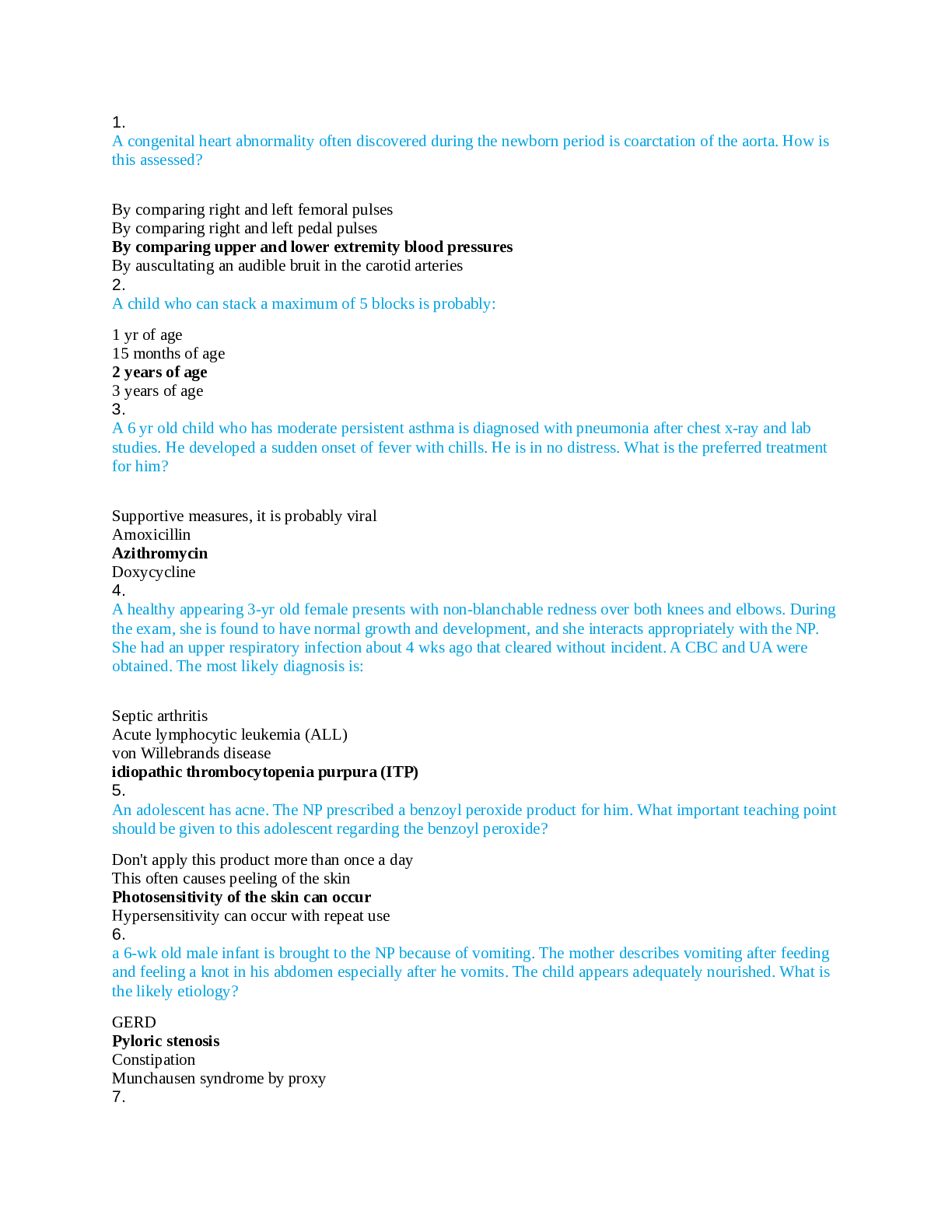
A congenital heart abnormality often discovered during the newborn period is coarctation of the aorta. How is this assessed?
By comparing right and left femoral pulses
By comparing right and left pedal pulses
By comparing upper and lower extremity blood pressures
By auscultating an audible bruit in the carotid arteries
2.
A child who can stack a maximum of 5 blocks is probably:
1 yr of age
15 months of age
2 years of age
3 years of age
3.
A 6 yr old child who has moderate persistent asthma is diagnosed with pneumonia after chest x-ray and lab studies. He developed a sudden onset of fever with chills. He is in no distress. What is the preferred treatment for him?
Supportive measures, it is probably viral
Amoxicillin
Azithromycin
Doxycycline
4.
A healthy appearing 3-yr old female presents with non-blanchable redness over both knees and elbows. During the exam, she is found to have normal growth and development, and she interacts appropriately with the NP. She had an upper respiratory infection about 4 wks ago that cleared without incident. A CBC and UA were obtained. The most likely diagnosis is:
Septic arthritis
Acute lymphocytic leukemia (ALL)
von Willebrands disease
idiopathic thrombocytopenia purpura (ITP)
5.
An adolescent has acne. The NP prescribed a benzoyl peroxide product for him. What important teaching point should be given to this adolescent regarding the benzoyl peroxide?
Don't apply this product more than once a day
This often causes peeling of the skin
Photosensitivity of the skin can occur
Hypersensitivity can occur with repeat use
6.
a 6-wk old male infant is brought to the NP because of vomiting. The mother describes vomiting after feeding and feeling a knot in his abdomen especially after he vomits. The child appears adequately nourished. What is the likely etiology?
GERD
Pyloric stenosis
Constipation
Munchausen syndrome by proxy
7.
Which suggestion below is the standard for treating iron deficiency anemia in infants and children?
Iron supplements in divided doses between meals with orange juice
Iron supplements once daily with the largest meal
Meat >5 servings per week with citrus juice
Iron supplement with orange juice 5 times per week
8.
A young child has developed a circumferential lesion on her inner forearm. It is slightly raised, red and is puritic. It is about 2.5 cm in diameter. This is probably related to:
Impetigo
the child's new cat
juvenile rheumatoid arthritis
A psoriatic lesion
9.
A 7-yr old entered clinic 1 month ago. There was no evidence that he had any immunizations. He was given the vaccinations listed on his vaccination record at the time of his visit. if he returns today, which immunizations can he receive?
Hep B, Td, Hib, polio, MMR
Hep B, Td, IPV, MMR, varicella
IPV only
Hep B, DTaP, IPV, MMR
10.
What would be appropriate anticipatory guidance for the parent of a 9-month old infant?
Discuss weaning from bottle
Keep syrup of ipecac in case of accidental poisoning
Your baby should be able to say 10 words before age 1 year
Stranger anxiety will develop by 1 year of age.
11.
An infant is diagnosed with diaper dermatitis. Satelite lesions are visible. This should be treated with a:
Moisture barrier like zinc oxide.
Topical anti-fungal agent.
Topical anti-bacterial agent.
Low potency steroid cream
12.
The NP sees a child who reports fatigue and presents with purpura on his lower extremities. His temperature is normal. The differential includes:
Anemia
Abuse
Acute Leukemia
Kawasaki syndrome
13.
Genetics
Nutrition
Prenatal/ environmental factors
Family/ community
Cultural factors
5 factors influencing development
14.
Nutrition
#1 thing most important in child's growth and development
15.
Height
Skin
Hair
Eye color
Biological potentials at conception
16.
Growth
An increase in size of the whole or its parts
17.
Development
Function or the gradual process of change and differentiation from simple to complex
18.
Teratogen
Any substance, an agent, or a process that interferes with normal prenatal development, causing the formation of one or more developmental abnormalities in the fetus
19.
Autocratic
Family pattern with strict rules and regulations
20.
Patriarchal
Family pattern that male dominated
21.
Matriarchal
Family pattern that's female dominated
22.
Democratic
Family pattern where everyone has a say
23.
Nuclear family
Married man and women with biological kids
24.
Social contract and cohabitation
Made up of man and woman living together without legal commitment but sharing roles and responsibilities
25.
Single parent family
Occurs by divorce, death, separation, abandonment, or choice; more common in recent years; typically one adult performs role of two adults
26.
Blended ( reconstituted)
Arises when divorced adults remarry and bring together children from prior relationships
27.
Erick Erickson
Psychosocial development theorist, psychoanalyst
28.
Sigmond Freud
Psychosexual development theorist
29.
Jean Piaget
Cognitive development theorist
30.
Extended family
Consists of nuclear plus additional family members living in the same household, provides a sharing of responsibilities
31.
Homosexual
Involves same sex partners living together with shared responsibilities
32.
Adoptive
Consists of usually traditional nuclear family members,husband, wife and adoptive child
33.
Gradfamilies
Children living in households headed by their grandparents; biological parents may or may not be involved in the child's care
34.
Foster
Responsible for care, supervision and nurturing of children in their charge
35.
Basic trust v mistrust
Ericksons; infancy birth - 1 yr
36.
Autonomy v shame and doubt
Ericksons; toddler 1-3
37.
Initiative v guilt
Ericksons; preschool 4-6
38.
Industry v inferiority
Ericksons; school age 7-11
39.
Identity v role confusion
Ericksons; adolescence 12-19
40.
Intimacy v isolation
Ericksons; young adulthood 20-44
41.
Generativity v stagnation
Ericksons; middle adulthood 45-65
42.
Ego integrity v despair
Ericksons; late adulthood 65+
43.
Mood swings
Acting out behavior
Change in eating or sleeping patterns
Frequent stomachaches, headaches, or other unexplained somatic symptoms
Excessive clinging to parents
Thumb sucking
Bed wetting
Return to behavior typical of an earlier stage of development
Common signs of stress is children
44.
male- Tanner stage I
no pubic hair, penis and testes same size as childhood
45.
Male-Tanner stage 4
coarse curly pubic hair as like adult, penis enlarges and rugae appear to scrotum
46.
earliest age child able to copy triangle, know colors and count on fingers
5 yrs
47.
earliest age avg child would appropriately receive paper and scissors with rounded points
4 yrs
48.
usual age for vision screening
3 yrs
49.
female Tanner stage 4
projection of areola & nipple form secondary mound above level of breast
50.
Female - Tanner stage 5
Projection of nipple only
51.
14 yr old male- acute painless swelling of groin. which tool will yield the most info
U.S. of scrotum
52.
Age of precocious puberty
less than 9 yrs male & female
53.
avg age of pubertal growth spurt in american boys
12-14
54.
Female - Tanner stage II
Breast buds
55.
12 yr old male, hip pain w/ activitiy, worsening, involves knee, no trauma, ?In office eval?
Trendelenburg test
56.
Trendelenburg test used to id
slipped capital femoral epiphysis
57.
what age should oral health risk assessment begin?
6 mo
58.
4 yr child not allergic to chickens but allergic to duck feathers, immunizations contraindicated?
None contraindicated
59.
child can walk backwards
18 months
60.
child can stand on one foot
3 yrs
61.
Can stack 5 blocks
2 yrs
62.
child can stack 3 blocks
18 monhts
63.
Positive support reflex ceases after
6 months
64.
In school aged child (6-12)___considered tachycardia
130
65.
Normal heart rate 60-100 after age
10
66.
Male-First sign of sexual maturation
increase in testicular size
67.
Male- average age of sexual maturation
13
68.
delayed puberty
female-after 13
male-after 14
69.
Most common cause of delayed puberty
1.constitutional delay
2.turners(girl) gonadal dygenesis
70.
to eval for hip dysplasia
0-3 mo-ortolani & barlow
>4 mo-glezzi & klissic
71.
6mo male-palpable cystic mass in scrotum, size varies
referral to urology if not resolved by age 1 yr.
72.
6 mo- disconjugate gaze- tilts head when looking at object
will have abnormal cover/uncover test
73.
Should be avoided in ITP
Aspirin
74.
Intussception can follow?
Viral illness in a child.
75.
NOT a sign of congenital hypothyroidism
frequent stools
76.
Adolescent -wt loss, chronic diarrhea, anemia, weakness
Ulcerative colitis
77.
Describe the s/s of small and large VSDs
small:
-often aysmptomatic
-detected as systolic murmur
-initially untreated to allow spontaneous closure.
-risk of infective endocarditis d/t turbulent flow
large:
-presents within days or weeks following birth
-tachycardia, tachypnea (compensation for decreased CO)
- manifestations of heart failure
-dyspnea (d/t pulmonary congestion)
-difficulty feeding (tire easily) and delayed growth
-late cyanosis (shunt reversal if untreated)
78.
Acynotic heart murmur d/t increased pulmonary flow
ventricular septal defect
79.
Pauciarthritis
(most common subgroup of juvi-idiopathic arthritis)
Pain in 4 or less joints
80.
side effects of ADHD meds
wt loss, insomnia, irritability, delayed puberty
81.
Parents/guardian of adolescents should receive health guidance
at least twice during adolescent yrs
82.
Age of onset of irritable bowel disease
15-25yrs
83.
characteristics of infant with bronchopulmonary dysplasia
hypoxemia on RA
84.
child with insulin pump is more likely to experience
-improved glycemic control
-increased interest in disease
-more frequent self-check
85.
palpable thrill in L upper sternal border
Pulmonic valve stenosis
86.
Which heart defect produces a systolic ejection click at the upper left sternal border with a thrill palpated at the upper left sternal border?
Pulmonic stenosis (1229)
87.
sit before standing is example of
cephalocaudal development
88.
Maternal iron stores are depleted by
4-6 months
89.
In adolescents with IBD, it is important to monitor
Linear growth
Skeletal development
puberty changes
90.
What are important thing to monitor in patient taking corticosteroids to control inflammation in IBD?
reduces immunity
fluid retention
increased blood sugars
moon face
po is hard on stomach
91.
treatment for Atypical pneumonia
Azithromycin
92.
Best tools for treating adolescents
mutual trust and pt education
93.
The adolescent growth spurt is triggered by
Estrogen and Androgen hormones
94.
Best way to screen for gonorrhea - FEMALE
Cervical culture
95.
Best way to screen for gonorrhea - MALE
UA
96.
HPV screening in female
pap & visual inspection
97.
Newborns of diabetic mothers are at risk for
hypoglycemia
98.
gardasil results in greater antibody response for adolescents who receive 3 dose series between ages
9-15
99.
VISION OF 2 YR OLD
20/70
100.
13 yr old pt with bone maturity of 10 yrs
he has room to grow
101.
treatment for delayed puberty
calcium and vit D
102.
Mother voices concern with 3 yr old stuttering
Normal characteristic of language development
103.
Eating disorders
Any age
104.
Common symptom of ASD (anterior septal defect)
fatigue
105.
Biomedical issues that may create academic performance issues
Fetal Alcohol syndrome
106.
Bipolar disease requires
Lifetime of medication
107.
•Joe, a 13 year old with asthma, developed a runny nose, coughing and wheezing on expiration. Joe takes Flovent 2 puffs BID. You would suggest he:
1. •Take an additional 2 puffs of Flovent now and BID for 2 weeks
2. •Go to urgent care immediately
3. •Drink fluids and lie down to rest
4. • Use albuterol inhaler 2 puffs now and every 20 minutes X 3
D
108.
• Janet is a 16 year old with moderate persistant asthma. She takes Advair discus 250/50 one inhalation BID in her green zone.
• Which of the following additional medications should she receive for quick relief of asthma symptoms?
• Atrovent inhaler 2 puffs every 4 hours prn
• Pulmicort 200 mcg one inhalation BID
Montelukast 10 mg po OD
A
109.
Which of the following medications would be most appropriate to intensify her controller therapy for yellow zone treatment?
A. Increase Advair 250/50 to 2 inhalations BID
B. Add Flovent 110 mcg 2 puffs BID
C. Add scheduled albuterol 4 puffs every 4 hours prn
D.Add theophylline OD
B -
ADVAIR DISKUS is a combination product containing a corticosteroid and a long-acting beta2-adrenergic agonist
110.
•When completing Beth’s physical exam which would be inconsistent with a dx of asthma?
•1. Prolonged expiratory flow time
•2. Clear breath sounds bilat.
•3. Digital clubbing
•4. Boggy, edematous nasal mucosa
3 clubbing
111.
•Beth is a 12 year old with suspected asthma. Which of following findings in her hx would support this dx?
A. Wakes up at night coughing
B. Midsternal burning after meals
C. Breaths hard when running the mile
D. Snores loudly at night
A
112.
ASTHMA
•Definition-Chronic inflammation of the airways characterized by bronchial hyperresponsiveness following airway triggersàinflammation and edema of airway mucosal lining, increased mucous production and bronchospasmàmay lead to airway obstruction
113.
ASTHMA DDx
• Cystic fibrosis
• Immunodeficiency
• Sinusitis
• Exercise hyperventilation
114.
Asthma
Clinical Manifestations
•Increased work of breathing (WOB), inspiratory/expiratory wheezing, cough-especially at night, children complain of not getting enough air
•Cough without wheezing most common presentation in children
•Degrees of asthma-
–(Mild-term no longer used) Intermittent asthma
–Normal pulmonary function tests, no hospitalizations or ER visits, regular attendance at school, wheezing less than 2x per week, treatment consists of prn B-agonists (no more than 2 days per weekàICS’s)
•Usually no interference with daily activities
•Example-Exercise induced asthma
•Exercise induced asthma-symptoms resolve 30-60 minutes after exercise ends
115.
Physical Assessement
• Lung sounds-wheezing, lack of breath sounds-air is not moving through the lung passages at all
• Retractions= increased WOB
• Cyanosis
• Increased respiratory rate
116.
Pulmonary function tests
• Used to determine the degree of pulmonary fx-PFTs
• Peak Expiratory Flow Readings (PEFR)
– The highest air flow that can be created when the child forcefully blows out after fully inflating their lungs
– These should be done initially when the child is well to determine their “personal best”
117.
Degrees of Asthma
Mild persistent sypmtoms 2x/week but less than 1x/day
Moderate persistent-severe- daily Sx. incr ER visits
118.
Mild Persistent Asthma-
•sxs occur more than 2x per week but less than once a day, may miss school, occasional ER visits, few hospitalizations, pulmonary function are usually normal but may decrease with sxs, require low-dose inhaled steroids plus albuterol
•Awakes at night with symptoms more than once a week
•Minor interference with daily activities
119.
Moderate Persistent/
Severe Asthma
•Daily symptoms, many ER visits, daily use of B-agonists due to cough and wheezing, missed school due to sx’s, require medium dose inhaled steroids and long acting beta agonist
•Severe Persistent Asthma-continuous sxs, activity is limited, many hospitalizations and ER visits, may require systemic steroids, high dose inhaled steroids and long acting B-agonists
•Both should be followed by an asthma specialist
120.
Diagnose asthma
•History-when do the sxs occur (time of day, season of the year, after exercise, during an URI, family hx, pets or smokers in the house
–In those <5 yrs, viral illness is most common trigger
•Asthma is difficult to dx but should be considered when the child coughs more at night, has known allergies, family hx of atopy, chronic URIs
121.
O2 Sats
•Monitor oxygen saturations-should be above 95%
–90-95%=trouble
–Below 90%-child needs evaluation
–Blood gases may be required in ED/hospitalization
122.
Therapeutic Mgmt
•Primary Goal-Prevent attacks and maintain normal pulmonary function with the least amount of medication through education
•(1)Monitor pulmonary function tests
•(2)Eliminate environmental allergens-vacuum, avoid carpets, no pets/ stuffed animals, use mattress covers, decrease humidity in the house, don’t use vaporizers, keep windows shut, use AC, no smoking, check for cock roaches
•(3) Long term pharmacotherapy to prevent airway obstruction
•(4) Develop and implement a comprehensive parent/child education program
123.
Asthma not controlled if:
–Do you use rescue inhaler >2x/week?
–Do you fill the prescription for rescue medication >2x/year
–If yesànot under control
–Dx=persistent asthma
124.
Rescue medications
quick relief
B Agonist -SABA - Albuterol use prn RT increased risk of death if used too often. If used daily --child needs Rx maintenance med.
Oral = increased side effects.
125.
Anticholinergics
Atrovent: Ipratropium bromide - decreases vasoconstrictions but SE= blurred vision cardiac and CNS stimulation.
126.
Inhaled Corticosteroids
• NIH “ICS are the most potent and effective long-term control medications”
May be used as short term or long term meds-depends on the route
Compliance is a problem-side-effects
–Growth velocity
–Facial edema
–Inhaled steroids do affect growth during the first 6-1 yr of treatment-Childhood Asthma Management Program
127.
Inhalers by age group
• Infants
–Budesonide Inhalation (Pulmicort)
–Fluticasone (Flovent)
Children
–Budesonide Inhalation
–Fluticasone (Flovent)
–Beclomethasone (Qvar)
–Flunisolide (Aerobid)
–Triamcinolone (Azmacort)
–
128.
LABA
long acting B2 Adrenergic Agonists
•Salmeterol DPI (Severent diskus) –safety in children < 4 ?
•Formoterol DPI (Foradil)-safety in children <5 ?
•2009-FDA-bans use of both medications for the treatment of asthma in children
•Advair and Symbicort-OK for use in children
129.
Which of the following asthma medications contains a blackbox warning for usage in regards to increased risk of asthma-related deaths
Advair and symbicort are long acting beta agonists plus a steroid
May increase bronchospasm and death-should not be first line treatment when taken without ICS;
130.
Long acting medications
•Leukotriene Inhibitors/receptor antagonists(Singulair)-used to treat mild-moderate asthma-use when inhaled steroids are ineffective
•Bronchodialators-long term-Serevent-no longer advised
131.
Metered dose inhaler - AGE?
ok for 3 years and over
132.
Aerochamber MDI
allows sloww deep inhalation don't use if can't use properly.
133.
Status Asthmaticus
•Children continue to display symptoms after repeated treatments
•Medical Emergency->respiratory failure & death
•May require intubation and PICU admission
•Child will require continuous nebulized treatments, O2 theapy, IV fluids
•Causes-pneumonia, noncompliance with medical regime, lower SES and minority populations
134.
Otitis Externa
•Inflammation of external canal or auricle
•Risk factors
–Excessive ear cleaning
–Swimming
–Hearing aids, headphones, diving caps
135.
OE pathogens
•Most common pathogens-P. aeruginosa and stap aureus
•Diagnosis-clinical diagnosis
•Symptoms-otalgia, discharge, hearing loss, puritis, pain with tragal pressure and/or pain when auricle is pulled up
136.
Otitis externa RX TX
•Remove cerumen and purulant material –may need to irrigate in the office
•Keep canal clean
•Pain control
•Topical antimicrobials-ideal choice is one that contains the following-a steroid, an antibiotic, should be acidic and is an antiseptic
–Cipro HC-BID
–Cortisporin
–Tobradex
–Pred-G
–Systemic antibiotics rarely needed
–To prevent OE instill Acetic acid (vinegar) after swimming
137.
Acute Otitis Media- Prevalence/incidence
•82 % or more children will have at least one ear infection
•Most common age-6-24 months
•Commonly follows a URI
•May be decreasing in incidence because of the Hib (little effect) and PCV vaccines, the AAP’s diagnostic guidelines developed in 2004, & CDC’s recommendations re: prescribing antibiotics when diagnosis is uncertain
•15 million prescriptions written each year
138.
Pathogen Acute Otits Media
•Etiology-most common cause is
hemophilus influenzae, strep pneumoniae, and Moraxella catarrhalis
•Viruses-many respiratory viruses associated with AOM
•May have combined bacterial and viral etiologies
•Risk Factors-daycare, bottle feeding, exposure to tobacco smoke, pacifer use, family history, genetic factors, ethnicity (higher in native Americans, Eskimos)
139.
AOM physical exam
•Physical exam-bulging TM, decreased mobility of eardrum(insufflation), ear pain, hearing loss, otorrhea
–Other symptoms-fever, irritability, decreased po intake, headache, vomiting and diarrhea
140.
Eustachian Tube
Tympanic Membrane
The middle ear area is connected to the nose by the Eustachian Tube. Whenever there is a negative pressure behind the eardrum because the Eustachian tube is blocked or not working well, the eardrum is sucked or "retracted"(pulled) backwards
we ask the child to perform a "Valsalva Maneuver" by holding his/her breathe and then tightening the body (as if one were pushing to have a bowel movement). This maneuver increases the pressure in the middle ear space behind the eardrum, and the problem is usually resolved.
On a practical note, we can get similar types of symptoms when we experience pressure changes typically occurring during airplane travel.
141.
Diagnose AOM
Physical exam
•1.” Recent, usually abrupt onset of signs and symptoms of middle ear inflammation and effusion
•AND
•2. The presence of middle ear effusion that is indicated by any of the following:
•Bulging of the tympanic membrane
•Limited or absent mobility of the tympanic membrane
•Air fluid level behind the tympanic membrane
•Otorrhea
•AND
•Signs or symptoms of middle ear inflammation as indicated by either:
–Distinct erythema of the tympanic membrane OR
–Distinct otalgia (discomfort clearly referable to the ear(s) that results in interference with or precludes normal activity or sleep”
–AAP
142.
OM with Effusion TX?
•Otitis media with effusion most common
•No decongestants or antihistamines
•Treatment for pain-
–Ibuprofen, Auralgan, Tylenol
•Treatment-controversial but antibiotics are still commonly prescribed
–30% of antibiotics prescribed in US were for OM
–809 prescriptions per 1,000 visits
143.
1st line Tx AOM
•treatment-Amoxicillin 80-90mg/kg/day
–Exceptions-Use of amoxicillin in the last 30 days
–Concurrent bacterial conjunctivitis
–Children receiving amoxicillin for recurrent UTI’s or AOMs
–PCN allergy-consider Erythromycin plus sulfisoxazole
–Azithromycin, Clarithromycin
–Trimethoprim-sulfamethoxazole
–10 day therapy unless otherwise specified
144.
AOM tx failure next?
•No improvement after 72 hours of antibiotics
–Consider Amoxicillin-clavulanate (80-90 mg/kg), cefuroxime, cetriaxone
–European study-uncomplicated OM resolves without antibiotics in 75-80 % of the cases
–**It may take 2-6 weeks for TM mobility to return
145.
Risk factors of Acute Otitis Media include_____, ______ and ____________.
•daycare, bottle feeding, exposure to tobacco smoke
146.
Conductive Hearing loss
•Conductive hearing loss-
–Normal bone conduction
–Sound waves are obstructed through the canal, middle ear and inner ear
147.
Conductive hearing loss Physical Exam- Weber-
Rinne-
Physical exam
•Weber-laterlizes to affected ear
•Rinne test-abnormal in affected ear
148.
causes of SensoriNeural
inner ear causes
•Hereditary hearing loss
•Congenital
•viral infections
•Congenital malformations
•Meningitis
•Ototoxic drugs
•Otologic surgery
•Noise exposure
•Barotrauma
•Penetrating trauma
•Acoustic neuroma
•Meningioma
149.
Sensori Neural loss
Weber
Rinne
•Weber-lateralizes to unaffected ear
•Rinne test-normal in affected ear
150.
Hordeoleum
•Purulant infection of the eyelid
•May be internal or external
–Internal-infection of the meibomian gland
–External-stye-arises from eyelashes
•Often caused by Staphylococcus aureus
151.
Management: Hordeolum
•Differential-Staph infection of the sebaceous glands, pediculosis of the eyelid, Blepharitis, Chalezion
•Management-Warm compresses 4 X per day (`15minutes each time)
•No improvement after 2 weeksàrefer to opthamalogy for incision and curettage
152.
DDx Hordeolum
•-Staph infection of the sebaceous glands, pediculosis of the eyelid, Blepharitis, Chalezion
153.
Chalazion
•Chronic inflammation of the meibomian gland
•Begins with redness and swellingàpainless nodule (may be painful)
•More common in those with blepharitis or rosacea
154.
Blepharitis
refers to inflammation of the eyelids, particularly at the lid margins. It's a common disorder and may be associated with a low-grade bacterial infection or a generalized skin condition
155.
chalazion mgmt
•Management
–May resolve spontaneously over weeks or months
–Warm compresses may help drain chalzion
–Clean with 1/2 strength baby shampoo
–May need to refer for incision and curettage
156.
Conjuctivitis- RED EYE
•Inflammation of the conjunctiva
•Very common problem in childhood
•Always consider the diagnosis of conjunctivitis when you see a red eye with discharge
•Usually benign condition
•Easily treated in primary care
157.
Conjunctivitis
inflammation of palpebral or bulbar conjunctiva caused by local infection of bacteria or virus, allergic reaction, systemic infection, chemical irritation
red, thick sticky discharge on eyelids in morning
158.
Viral conjuctivitis
•Often due to adenovirus-more common in school aged children
•Often occurs with URI or viral syndrome
•Highly contagious
•Symptoms-watery discharge, burning, may have crusting but it isn’t purulant, eyes feel gritty
159.
Allergic Conjunctivitis
Itchy, red, watery eyes with a history of allergies/atopy. Typically is bilateral with cobblestone papillae inside the lids.
Treatment: avoidance of allergen, topical glucocorticoids, antihistamines, avoidance of allergen, topical vasoconstrictor
160.
Gonococcal conjunctivitis
•Often spread from genitalia to eyes or following delivery by an infected woman
•Urethritis often present
•Symptoms-profuse drainage, redness, irritation, and tenderness, periauricular lymphadenopathy
•Medical emergency-refer to opthamology-sight-threatening potential
161.
Rx Bacterial Conjuctivitis
•Bacterial conjunctivitis
–Erythromycin opthalmic ointment (preferred in children because it stays on the lids)-1/2 inch QID for 5-7 days
–Vigamox-Instill one drop in the affected eye 3 times a day for 7 days
–Sulfa Opthamic drops-1-2 gtts QID for 5-7 days
•May burn but is an acceptable alternative
–May also consider-Bacitracin ointment, gentamycin, tobramycin
162.
PeriOrbital Cellulitis
•Most common in children
–Average age=21 months
•Periorbital (preseptal) cellulitis-infection of the eyelid without effecting the eye
–Risk factors-insect bites, trauma, bacteremia
•Common organisms-strep pneumoniae, staph aureus
163.
Orbital Cellulitis Tx
•If the orbit is not infected and child doesn’t appear toxic may treat as an outpatient
–Amoxicillin-clauvulanate-90 mg/kg/day of amoxicillin and 6.4 mg/kg/day of clavulanate in 2 divided doses (7-10 days)
–Cefpodoxine-10 mg/kg/day every 12 hours (7-10 days)
–Cefdinir-14mg/kg/day every 12 hours
–Follow-up in 12-24 hours
•If child is toxic, if a purulent wound appears near the eyelid, or if close follow-up is difficult, refer to hospital for IV antibiotics
164.
MISCELLANEOUS AIRWAY CONSIDERATIONS IN KIDS
----›DIAMETER IS SMALLER IN KIDS – E.G. ½ THE DIAMETER RESULTS IN 16X THE RESISTANCE
-----›TRACHEA IS SHORTER SO THERE IS A TENDENCY TO RIGHT MAIN STEM INTUBATE THE PATIENT
-----›KIDS HAVE LARGE TONGUES, ANTERIOR AIRWAYS
-----›OXYGEN CONSUMPTION IN KIDS 2-3X GREATER PER GIVEN WEIGHT
------›FUNCTIONAL RESIDUAL CAPACITY IS LESS
165.
Pediatric airway
• Childs airway is the size of a _____.
• Childs airway is _____ & ______
• Infants breath thru _______
•Child’s airway is shorter and narrower
•Infants airway is the size of a drinking straw
•If inflammation occurs, they can easily obstruct
•Infants are obligate nose breathers
•Airway increases in length but not width during the first 5 years of life
166.
Ped Respiratroy Assessment
Nail Clubbing
•Quality of respiratory rate-need to know normal rate
•Signs of respiratory distress-dyspnea
–Use of accessory muscles to pull in airàretractions
–Breath sounds-may be diminished, wheezing
–Stridor-high pitched harsh sound heard during respiration-due to obstruction
Nasal FLaring
Pulse ox shoudl be >95%
167.
Wet diapers/stools a day
6-8 wet diapers a day
4-8 stools/day
168.
Common cold
Sx, PE, DDx
–Sx’s-fever, nasal discharge, sore throat, conjunctivitis, cough, headache, difficulty sleeping, decreased appetite
–May also see swelling and erythema of the nasal mucosa, cervical adenopathy
–Differential-Allergic Rhinitis, bacterial sinusitis, OM
169.
Complications of the common cold
•Otitis media
•Asthma-URIs may trigger asthma exacerbation in children
•Sinusitis
•Bacterial pneumonia
170.
Pharyngitis
•rhinoviruses, coronaviruses, RSV, parainfluenza viruses
171.
Bacterial Pharyngitis
•Bacterial infection-group A beta hemolytic strep
•Common in fall and winter
•Responsible for 15-30% of sore throats in children
•Common in children b/t the ages of 5-8
•Sx’s-sudden onset of fever, sore throat, exudate on tonsils, enlarged lymph nodes, petechia on tonsils, headache, abdominal pain
•Not as likely to have cold symptoms
172.
Group A Strep
Pharyngitis - Strep throat (strawberry tongue - infected tongue)
Scarlet Fever (puerperal sepsis infection of the uterus)
Pyoderma - Pus forming lesions
Rectal Infections
Necrotizing Facciitis - AAAHHHHH!!! 50% mortality
Rheumatic Fever - Damage to heart tissue from complement adherance (15,000 deaths/ year)
Glomerulonephritis - Inflamation of the kidneys
Dont allow strep infections to go untreated
Cause disease all over body away from infection site because toxins, compliment, and antibody cross react
173.
Bacterial Pharyngitis Ddx
•Non-group A strep-Groups C or G strep
•Neisseria gonorrhoeae-may see in sexually active teens
•Viral pharyngitis
•Mycoplasma pneumonia
•Mononucleosis
•HIV infection
•Influenza
174.
Pharyngitis Ddx <3years
>6years
•Differential diagnosis-in children less than 3 years-probably viral
•Strep more common in children > 6 years of age
•Throat culture-rapid antigen detection test (10-35 % false negatives) +culture
–Don’t test for strep in children < 3years-they don’t have the ability to acquire ARF
175.
GAS Rx
•PCN-narrow spectrum, inexpensive, 10 day course
•Amoxicillin-better tasting, shorter regime-6 days, cheap-drug of choice if child also has an OM
•Augmentin-good choice for recurrent GAS
•Avoid macrolides-4-48% resistance (zpak)
•Avoid single dose ceftriaxone-failure rates of 54%
•PCN allergy/PCN tolerance-Cehphalosporins-Cephalexin, cefadroxil, cefaclor, etc
•Don’t need to culture healthy household members
•6 GAS infections in one year or 3-4 infections in each of 2 years, consider tonsillectomy
176.
Allergic Rhinnitis-MGMT RX
•Allergen avoidance
–Close windows, stay indoors, use AC
•Intranasal glucocorticoids-most effective tx with few side-effects
–Beclomethasone (Beconase, Vancenase)
–Budesonide (Rhinocort)*
–Fluticasone (Flonase)*
–Limited to no effect on growth
–Choose once daily medications to reduce risk of growth problems*
–May also prescribe anti-histamines but some cause drowsiness and/or agitation in children-What age?
–If parents prefer not to use INGCs, may prescribe Cromolyn sodium although less effective
177.
Sinusitis
xrays?
CT?
•X-rays not helpful unless maxillary sinuses involved
•CT used only if disease becomes serious
178.
Treat Sinusitis
•Amoxicillin (90 mg/kg/day) or E-mycin for 14 days
•If no improvement after 3-4 days, consider Augmentin, cefuroxime axetil, or a macrolide
•No decongestants or antihistamines
•Humidifier may be helpful
•Increase fluid intake
179.
Croup- Steeple sign
•Inflammation of the mucosal lining of larynx and tracheaànarrowing of the airwayàstridor, barking cough, retractions and hoarseness
-narrowing of trachea
180.
Laryngitis
Laryngotrachetis
Laryngotracheobronchitis
Bacterial tracheitis
Spasmodit croup
•Laryngitis=inflammation of larynx
•Laryngotracheitis (croup)-both trachea and larynx are inflammed
•Laryngotracheobronchitis-trachea, larynx and bronchi are inflamed
•Bacterial tracheitis-infection of subglottic trachea
•Spasmodic croup-onset of symptoms at night lasting a short time
181.
croup-
Viral
Bacterial causes
•Most are viral
–Parainfluenza virus type 1 (most common)
–RSV
–Adenoviruses
•Bacterial causes-
–Mild infection-mycoplasma pneumoniae
–Secondary pathogens-strep pneumoniae, S. pyogenes, staph aureus
182.
Croup most common in ages______
•Most common in children 3 mos-3 years
•Uncommon after age 6
•Increased incidence fall and winter
•Decrease in hospital admissions since the 70s
183.
Epiglottitis
•Life-threatening disorder usually seen in children b/t the ages of 2-5
•Supragottic obstruction usually due to Group A beta hemolytic strep, H. Influenzae or staph aureus
•Hib vaccine has decreased # of cases draumatically
•Sx-abrupt, high fever, sore throat, pain on swallowing, drooling r/t inability to swallow
184.
Bacterial Pneumonia Rx less than 5
•Antimicrobials
–Children less than 5-drug of choice=Amoxicillin 80-100 mg/kg/day in 3 divided doses for 7-10 days
–Allergic to PCN-Cefdinir 14 mg/kg/day in 1-2 divided doses
–May also consider Clindamycin, E-mycin, Clarithromycin or Azithromycin
185.
Bacterial Pneumo greater than 5 years
•Children over 5 years of age
–Most likely pathogens are M. pneumoniae or C. pneumoniae
–E-mycin
–Clarithromycin
–Azithromycin
–If allergic to macrolides and over 8 years consider Doxycycline
186.
Bacterial Pneumo
Hospitialize when?
•Infants 3 weeks-4 months who are febrile or hypoxic
•Hypoxemia >92%
•Dehydration
•Respiratory distress-RR > 70 in infants under 12 months or > than 50 in older children
•Respiratory distress
Chronic illness
187.
TB Sx
•Fever
•Productive cough
•Weight loss
•Malaise
•Night sweats
•Hemoptysis
textfill-fill-themecolor: text1;mso-style-textfill-fill-color:black;mso-style-textfill-fill-alpha:100.0%'>If allergic to macrolides and over 8 years consider Doxycycline
188.
Epstein Barr Virus (MONO)
Incubation 30-50 days
sypmtoms: fever, sore throat, swollen glands, lethargy
attaches to epithelial cells of pharynx (after 4-7 weeks it migrates to body)
develop lifetime immunity (stays in B cells)
treat with rest and steroid for inflammation
189.
Epstein-Barr virus (mono)
• spread through saliva
• great fatigue, sore throat, sore muscles, fever; spleen, liver, lymph node enlargement
• 3-7 week intubation period; self limiting course 4-6 weeks
• dx:
• monospot test
• antibody test- mix pt's blood with modified IgG and IgM
• erythema multiforme (rash)
• small, flat, discolored spots
190.
Mono S/Sx
•~10% have a rash
•Enlarged spleen-~50%
•Laboratory Evaluation
–CBC-WBC between 10,000 and 20,000 mm3
–+ atypical lymphocytes
–Tansient hepatitisà increased transminase levels, alkaline phosphotase & lactate dehydrogenase
–Monospot test-detects EBV
•Sensitivity of >86%
•If negative but symptoms suspiciousàrepeat
•May also check EBV titers
191.
Mono Mgmt
•Supportive
–Rest 1-2 weeks
•NSAIDs & Acetaminophen
•Splenomegaly-no contact sports for ~4-6 weeks; must also be well-hydrated and clinically asymptomatic; no splenomegaly
•Chronic fatigue
•? MS
192.
Polio vaccine given @
•Give at 2,4, 6-18months of age. Booster @ 4-6years
193.
•Parents ask the NP why their baby will receive an IM polio injection instead of the oral vaccine. The best response would be:
•
•A. The consensus is that either can be used with equal results and safety
•B. The AAP recommends the IM because it is safer
•C. The oral vaccine is more expensive so IM is preferred
•D. US Center for Infectious Disease Control recommends the IM unless the infant or family member is immunocompromised
•D. US Center for Infectious Disease Control recommends the IM unless the infant or family member is immunocompromised
194.
Tetanus DTap
•Vaccination-DTaP
•2, 4, and 6 months
•Boosters-15-18 months, 4-6 years & at 11-12 years (Tdap)
•Tdap every 10 years
•Treatment-antitoxin-not always effective
195.
whooping cough
Due to gram-negative bacterium, Bordetella pertussis
196.
Hemophilis Influenzae
•Hemophilis Influenzae-Type B-decreases the risk of meningitis, OM and epiglottitis-give at 2,4,6 months of age and b/t 12-18 months
•2009-1 dose may be given to those >5 years if high risk
197.
Meningeal signs--
tests
•Signs present in
~ 60 % of children
•+ Brudzinski’s sign
•+ Kernig’s sign-child supineàflex hip and knee at 90 degreesà cannot extend leg more than 135 degrees
198.
Enterovirus- types, routes, incubation shedding
¨Agent/Epidemiology:
¤Group A&B Coxsackie viruses, Human Enteroviruses
¨Transmission:
¤Worldwide, summer and fall, overcrowded conditions
¤Fecal-oral and respiratory routes
¨Incubation/Communicability:
¤Incubation 3-6 days
¤Viral shedding occurs weeks-months after infection
199.
Herpangina, Hand foot mouth
¨Herpangina
¤Treatment-fluids, pain relief, good hand washing
¨
Hand, Foot, and Mouth
¤Diagnosis-history and physical
¤ Exclude child from day care while blisters are present-usually ~1 week
¤Good hand washing (especially after diaper change) important to reduce the spread of virus
*Overall prognosis-good with supportive care
200.
Herpangina
• Lesions --> ulcers --> heal in 1-5 d
• Fever + Sore Throat + HA
• Epidemics
• Infants & children
• Eti
• Coxsackie A & Enterovirus
201.
What causes Hand-Foot-Mouth disease?
Coxsackie A virus
202.
Erythema Infectiosum-Fifth Disease
¨Agent/Epidemiology:
¤Human Parvo-virus B19
¤Occurs worldwide, winter and spring, *epidemics every 3-7 years, highest incident children 5-14 years
¨Transmission:
¤Respiratory secretions and blood
¨Incubation/Communicability:
¤Incubation-6-21 days
¤Communicable-No longer contagious once rash appears
¨High Risk groups:
¤Sickle cell disease-can cause acute anemia/aplastic crisis
¤Immunosuppressed (Leukemia, HIV infection, organ transplant)
¤Pregnant women-most have been exposed in the past. Usually no complications-5% of pregnancies end in miscarriage or baby is born with severe anemia
203.
Erythema Infectiosum (fifth disease)
• Human parvovirus
• Incubation 4-14 days
• Three stages: erythema on face (cheeks 1-4 days), rash on face, and becomes symmetrically distributed on upper and lower extremities (1 week), rash leaves but returns if skin is irritated
• Risk for fetus - anemia miscarriage
204.
5ths disease
Stage1 and 2
• ¨Stage 1:
¤Mild Illness
¤Fever, headache, chills, nausea, malaise
¤Lasts 2-3 days followed by symptom-free period of 1-7 days
¨Stage 2:
¤Fiery-red rash on face-giving it a “slapped face” appearance
¤Circumoral pallor
¤In 1-4 days lacelike, symmetric, maculopapular rash on trunk and spreads to extremeties
¤Not on palms or soles
205.
fifths disease Tx
Management
¨Treatment
¤Symptomatic, supportive
¤Good hand-washing
¤Child with hemolytic conditions may need transfusion (If aplastic crisis)
¤IVIG in immunosuppressed w/chronic infection
¤Return to school once rash is PRESENT
206.
¨The nurse is educating parents re: fifth disease. What explanation takes priority?
¨A. The child may return to school once rash present
¨B. Treatment is supportive
¨C. The rash may be precipitated by trauma, sunlight, heat or cold
¨D. The child should avoid pregnant women
D. The child should avoid pregnant women
ABC are true but not a priority. Pregnant womenà hydrops fetalis
207.
Lyme dz Tx Rx
¨Amoxicillin, Cefuroxime, or Doxycycline
¤ELD-14-21days
¤EDD-21-28 days
¤LDD-Up to 28 days
¨Children >8 years-Doxycycline or Tetracycline
¨May need IV antibiotics if disseminated disease occurs
¤Up to 28 days (for arthritis, carditis, meningitis)
¨Fever Management-non ASA
¨Standard precautions
¨Avoid sun exposure if on Doxy
¨Promote rest
208.
Kawasaki disease (KD)
-Children, boys
-No diagnostic test
-High fever, rash, red eyes/ lips/ mouth, swollen glands
- Symptoms spontaneously resolve 1-3 wks
-Small/medium vessels, coronary arteries
209.
Kawasaki Disease(KD)
¨Usually a self-limiting systemic inflammatory disease/multisystem vasculitis
¨Agent/Epidemiology
¤Not spread person to person however, seasonal outbreaks and geographic factors(Asian/Pacific Island) suggest infectious process??
¤Exaggerated immune response
¤50% of cases < 2 years
¤80% of cases < 5 years
¨Lasts~12 days without treatment
¨Most concerned about cardiac complications
¨Leading cause of Acquired heart disease in children!!
210.
¨Leading cause of Acquired heart disease in children?
Kawasaki disease
211.
Kawasaki disease stage 1
¨Stage One:
¤Acute stage, lasts 1-2 weeks
¤High fever > 5 days
¤Irritability, hyperemic conjunctivae, red throat
¤Swollen hands, feet, unilateral cervical lymph nodes
¤Maculopapular or erythema multiforme rash(trunk, perineal area)
¤Diarrhea
¤Hepatic dysfunction
¤Often confused with other diseases!!
212.
Kawasaki Dz
stage 2 and 3
¨Stage Two
¤Subacute stage, lasts 2-4 weeks
¤Cracking lips and fissures
¤Desquamation of the skin on tips of fingers and toes
¤Joint pain
¤Cardiac disease and thrombocytosis
¨Stage Three
¤Convalescence, lasts 6-8 weeks afterwards
¤Child normal but lingering signs of inflammation
213.
Kawasaki dz Diagnosis
High fever (>102.2) of unknown source > 5 days
plus at least 4 of the following principle features:
Eyes:
Bilateral bulbar conjunctivitis-No exudate
Skin/Mucous membranes:
Intense erythema of buccal and pharyngeal surfaces
Dry, swollen, cracked, fissuring lips and strawberry tongue
Erythema of palms or soles, edema of hands or feet (acute phase)
Desquamation (convalescent phase)
Erythematous maculopapular rash of trunk
Lymph nodes:
Cervical lymphadenopathy (at least one lymph node >1.5 cm in diameter) Frequently unilateral
214.
Kawasaki rash
Rash in groin
215.
Hand swelling
Kawaski dz
216.
nonexudative conjuctivitis
kawasaki dz
217.
strawberry tongue
Kawasaki dz
218.
A 3 year old with KD is admitted to the hospital for fever. The nurse knows that the following tx will be started to shorten the fever and decrease the risk of complications?
A. High dose ASA therapy
B. IV antibiotics
C. IV steroids
D. IVIG
D. IVIG
[Show More]