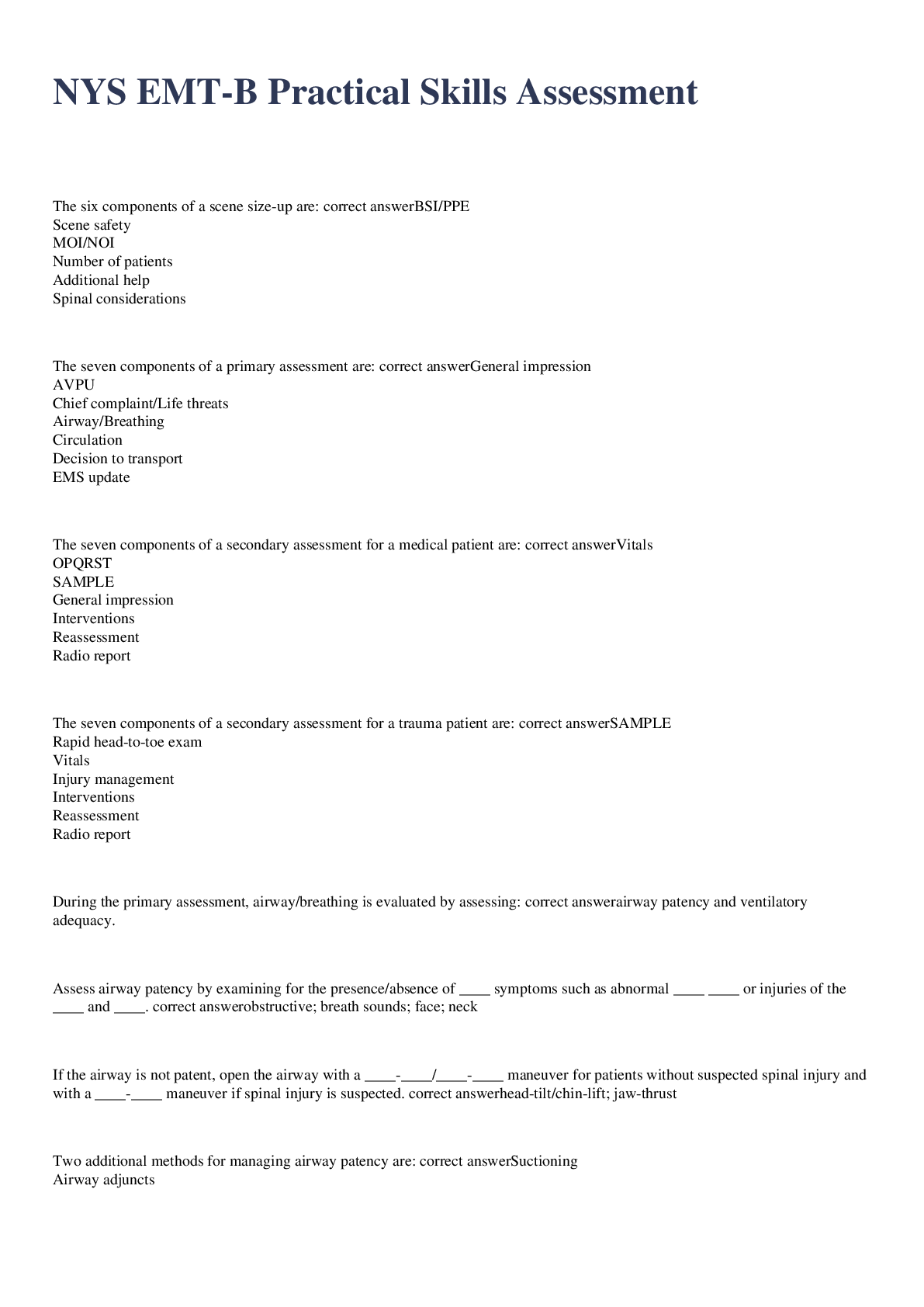
The six components of a scene size-up are:
BSI/PPE
Scene safety
MOI/NOI
Number of patients
Additional help
Spinal considerations
The seven components of a primary assessment are:
General impression
AVPU
C
...
The six components of a scene size-up are:
BSI/PPE
Scene safety
MOI/NOI
Number of patients
Additional help
Spinal considerations
The seven components of a primary assessment are:
General impression
AVPU
Chief complaint/Life threats
Airway/Breathing
Circulation
Decision to transport
EMS update
The seven components of a secondary assessment for a medical patient are:
Vitals
OPQRST
SAMPLE
General impression
Interventions
Reassessment
Radio report
The seven components of a secondary assessment for a trauma patient are:
SAMPLE
Rapid head-to-toe exam
Vitals
Injury management
Interventions
Reassessment
Radio report
During the primary assessment, airway/breathing is evaluated by assessing:
airway patency and ventilatory adequacy.
Assess airway patency by examining for the presence/absence of ____ symptoms such as abnormal ____ ____ or injuries of the ____ and ____.
obstructive; breath sounds; face; neck
If the airway is not patent, open the airway with a ____-____/____-____ maneuver for patients without suspected spinal injury and with a ____-____ maneuver if spinal injury is suspected.
head-tilt/chin-lift; jaw-thrust
Two additional methods for managing airway patency are:
Suctioning
Airway adjuncts
Assess breathing by looking for adequate ____ ____/____ and feeling for ____ ____.
chest rise/fall; air movement
If breathing rate and/or depth are insufficient, ____ ____ can be provided via the following three means:
supplemental oxygen
Nasal cannula at 6L/min
Nonrebreathing mask at 15 L/min
Bag-valve mask at 15 L/min
During the primary assessment, circulation is evaluated by assessing:
pulse quality, external bleeding, and skin condition.
During a rapid trauma assessment, assess the mouth for ____ ____.
oral trauma
During a rapid trauma assessment, assess the nose for ____ ____.
singed hairs
During a rapid trauma assessment, assess the nose and ears for leakage of ____ or ____.
blood; CSF
During a rapid trauma assessment, assess the neck for ____ or ____ ____.
JVD; tracheal deviation
While palpating the thorax, have the patient ____ to check for ____ ____.
breath; flail segments
[Show More]