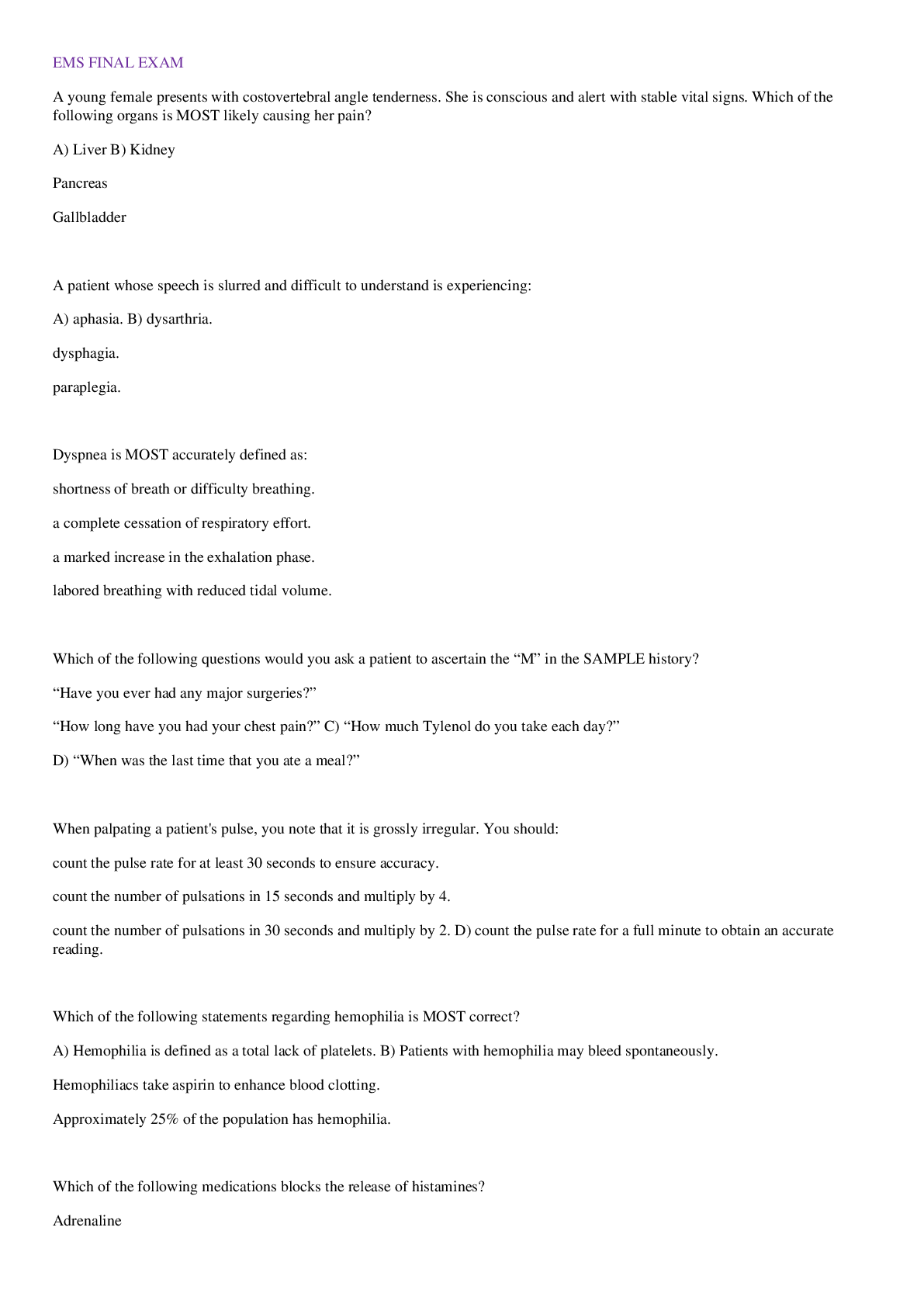
EMTs should wear high-effficiency particulate air (HEPA) respirators when they are in contact with patient who have which of the following?
tuberculosis (TB)
You are called to assist a 60-year old female who comp
...
EMTs should wear high-effficiency particulate air (HEPA) respirators when they are in contact with patient who have which of the following?
tuberculosis (TB)
You are called to assist a 60-year old female who complaints of a severe headache. Upon entering the home, you smell a strong odor of natural gas. What is your first action?
Remove the patient from the house to your ambulance.
The most common electrical rhythm disturbance that result in sudden cardiac arrest is called
ventricular fibrillatoin.
Which of the following is the highest priority patient?
57-year-old male with chest pain and systolic blood pressure of 80
Of the following, which body fluid has the most potential to transmit blood-borne diseases?
amniotic fluids
Your patient is an 11-month-old female. how can you determine if she has a decreased mental status and is responsive to verbal stimuli?
She will attempt to locate her parents' voice when they speak.
What is the best method to assess circulation in an infant?
Palpate the brachial pulse.
A 45-year-old male is experiencing chest discomfort. After placing him in the position of comfort, Your next action should be to
administer oxygen by non-rebreather mask at 15 L/min.
Which patient should receive a rapid trauma survey to determine hidden injuries?
alert 2-year-old child in a car seat who was in a medium-speed crash
Which of the following is a sign of increased pressure in the circulatory system?
distended jugular veins
An AED will shock which of the following rhythms?
ventricular fibrillation
To assess the motor function in the lower extremities of a responsive patient, you would
ask the patient to wiggle his toes.
Which patient can safely receive only a focused physical examination rather than rapid trauma assessment?
20-year-old female who complains of severe pain in her ankle after stepping off a curb
You are using the OPQRST acronym to assess a responsive medical patient. What question would you ask to assess the P component?
What makes the pain worse or better?
What is the first step in the physical assessment of an unresponsive medical patient?
Perform the initial assessment.
Which patient needs a detailed physical examination?
35-year-old female who has been in a single car collision and who briefly lost consciousness
Where is a detailed physical exam typically performed?
in the ambulance during transport
[Show More]