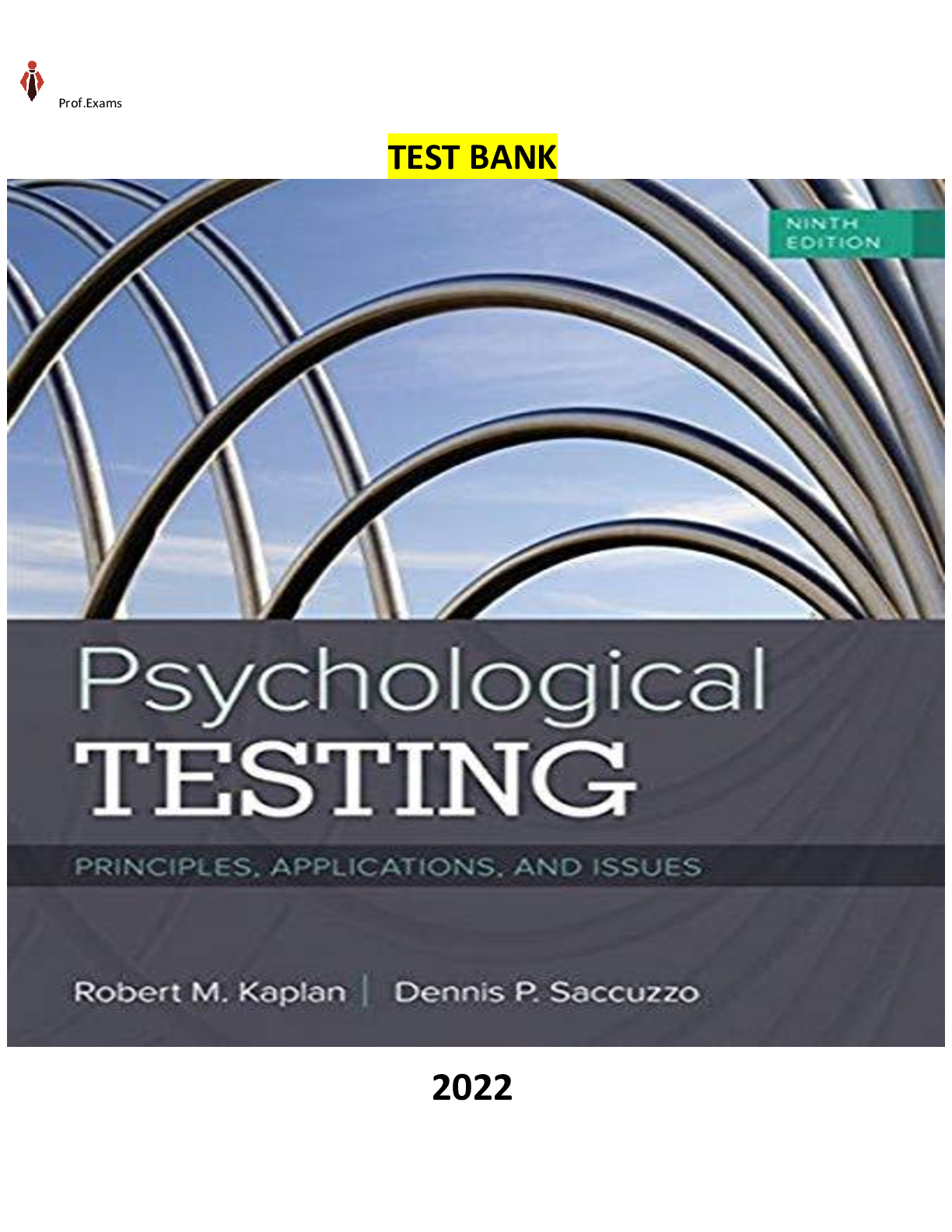
COMPLETE - Elaborated Test Bank for Psychological Testing-Principles, Applications, and Issues 9Ed.by Robert M. Kaplan & Dennis P. Saccuzzo. ALL Chapters 1-21 Included and updated for 2023
COMPLETE - Elaborated Test
...
COMPLETE - Elaborated Test Bank for Psychological Testing-Principles, Applications, and Issues 9Ed.by Robert M. Kaplan & Dennis P. Saccuzzo. ALL Chapters 1-21 Included and updated for 2023
COMPLETE - Elaborated Test Bank for Psychological Testing-Principles, Applications, and Issues 9Ed.by Robert M. Kaplan & Dennis P. Saccuzzo. ALL Chapters 1-21 Included and updated for 2023
Part I: PRINCIPLES.
1. Introduction.
2. Norms and Basic Statistics for Testing.
3. Correlation and Regression.
4. Reliability.
5. Validity.
6. Writing and Evaluating Test Items.
7. Test Administration.
Part II: APPLICATIONS.
8. Interviewing Techniques.
9. Theories of Intelligence and the Binet Scales.
10. The Wechsler Intelligence Scales: WAIS-III, WISC-IV, and WPPSI-III.
11. Testing in Education: Tests of Ability in Education and Special Education.
12. Standardized Tests in Education, Civil Service, and the Military
13. Applications in Clinical and Counseling Settings.
14. Projective Personality Tests.
15. Computers and Basic Psychological Science in Testing
16. Testing in Counseling Psychology. 17. Testing in Health Psychology and Health Care.
18. Testing in Industrial and Business Settings.
Part III: ISSUES.
19. Test Bias.
20. Testing and the Law
21. Ethics and the Future of Psychological Testing.
SAMPLE QUESTIONS
1. According to recent research, growing numbers of four-year colleges are not relying on the SAT test partly because
of
a. budget constraints.
b. diversity concerns.
c. reliability issues.
d. quality control.
ANSWER: b
2. Psychological tests
a. pertain only to overt behavior.
b. always have right or wrong answers.
c. do not attempt to measure traits.
d. measure characteristics of human behavior.
ANSWER: d
3. The specific stimulus on a test to which a person responds overtly is called a(n)
a. overt event.
b. answer.
c. item.
d. scale.
ANSWER: c
4. An individual test
a. involves a single examiner for two or more subjects.
b. involves only tests of human ability.
c. can be given to only one person at a time.
d. involves more than one examiner for a single subject.
ANSWER: c
5. A group test
a. can be given to multiple people by one examiner.
b. can be given to only three people at a time.
c. involves a group of examiners for a single subject.
d. involves only tests of human ability.
ANSWER: a
Copyright Cengage Learning. Powered by Cognero. Page 1
Name: Class: Date:
Chapter 01: Introduction
6. Previous learning can best be described as
a. achievement.
b. aptitude.
c. intelligence.
d. ability.
ANSWER: a
7. The potential for learning a specific skill can best be described as
a. achievement.
b. aptitude.
c. intelligence.
d. ability.
ANSWER: b
8. One’s general potential, independent of prior learning, can best be described as
a. achievement.
b. aptitude.
c. intelligence.
d. ability.
ANSWER: c
9. Achievement, aptitude, and intelligence can be encompassed by the term
a. human potential.
b. human traits.
c. human personality.
d. human ability.
ANSWER: d
10. Structured personality tests
a. require you to produce something spontaneously.
b. require you to choose between two or more alternative responses.
c. involve an ambiguous test stimulus about which the response is structured.
d. involve an ambiguous test response.
ANSWER: b
Copyright Cengage Learning. Powered by Cognero. Page 2
Name: Class: Date:
Chapter 01: Introduction
11. The main purpose of psychological testing is to evaluate
a. covert behavior.
b. individual differences.
c. personality traits.
d. overt behavior.
ANSWER: b
12. Projective personality tests
a. provide a statement, usually of the self-report variety.
b. require the subject to choose between two or more alternative responses.
c. are unstructured.
d. are structured.
ANSWER: c
13. Tests that measure an individual’s typical behavior are called
a. ability tests.
b. personality tests.
c. intelligence tests.
d. group tests.
ANSWER: b
14. Tests that provide a statement, usually of the self-report variety, and require the subject to choose between two or
more alternative responses, are called
a. group tests.
b. individual tests.
c. structured personality tests.
d. projective personality tests.
ANSWER: c
15. Personality tests in which the test stimulus and/or required response are ambiguous are called
a. projective personality tests.
b. structured personality tests.
c. individual personality tests.
d. achievement personality tests.
ANSWER: a
Copyright Cengage Learning. Powered by Cognero. Page 3
Name: Class: Date:
Chapter 01: Introduction
16. Which of the following is true of tests?
a. Tests produce explicit data that are subject to scientific study.
b. Tests are successful in separating prior learning from potential for learning.
c. Very few tests can actually predict behavior.
d. Tests can provide insight into overt but not covert behavior.
ANSWER: a
17. Which of the following relates raw test scores to theoretical or empirical distributions?
a. Transforms
b. Reliability
c. Scales
d. Theories
ANSWER: c
18. The general potential to solve problems, adapt, and profit from experience is called
a. ability.
b. achievement.
c. prediction.
d. intelligence.
ANSWER: d
19. Which of the following is the most important function of testing?
a. To determine what sort of treatment or other intervention is appropriate
b. To develop accurate portraits of individuals
c. To discriminate among related constructs
d. To differentiate among individuals taking the test
ANSWER: d
20. When you gather information through verbal interaction, you are using a(n)
a. individual test.
b. interview.
c. group test.
d. brainstorming.
ANSWER: b
Copyright Cengage Learning. Powered by Cognero. Page 4
Name: Class: Date:
Chapter 01: Introduction
21. If one can depend upon the results of a particular test to be consistently accurate, the test can be said to be
a. valid.
b. structured.
c. unambiguous.
d. reliable.
ANSWER: d
22. A test that yields dependable and consistent results is ____.
a. meaningful
b. objective
c. reliable
d. valid
ANSWER: c
23. The validity of a psychological test refers to its
a. dependability.
b. meaning.
c. objectivity.
d. fairness.
ANSWER: b
24. If a particular test “X” is designed to measure success in a particular job, and it is accurate and useful for that
purpose, then the test is said to be
a. valid.
b. structured.
c. ambiguous.
d. reliable.
ANSWER: a
25. Test administration refers to the
a. construction of the test.
b. validation of the test.
c. act of taking a test.
d. act of giving a test.
ANSWER: d
Copyright Cengage Learning. Powered by Cognero. Page 5
Name: Class: Date:
Chapter 01: Introduction
26. What evolutionary constructs did Galton apply in his book Hereditary Genius?
a. Genetics and epigenetics
b. Survival of the fittest and individual differences
c. Random differences and population variation
d. Evolution and selective breeding
ANSWER: b
27. The origins of testing can be traced to
a. Egypt.
b. England.
c. China.
d. Russia.
ANSWER: c
28. The use of test batteries was common by the time of the
a. Ling Dynasty.
b. Han Dynasty.
c. Tam Dynasty.
d. Nam Dynasty.
ANSWER: b
29. Two or more tests that are given together and relate seemingly diverse topics are called
a. structured.
b. unstructured.
c. batteries.
d. portfolios.
ANSWER: c
30. Sir Francis Galton set out to show
a. that some humans possessed characteristics that made them more fit than other humans.
b. that humans did not differ significantly from each other.
c. that life evolved on this planet partially because of individual differences among individual forms of life within a
species or type of animal.
d. that the concept of survival of the fittest was essentially incorrect.
ANSWER: a
Copyright Cengage Learning. Powered by Cognero. Page 6
Name: Class: Date:
Chapter 01: Introduction
31. The term mental test was coined by
a. Charles Darwin.
b. Sir Francis Galton.
c. Alfred Binet.
d. James M. Cattell.
ANSWER: d
32. The work of Weber and Fechner represents which foundation of psychological testing?
a. Individual differences
b. Psychophysical measurement
c. Survival of the fittest
d. Darwinian evolution
ANSWER: b
33. Which of the following scientists is credited with founding the science of psychology?
a. Herbart
b. Wundt
c. Weber
d. Cattell
ANSWER: b
34. The first version of the Binet-Simon scale was published in
a. 1896.
b. 1905.
c. 1908.
d. 1911.
ANSWER: b
35. Which test represented a major breakthrough in the measurement of cognitive ability?
a. Binet-Simon Scale
b. Sequin Form Board Test
c. Strong Vocational Interest Bank
d. Carnegie Interest Inventory
ANSWER: a
Copyright Cengage Learning. Powered by Cognero. Page 7.
[Show More]