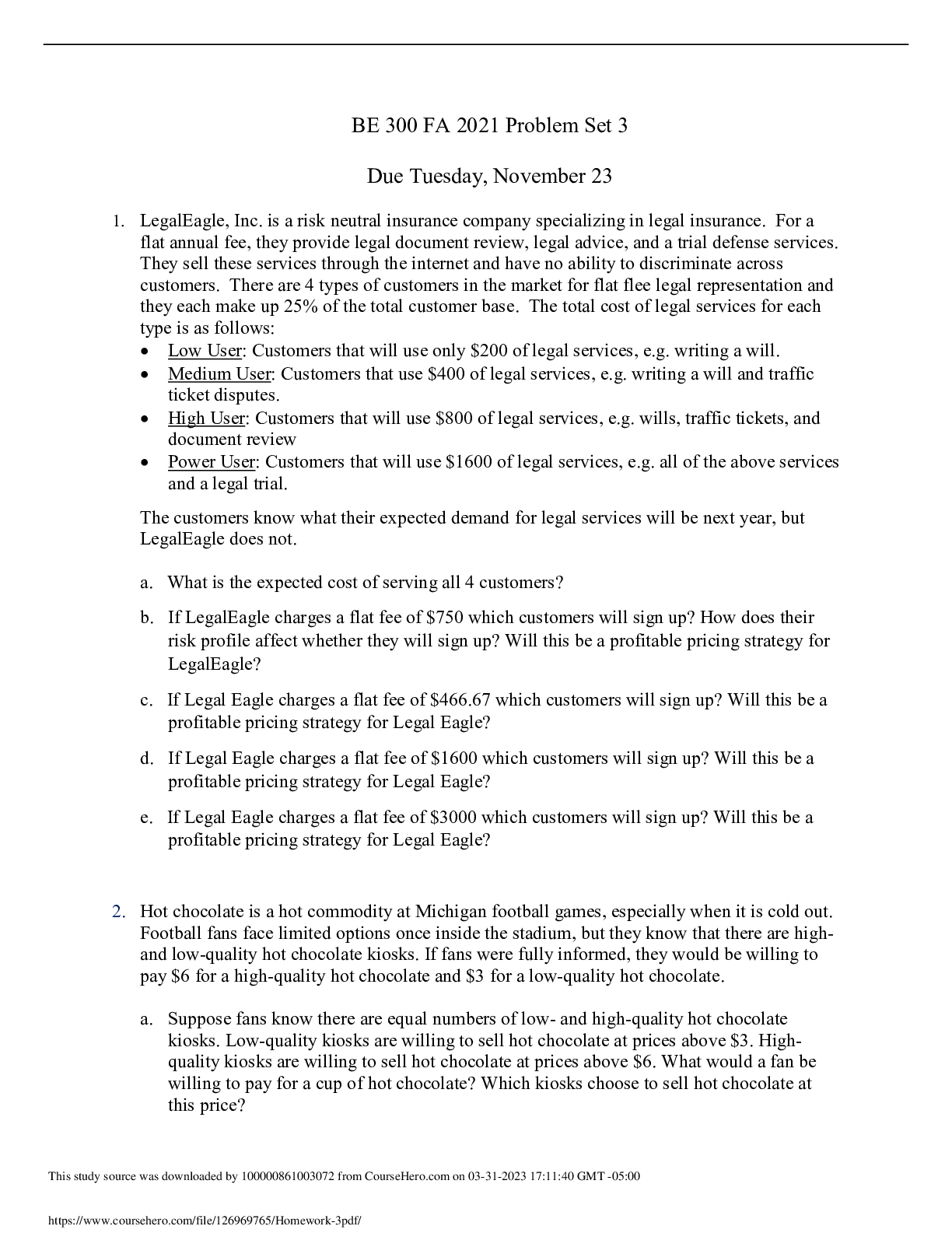
ECONOMICS 3310 - University of Texas _ BE 300 FA 2021 Problem Set 3 LegalEagle, Inc. is a risk neutral insurance company specializing in legal insurance. For a
flat annual fee, they provide legal document review, legal
...
ECONOMICS 3310 - University of Texas _ BE 300 FA 2021 Problem Set 3 LegalEagle, Inc. is a risk neutral insurance company specializing in legal insurance. For a
flat annual fee, they provide legal document review, legal advice, and a trial defense services.
They sell these services through the internet and have no ability to discriminate across
customers. There are 4 types of customers in the market for flat flee legal representation and
they each make up 25% of the total customer base. The total cost of legal services for each
type is as follows:
x Low User: Customers that will use only $200 of legal services, e.g. writing a will.
x Medium User: Customers that use $400 of legal services, e.g. writing a will and traffic
ticket disputes.
x High User: Customers that will use $800 of legal services, e.g. wills, traffic tickets, and
document review
x Power User: Customers that will use $1600 of legal services, e.g. all of the above services
and a legal trial.
The customers know what their expected demand for legal services will be next year, but
LegalEagle does not.
a. What is the expected cost of serving all 4 customers?
b. If LegalEagle charges a flat fee of $750 which customers will sign up? How does their
risk profile affect whether they will sign up? Will this be a profitable pricing strategy for
LegalEagle?
c. If Legal Eagle charges a flat fee of $466.67 which customers will sign up? Will this be a
profitable pricing strategy for Legal Eagle?
d. If Legal Eagle charges a flat fee of $1600 which customers will sign up? Will this be a
profitable pricing strategy for Legal Eagle?
e. If Legal Eagle charges a flat fee of $3000 which customers will sign up? Will this be a
profitable pricing strategy for Legal Eagle?
2. Hot chocolate is a hot commodity at Michigan football games, especially when it is cold out.
Football fans face limited options once inside the stadium, but they know that there are highand low-quality hot chocolate kiosks. If fans were fully informed, they would be willing to
pay $6 for a high-quality hot chocolate and $3 for a low-quality hot chocolate.
a. Suppose fans know there are equal numbers of low- and high-quality hot chocolate
kiosks. Low-quality kiosks are willing to sell hot chocolate at prices above $3. Highquality kiosks are willing to sell hot chocolate at prices above $6. What would a fan be
willing to pay for a cup of hot chocolate? Which kiosks choose to sell hot chocolate at
this price?
b. Suppose now that there are unequal numbers of low- and high-quality hot chocolate
kiosks and fans are still willing to pay $6 for a high-quality hot chocolate and $3 for a
low-quality hot chocolate. At these two demand levels, 50 high-quality hot chocolates
and 100 low-quality hot chocolates would be sold to fully-informed consumers
[Show More]