Physics B Module 8 Homework
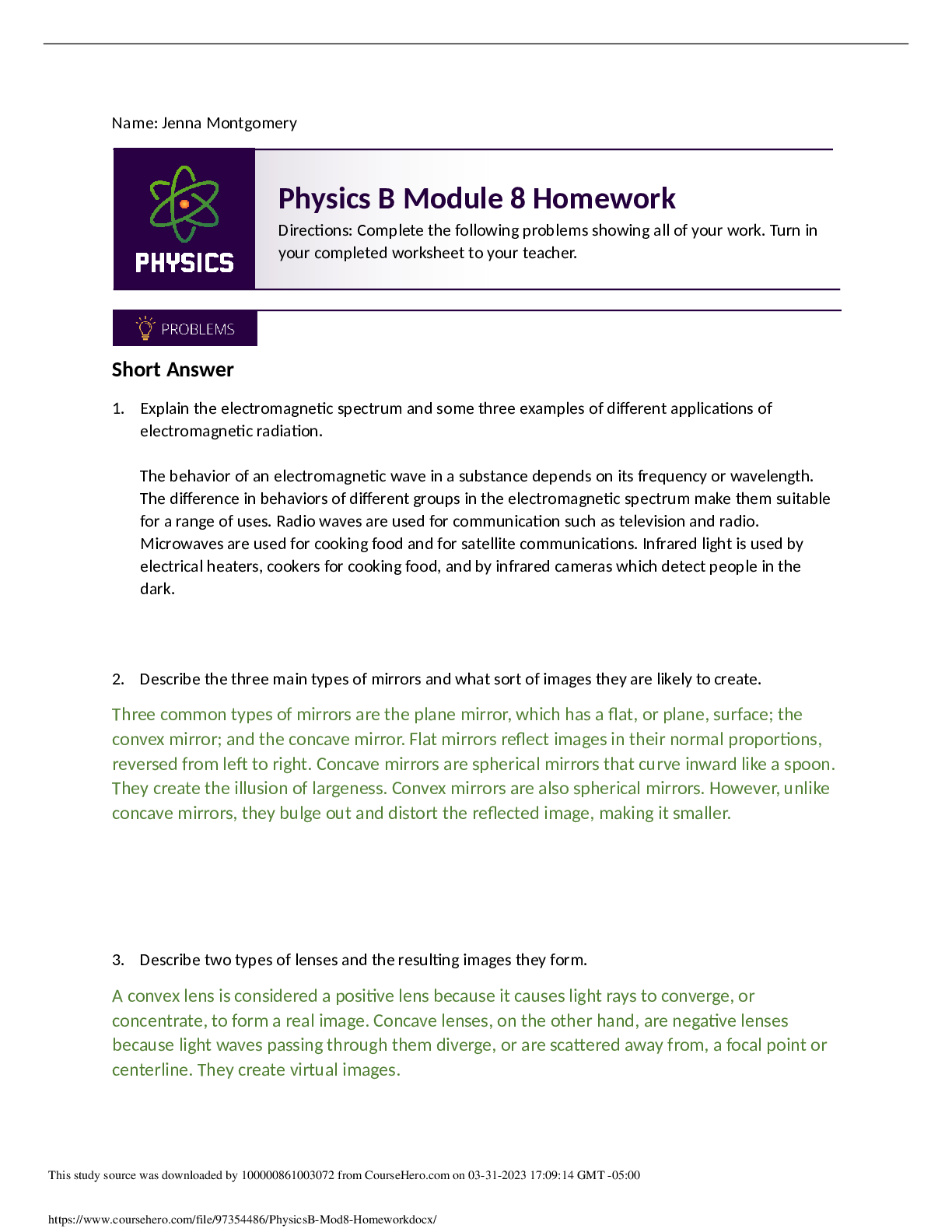
Explain the electromagnetic spectrum and some three examples of different applications of
electromagnetic radiation.
2. Describe the three main types of mirrors and what sort of images th
...
Physics B Module 8 Homework
Explain the electromagnetic spectrum and some three examples of different applications of
electromagnetic radiation.
2. Describe the three main types of mirrors and what sort of images they are likely to create.
3. Describe two types of lenses and the resulting images they form.
4. Pick your favorite temperature scale and explain why you prefer it by using logical reasoning.
5. Explain how and why thermal expansion occurs, in your own words.
6. In what situations can light bend?
7. Describe how heat is transferred between two objects.
Practice
8. A ray of light has a wavelength of 600 nanometers. What is its frequency?
9. Which characteristic distinguishes between different regimes of the Electromagnetic spectrum?
10. A ray of light passes from air (n = 1) to acrylic (n=1.3) at an angle of 20 degrees relative to the
surface. What is the angle of refraction inside the acrylic?
15.25 deg
11. A virtual image is 3 meters behind a flat mirror and it is 2 meters tall. What is the height and
distance from the mirror, for the object?
12. A concave mirror has a focal length of 1 meter. An object is 2 meters from the mirror. What is the
image distance from the mirror?
13. A lens has a focal length of -10 cm. If the image of an object is located at -20 cm, what is the
distance of the object?
14. If you view an object with binoculars, and the image appears right side up and a dozen times larger,
then what is the magnification of the binoculars?
15. Convert the temperature of 73°F to degrees Celsius and Kelvin.
16. A motor outputs 1000 J of energy in a given amount of time. 100 J is used to turn a rotor. How
much heat energy is gained by the air around the engine?
A group of physics students are playing with lasers. The laser they have decided to use emits 400 nm
wavelength of light. 17. What is the frequency of that light?
18. If the students shine the laser at a flat mirror, at an angle of 20° with respect to the surface, what
angle should they expect from the reflected ray?
19. This laser light bounces from a mirror, continues through air, n = 1.0, to a piece of glass, n = 1.5, at an
angle of 25° from the normal. What will be the lasers refracted angle inside the glass?
20. The laser then goes towards a lens, but the laser light is PARALLEL to the optical axis of the lens. The
lens has a focal point of 0.5 meters. Where will the laser light CROSS the optical axis?
[Show More]