Pharmacology and Pharmacotherapeutics in Advanced Nursing Practice
NGR6172
Chapter 1: Prescriptive Authority and Role Implementation: Tradition vs Change
o Primary Care is provided by clinicians who address "personal
...
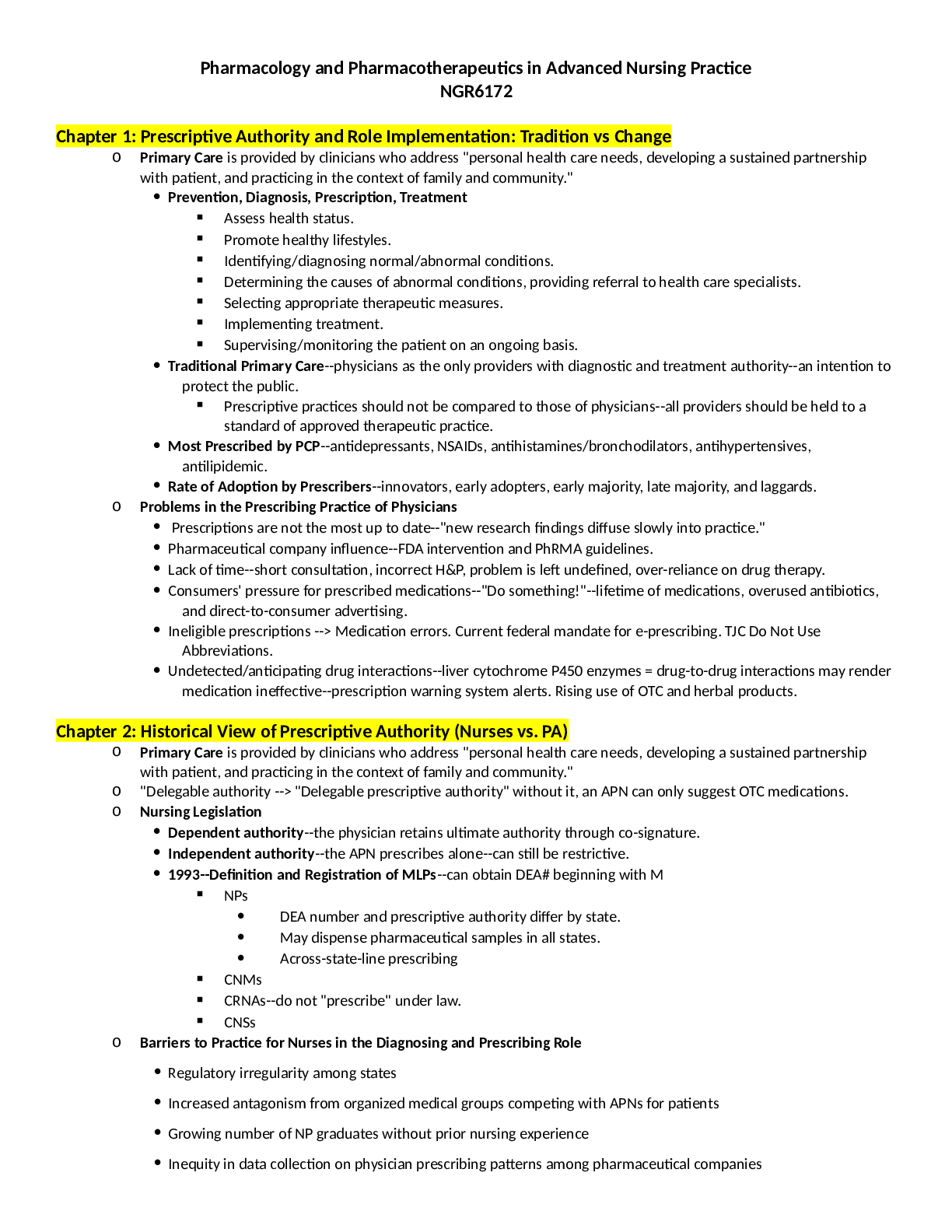
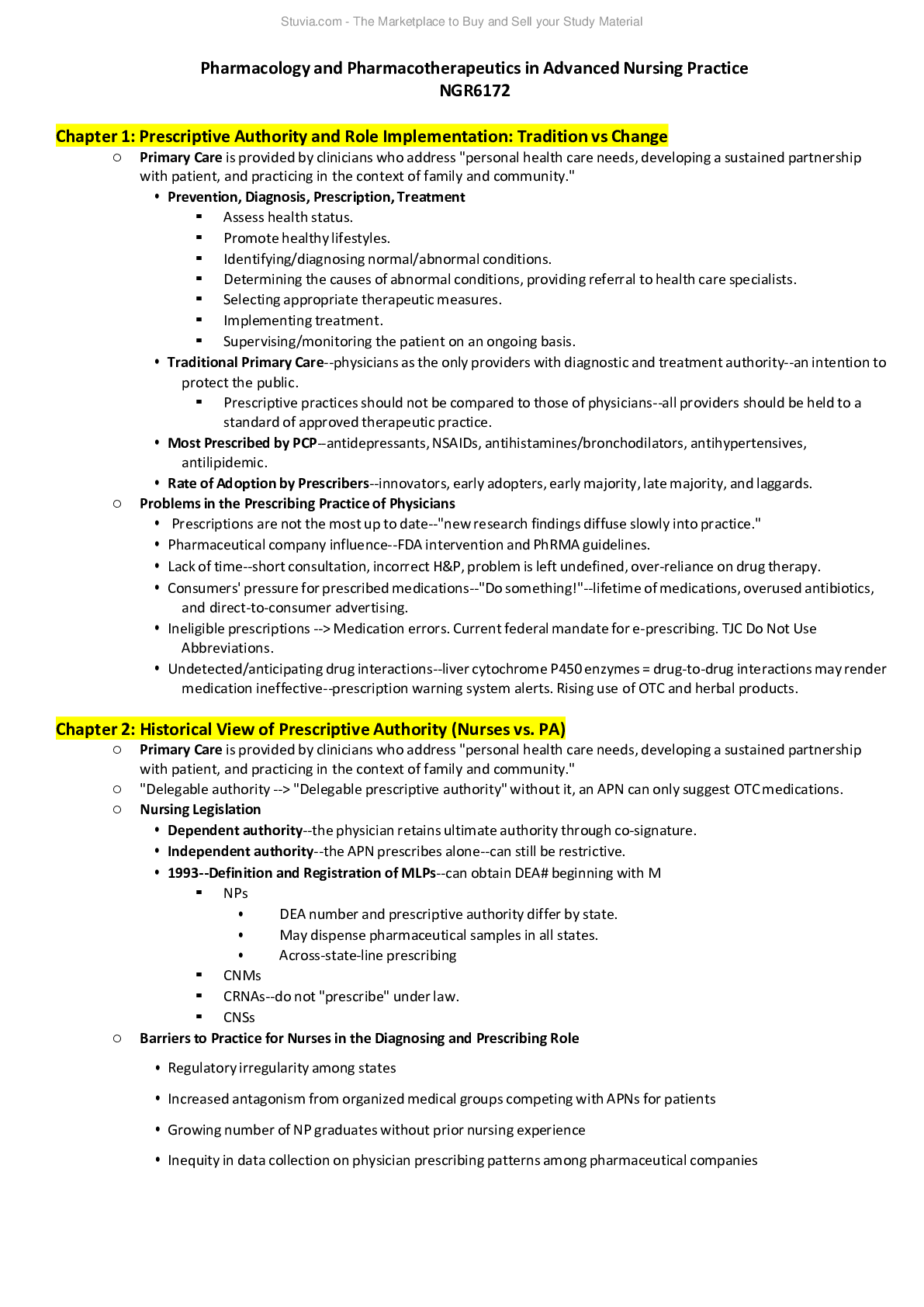
Pharmacology and Pharmacotherapeutics in Advanced Nursing Practice
NGR6172
Chapter 1: Prescriptive Authority and Role Implementation: Tradition vs Change
o Primary Care is provided by clinicians who address "personal health care needs, developing a sustained partnership
with patient, and practicing in the context of family and community."
Prevention, Diagnosis, Prescription, Treatment
Assess health status.
Promote healthy lifestyles.
Identifying/diagnosing normal/abnormal conditions.
Determining the causes of abnormal conditions, providing referral to health care specialists.
Selecting appropriate therapeutic measures.
Implementing treatment.
Supervising/monitoring the patient on an ongoing basis.
Traditional Primary Care--physicians as the only providers with diagnostic and treatment authority--an intention to
protect the public.
Prescriptive practices should not be compared to those of physicians--all providers should be held to a
standard of approved therapeutic practice.
Most Prescribed by PCP--antidepressants, NSAIDs, antihistamines/bronchodilators, antihypertensives,
antilipidemic.
Rate of Adoption by Prescribers--innovators, early adopters, early majority, late majority, and laggards.
o Problems in the Prescribing Practice of Physicians
Prescriptions are not the most up to date--"new research findings diffuse slowly into practice."
Pharmaceutical company influence--FDA intervention and PhRMA guidelines.
Lack of time--short consultation, incorrect H&P, problem is left undefined, over-reliance on drug therapy.
Consumers' pressure for prescribed medications--"Do something!"--lifetime of medications, overused antibiotics,
and direct-to-consumer advertising.
Ineligible prescriptions --> Medication errors. Current federal mandate for e-prescribing. TJC Do Not Use
Abbreviations.
Undetected/anticipating drug interactions--liver cytochrome P450 enzymes = drug-to-drug interactions may render
medication ineffective--prescription warning system alerts. Rising use of OTC and herbal products.
Chapter 2: Historical View of Prescriptive Authority (Nurses vs. PA)
o Primary Care is provided by clinicians who address "personal health care needs, developing a sustained partnership
with patient, and practicing in the context of family and community."
o "Delegable authority --> "Delegable prescriptive authority" without it, an APN can only suggest OTC medications.
o Nursing Legislation
Dependent authority--the physician retains ultimate authority through co-signature.
Independent authority--the APN prescribes alone--can still be restrictive.
1993--Definition and Registration of MLPs--can obtain DEA# beginning with M
NPs
DEA number and prescriptive authority differ by state.
May dispense pharmaceutical samples in all states.
Across-state-line prescribing
CNMs
CRNAs--do not "prescribe" under law.
CNSs
o Barriers to Practice for Nurses in the Diagnosing and Prescribing Role
Regulatory irregularity among states
Increased antagonism from organized medical groups competing with APNs for patients
Growing number of NP graduates without prior nursing experience
Inequity in data collection on physician prescribing patterns among pharmaceutical companies
Difficulty in obtaining prescribing data from Prescription Drug Marketing Act
Chapter 9: Establishing the Therapeutic Relationship
"How scientific principles are introduced in the relationship with the patient has everything to do with therapeutic success."
The balance of art and science in healthcare.
"A continuing relationship with the healthcare provider is essential in making adjustments to discover the proper therapy for
the individual."
o Identify a problem, assess it adequately, identify various potential solutions, examine he variables needed to judge
the risk/benefit ratio of the solutions, choose the most appropriate solution, and identify the effects (beneficial and
adverse) that may result from implementation of the chosen solution.
Factors of a Therapeutic Relationship
o Time--investment--particularly with the elderly--initial investment to obtain thorough H&P--cost-effective--follow
up call strengthen the relationship
o Attitude--how time is spent and what is said--"Who owns the problem?"
o Information--it may take several visits to obtain a full history
o Communication--effective two-way communication between patient and provider requires consistent commitment
to respect the others' role in the relationship.
Transference
Focus on patient, environment, and lastly, self.
Find a balance between creating uncontrolled and unfounded anxieties vs creating a false sense of equally
grounding security and reassurance.
It is implicitly understood that once a problem is presented, the provider will do their utmost to provide
the best therapy.
The therapeutic objective must be clearly stated--1) must be realistic and attainable, 2) clearly related to
the problem as defined and assessed, 3) measurable.
Be flexible, accept occasional lapses in compliance, attempt to understand the patient's point of view.
o Therapeutic Relationship Fails
Skepticism in the medical profession.
Provider main goal is pharmacoadherence.
Over or under utilization.
Therapeutic failure and increase in disease severit
[Show More]

.png)
.png)
 Questions and Answers (latest Update), All Correct, Download to Score A.png)