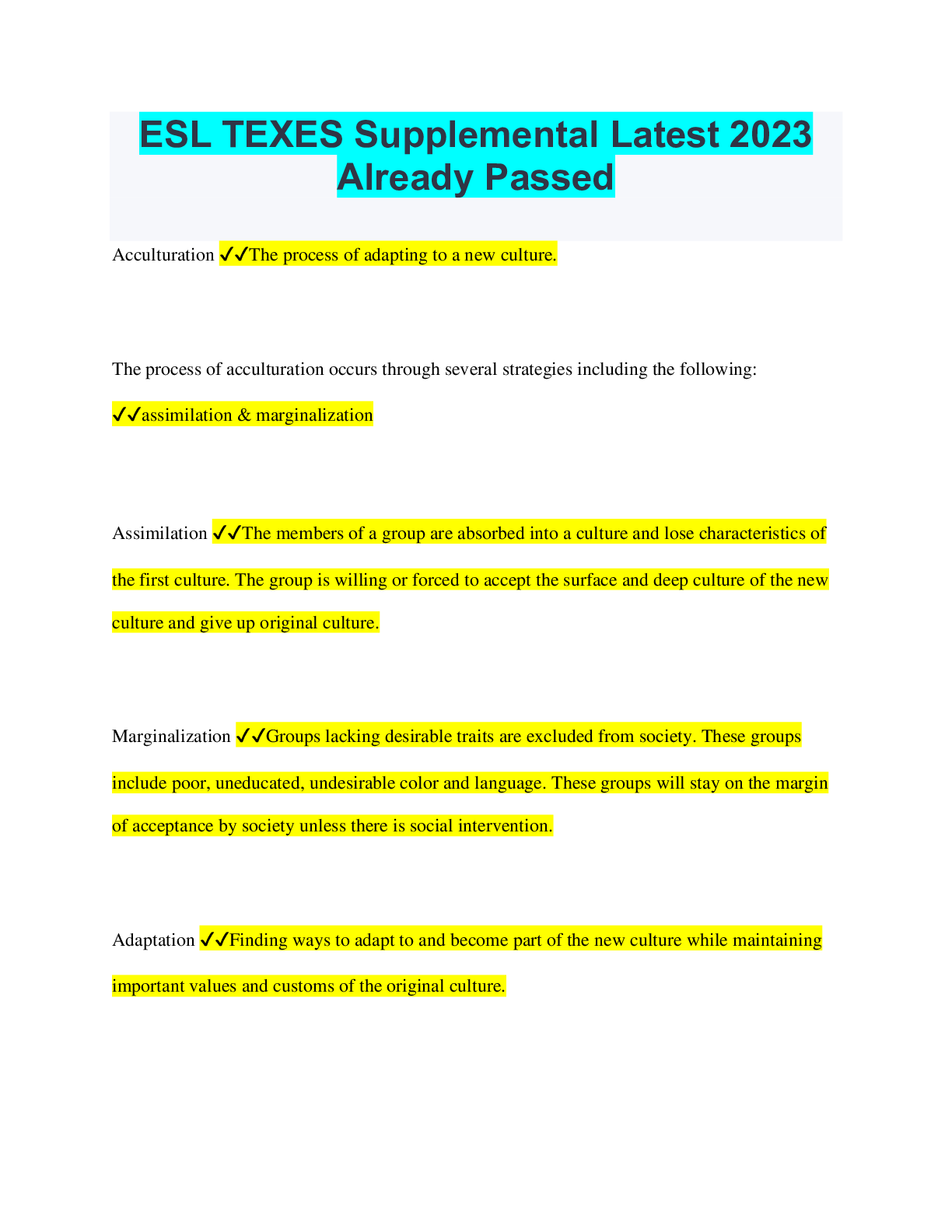
ESL TEXES Supplemental Latest 2023
Already Passed
Acculturation ✔✔The process of adapting to a new culture.
The process of acculturation occurs through several strategies including the following:
✔✔assimilation & mar
...
ESL TEXES Supplemental Latest 2023
Already Passed
Acculturation ✔✔The process of adapting to a new culture.
The process of acculturation occurs through several strategies including the following:
✔✔assimilation & marginalization
Assimilation ✔✔The members of a group are absorbed into a culture and lose characteristics of
the first culture. The group is willing or forced to accept the surface and deep culture of the new
culture and give up original culture.
Marginalization ✔✔Groups lacking desirable traits are excluded from society. These groups
include poor, uneducated, undesirable color and language. These groups will stay on the margin
of acceptance by society unless there is social intervention.
Adaptation ✔✔Finding ways to adapt to and become part of the new culture while maintaining
important values and customs of the original culture.
Affective Filter ✔✔The psychological barrier that allows input to be filtered through to a
language processing mechanism. A low filter has little anxiety increasing comprehension and
attention.
Assimilation ✔✔Deciding to become like members of the new culture, to accept their surface
and deep culture, and giving up the original culture.
Bilingual Education ✔✔An educational program in which two languages are used during
instruction in order to 1) continue primary language development, 2) provide instruction in
content in both L1 and L2, and 3) English acquisition.
BICS ✔✔(Cummins, J. 1979-1980) Basic Interpersonal Communication Skills: Skills necessary
for functioning in every day life, face-to face interactions. These skills usually take about two
years to develop in most second language learners.
Brain Laterization ✔✔Refers to functions of the left and right hemispheres of the brain which
affects language acquisition.
CALP ✔✔(Cummins, J. 1979-1980) Cognitive Academic Language Proficiency: The aspects of
language linked to literacy and academic achievement. These skills usually take five to seven
years to fully develop in Second language learners.
Chompsky, Noam ✔✔Professor Emeritus of Linguistics, MIT. He is credited with the creation of
the Theory of Generative Grammar. His naturalistic approach to the study of language affected
the philosophy of language and mind through his theory of the Language Acquistion Device. His
work influenced the works of Krashen and Terrell among others.
Cognates ✔✔Words which have a common origin. There are 3 distinct levels. They are: True
Cognate- Partial Cognate- False Cognate
True Cognate ✔✔The word is spelled the same, meaning the same, but pronunciation will be
different according to language structure of the words such as an accent mark. Example: Englishrodeo Spanish- rodeo
Partial Cognate ✔✔The word in other languages has the same origin but the spelling will differ.
The meaning will be the same but the pronunciation due to the language structure will be
different. Example: english- fragrance spanish- frangancia english- apple german apfel
False Cognate ✔✔The word in another language may have the same origin but will have
different spelling and different meaning. Pronunciation will be different. Example: English- extto go out, leave Spanish- exito- success English- embarrassed- uncomfortable Spanish
embarazada- pregnant
Cognitive Strategies ✔✔Learning strategies that are taught to promote independent learning and
higher order thinking skills.
Comprehensible Input ✔✔Language that is understood by the learner. Focuses on meaning first
and uses simplified speech.
Connotation ✔✔The implying or suggesting of an additional meaning for a word or phrase apart
from the explicit meaning.
Culture ✔✔is shared beliefs, values , and rule governed by patterns of behavior that define a
group. (Peregoy & Boyle, 2001) It includes what people know and believe, what people do, and
what people make and use.
Surface Culture ✔✔Part of culture that can be seen:
[Show More]


.png)