Neurology > QUESTIONS & ANSWERS > NUR 211 Neurological Disorders NCLEX Questions and Answers with Verified Solutions (All)
NUR 211 Neurological Disorders NCLEX Questions and Answers with Verified Solutions
Document Content and Description Below
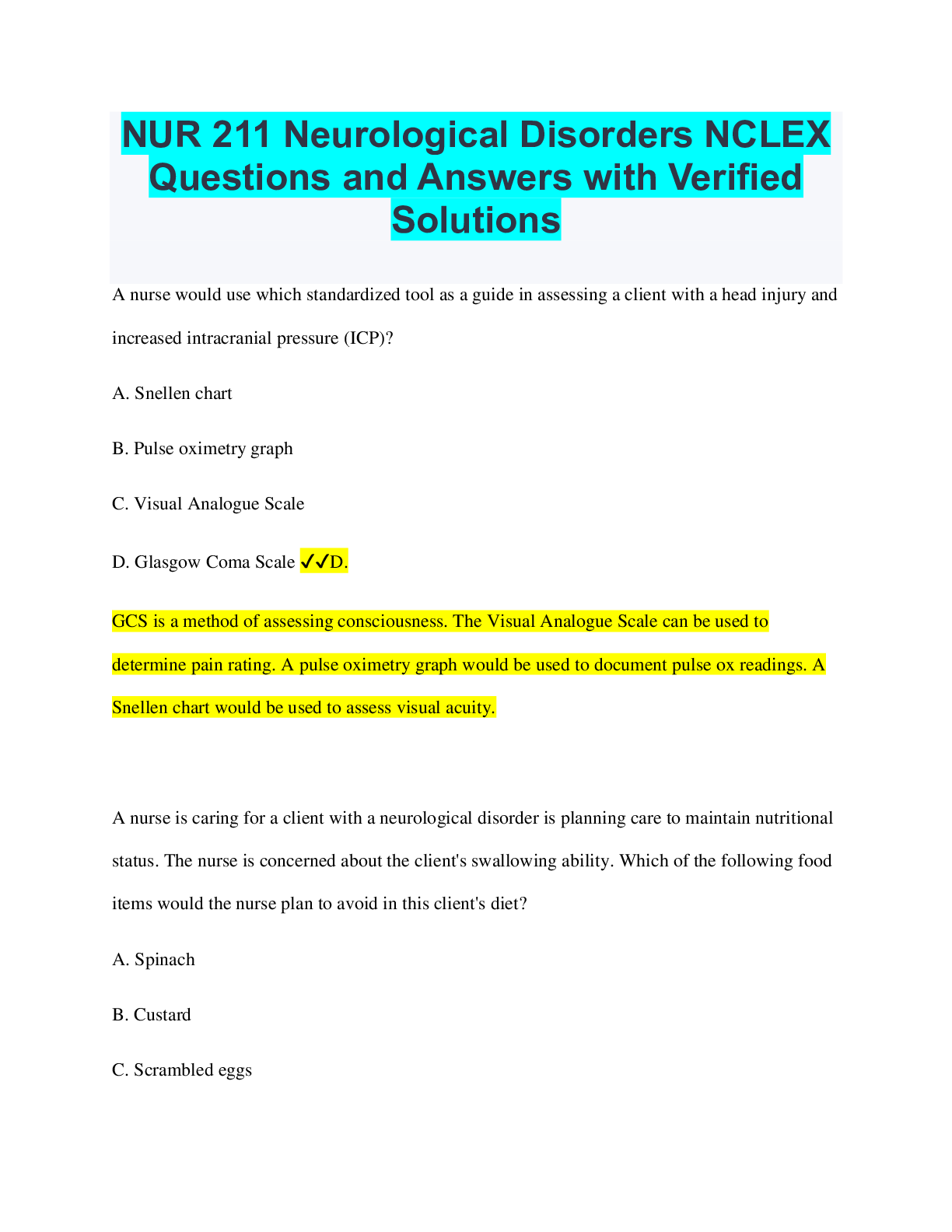
NUR 211 Neurological Disorders NCLEX Questions and Answers with Verified Solutions A nurse would use which standardized tool as a guide in assessing a client with a head injury and increased intra ... cranial pressure (ICP)? A. Snellen chart B. Pulse oximetry graph C. Visual Analogue Scale D. Glasgow Coma Scale ✔✔D. GCS is a method of assessing consciousness. The Visual Analogue Scale can be used to determine pain rating. A pulse oximetry graph would be used to document pulse ox readings. A Snellen chart would be used to assess visual acuity. A nurse is caring for a client with a neurological disorder is planning care to maintain nutritional status. The nurse is concerned about the client's swallowing ability. Which of the following food items would the nurse plan to avoid in this client's diet? A. Spinach B. Custard C. Scrambled eggs D. Mashed potatoes ✔✔A. Flavorful, warm, or well-chilled foods with texture stimulate the swallowing reflex. Soft and semisoft foods, such as custards or puddings, egg dishes, and potatoes, are usually effective Raw vegetables, chunky vegetables, such as diced beets, and stringy vegetables, such as spinach, corn, and peas are foods commonly excluded from the diet of a client with a poor swallowing reflex. A client experiences an episode of Bell's palsy and complains about increasing clumsiness. The nurse should prepare the client for which diagnostic study(ies) to determine the cause of the assessment findings? A. Serum sodium level B. Cerebral angiography C. Lumbar puncture (LP) D. Oculovestibular reflex E. Electroencephalogram F. Computed tomography ✔✔B, C, F The most sensitive and specific tests that provide relevant diagnostic information for these types of pathology are cerebral angiography, LP, and CT. The imaging studies potentially illustrate central nervous system lesions and the LP enables the care provider to analyze cerebrospinal fluid for immunoglobulins (antibodies) and other components. Because the client's neurological problem unlikely to be metabolic, the sodium level is unlikely to be helpful (option A). Usually electroencephalogram and oculovestibular reflex are tests that are reserved to evaluate electrical activity of the brain in seizure disorders and to determine brain death (options D and E). In addition, the oculovestibular reflex is not performed on a client who is conscious. A clients with Parkinson's disease is experiencing tremors, rigidity, and bradykinesia. The nurse anticipates that the physician will prescribe which medication to control these symptoms? A. Phenytoin (Dilantin) B. Carbidopa-levodopa (Sinemet) C. Pyridostigmine (Mestinon) D. Warfarin (Coumadin) ✔✔B. Carbidopa-levodopa is an antiparkinsonian agent and is used to control symptoms of Parkinson's disease. Phenytoin is an anticonvulsant and antidysrhythmic. Pyridostigmine is a cholinergic medication often used to treat myasthenia gravis. Warfarin is an anticoagulant. A client recovering from a craniotomy complains of a "runny nose". Which of the following nursing actions should be immediately implemented? A. Notify the physician B. Provide the client with soft tissues C. Monitor the client for signs of a cold D. Tell the client to use soft tissues to soak up the drainage ✔✔A. If the client has sustained a craniocerebral injury or is recovering from a craniotomy, careful observation of any drainage from the eyes, ears, nose or traumatic area is critical because this may indicate leakage of cerebrospinal fluid. Cerebrospinal fluid is colorless and generally nonpurulent, and its presence indicates a serious breach of cranial integrity. Any suspicious drainage should be reported to the physician immediately. A client is being prepared for lumbar puncture (LP). The nurse assists the client into which of the following positions for the procedure? A. Prone, in slight Trendelenburg's position B. Prone, with a pillow under the abdomen C. Side-lying, with the legs pulled up and the head bent down onto the chest. D. Side-lying, with a pillow under the hip ✔✔C. The client undergoing LP is positioned lying on the side, with the legs pulled up against the abdomen and with the head bent down toward the chest. This position helps widen the spaces between the vertebrae. A client with multiple sclerosis is experiencing muscle weakness, spasticity and an ataxic gait. On the basis of this information, the nurse would formulate which of the following nursing diagnoses for the client? A. Self-care deficit B. Risk for activity intolerance C. Impaired tissue integrity D. Impaired physical mobility ✔✔D. NANDA Impaired Physical Mobility is defined "a state in which the individual experiences a limitation of ability for independent physical movement." The client's muscle weakness, muscle spasticity, and ataxic gait meet the defining characteristics for this nursing diagnosis. The nurse is caring for a client who is in the chronic phase of brain attack (stroke) and has a right-sided hemiparesis. The nurse identifies the nursing diagnosis of Imbalanced Nutrition: less than body requirements, related to inability to feed self . Which of the following is a priority nursing intervention to help improve the client's nutrition? A. Assist the client to eat with the left hand to build strength. B. Provide a pureed diet that is easy for the client to swallow. C. Inform the client that a feeding tube will be placed if progress is not made D. Provide a variety of foods on the meal tray to stimulate the client's appetite. ✔✔A. The nurse should teach the client to use both sides of the body to increase strength and build endurance. Option B is incorrect; the question does not mention swallowing difficulty, so there is no need to puree the food. Option C is incorrect; that information would come from the physician. Option D is incorrect; the problem is not the food selection but the client's ability to eat the food independently. A client with trigeminal neuralgia asks a nurse what can be done to minimize the episodes of pain. The nurse's response is based on an understanding that the symptoms can be triggered by: A. infection or stress B. Excessive watering of the eyes or nasal stuffiness C. Sensations of pressure or extreme temperature D. Hypoglycemia and fatigue ✔✔C. Pain that accompany this neuralgia are triggered by stimulation of the terminal branches of the trigeminal nerve. Symptoms can be triggered by pressure from washing the face, brushing the teeth, shaving, eating and drinking. Symptoms also can be triggered by thermal stimuli such as a draft of cold air. The symptoms listed in the other options do not trigger the pain. The nurse makes a home-care visit to a client with Bell's palsy. Which of statement by the client requires clarification by the nurse? A. I wear an eye patch at night B. I am staying on a liquid diet C. I wear dark glasses when I go out D. I have been gently massaging my face. ✔✔B. It is not necessary for a client with Bell's palsy to stay on a liquid diet. The client should be encouraged to chew on the unaffected side. Options A, C, and D identify accurate statements related to the management of Bell's palsy. A nurse is providing medication to a client receiving Phenytoin (Dilantin). The nurse tells the client that: A. Good oral hygiene is needed, including brushing and flossing B. The daily medication dose should be taken before a scheduled serum drug level is drawn C. The medication dose may be self-adjusted, depending on side effects. D. Alcohol may be used in moderation while taking this medication ✔✔A. Gingival hyperplasia is a side effect of this medication. Therefore the client should have good oral hygiene and regular dental examinations. The post-head injury client opens eyes to sound, has no verbal response and localizes to painful stimuli when applied to each extremity. How should the nurse document the Glasgow Coma Scale (GCS) score? A. GCS= 3 B. GCS= 6 C. GCS= 9 D. GCS= 11 ✔✔C. Score of 3 is given when the client opens the eyes to sound. Localization to pain is scored as 5. When there is no verbal response the score is a 1. The total score is then equal to 9. A nurse analyzes the results of a Romberg test performed on a client with Parkinson's disease. Which finding during testing best indicates that the client has a positive Romberg test? A. Client marches in place B. Client stands quietly C. Client sways slightly D. Client begins to fall ✔✔D. [Show More]
Last updated: 2 years ago
Preview 1 out of 8 pages
Buy this document to get the full access instantly
Instant Download Access after purchase
Buy NowInstant download
We Accept:

Also available in bundle (1)
Click Below to Access Bundle(s)

Neurology NCLEX Bundled Exams Questions and Answers (2022/2023) Already Passed
Neurology NCLEX Bundled Exams Questions and Answers (2022/2023) Already Passed
By Nutmegs 2 years ago
$22
16
Reviews( 0 )
$10.00
Can't find what you want? Try our AI powered Search
Document information
Connected school, study & course
About the document
Uploaded On
Apr 14, 2023
Number of pages
8
Written in
All

Additional information
This document has been written for:
Uploaded
Apr 14, 2023
Downloads
0
Views
126




.png)