*NURSING  >  QUESTIONS & ANSWERS  >  NCLEX Neuro Review Questions with Correct Answers (All)

NCLEX Neuro Review Questions with Correct Answers

Document Content and Description Below

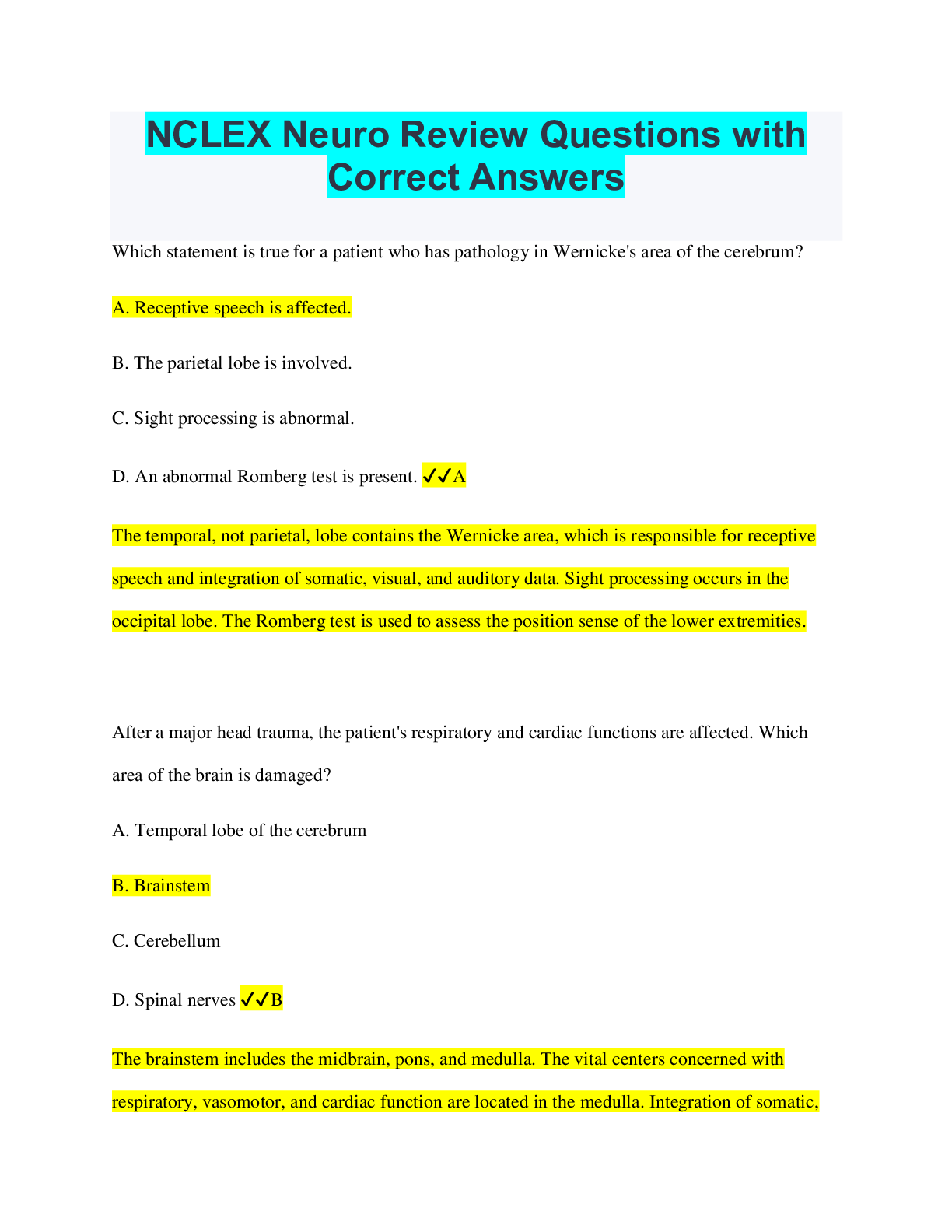
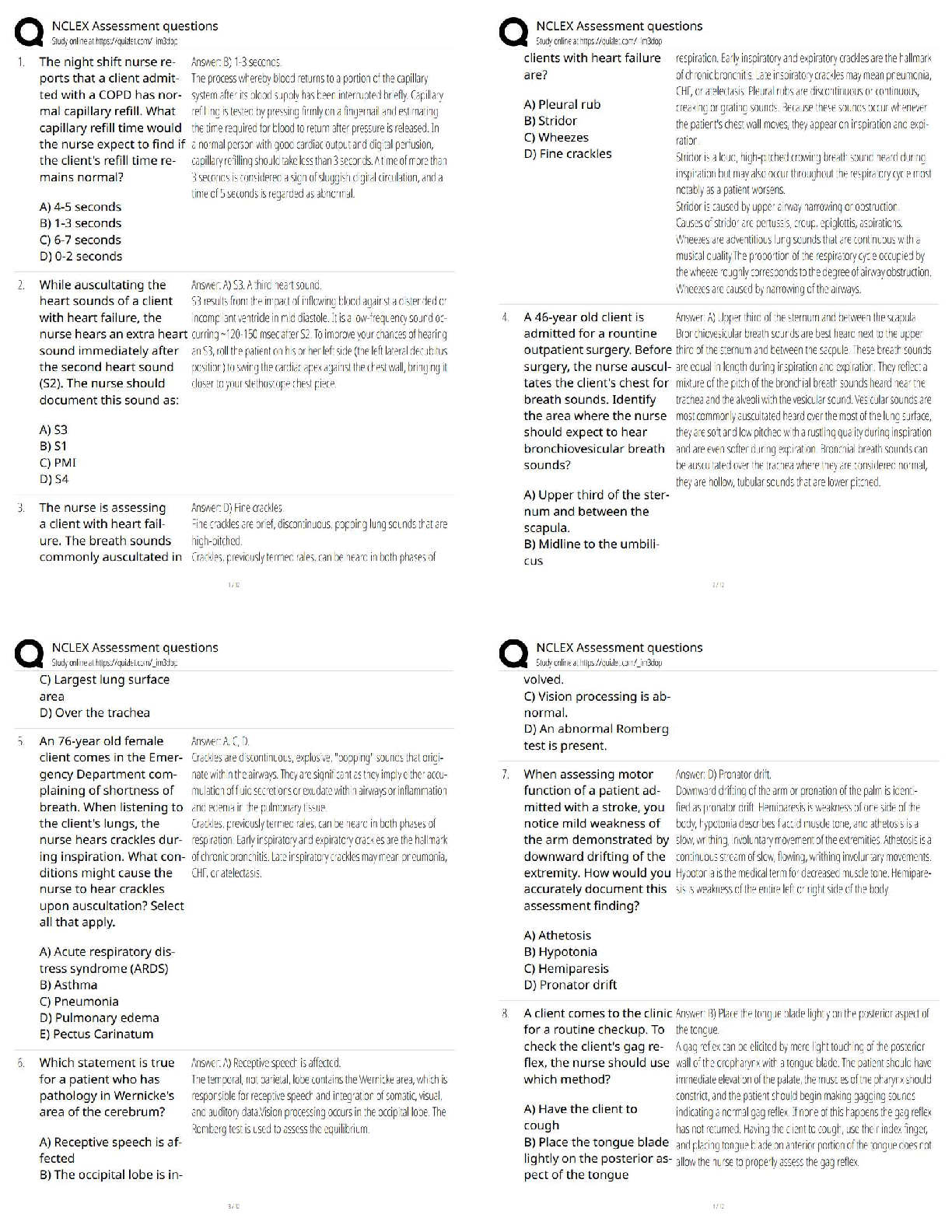
NCLEX Neuro Review Questions with Correct Answers Which statement is true for a patient who has pathology in Wernicke's area of the cerebrum? A. Receptive speech is affected. B. The parietal lobe ... is involved. C. Sight processing is abnormal. D. An abnormal Romberg test is present. ✔✔A The temporal, not parietal, lobe contains the Wernicke area, which is responsible for receptive speech and integration of somatic, visual, and auditory data. Sight processing occurs in the occipital lobe. The Romberg test is used to assess the position sense of the lower extremities. After a major head trauma, the patient's respiratory and cardiac functions are affected. Which area of the brain is damaged? A. Temporal lobe of the cerebrum B. Brainstem C. Cerebellum D. Spinal nerves ✔✔B The brainstem includes the midbrain, pons, and medulla. The vital centers concerned with respiratory, vasomotor, and cardiac function are located in the medulla. Integration of somatic, visual, and auditory data occurs in the temporal lobe. The cerebellum coordinates voluntary movement, trunk stability, and equilibrium. Motor and spinal nerves serve particular areas of the body. What is the purpose of the blood-brain barrier? A. To protect the brain by cushioning B. To inhibit damage from external trauma C. To keep harmful agents away from brain tissue D. To provide the blood supply to brain tissue ✔✔C The blood-brain barrier is a physiologic barrier between capillaries and brain tissue. The structure of the brain's capillaries is different from others, and substances that are harmful are not allowed to enter brain tissue. Lipid-soluble compounds enter the brain easily, but water-soluble and ionized drugs enter slowly. The spinal fluid and meninges help cushion the brain. The skull protects from external trauma. Blood is supplied to the brain from the internal carotid arteries and the vertebral arteries. In a patient with a disease that affects the myelin sheath of nerves, such as multiple sclerosis, which glial cells are affected? ✔✔D Types of glial cells include oligodendrocytes, astrocytes, ependymal cells, and microglia, and each has specific functions. Oligodendrocytes are specialized cells that produce the myelin sheath of nerve fibers, and they are primarily found in the white matter of the central nervous system. Drugs or diseases that impair the function of the extrapyramidal system may cause loss of [Show More]

Last updated: 2 years ago

Preview 1 out of 106 pages

Buy Now

Instant download

We Accept:

Payment methods accepted on Scholarfriends (We Accept)
Preview image of NCLEX Neuro Review Questions with Correct Answers document

Buy this document to get the full access instantly

Instant Download Access after purchase

Buy Now

Instant download

We Accept:

Payment methods accepted on Scholarfriends (We Accept)

Also available in bundle (1)

Click Below to Access Bundle(s)

Neurology NCLEX Bundled Exams Questions and Answers (2022/2023) Already Passed

Neurology NCLEX Bundled Exams Questions and Answers (2022/2023) Already Passed

By Nutmegs 2 years ago

$22

16  

Reviews( 0 )

$12.00

Buy Now

We Accept:

Payment methods accepted on Scholarfriends (We Accept)

Instant download

Can't find what you want? Try our AI powered Search

128
0

Document information


Connected school, study & course


About the document


Uploaded On

Apr 14, 2023

Number of pages

106

Written in

All

Seller


Profile illustration for Nutmegs
Nutmegs

Member since 4 years

607 Documents Sold

Reviews Received
77
14
8
2
21
Additional information

This document has been written for:

Uploaded

Apr 14, 2023

Downloads

 0

Views

 128

Document Keyword Tags


$12.00
What is Scholarfriends

Scholarfriends.com Online Platform by Browsegrades Inc. 651N South Broad St, Middletown DE. United States.

We are here to help

We're available through e-mail, Twitter, Facebook, and live chat.
 FAQ
 Questions? Leave a message!

Follow us on
 Twitter

Copyright © Scholarfriends · High quality services·