What period follows depolarization of the myocardium and represents a period during
which no new cardiac potential can be propagated?
Refractory
Threshold
Sinoatrial (SA)
Hyperpolarization
During the refractory per
...
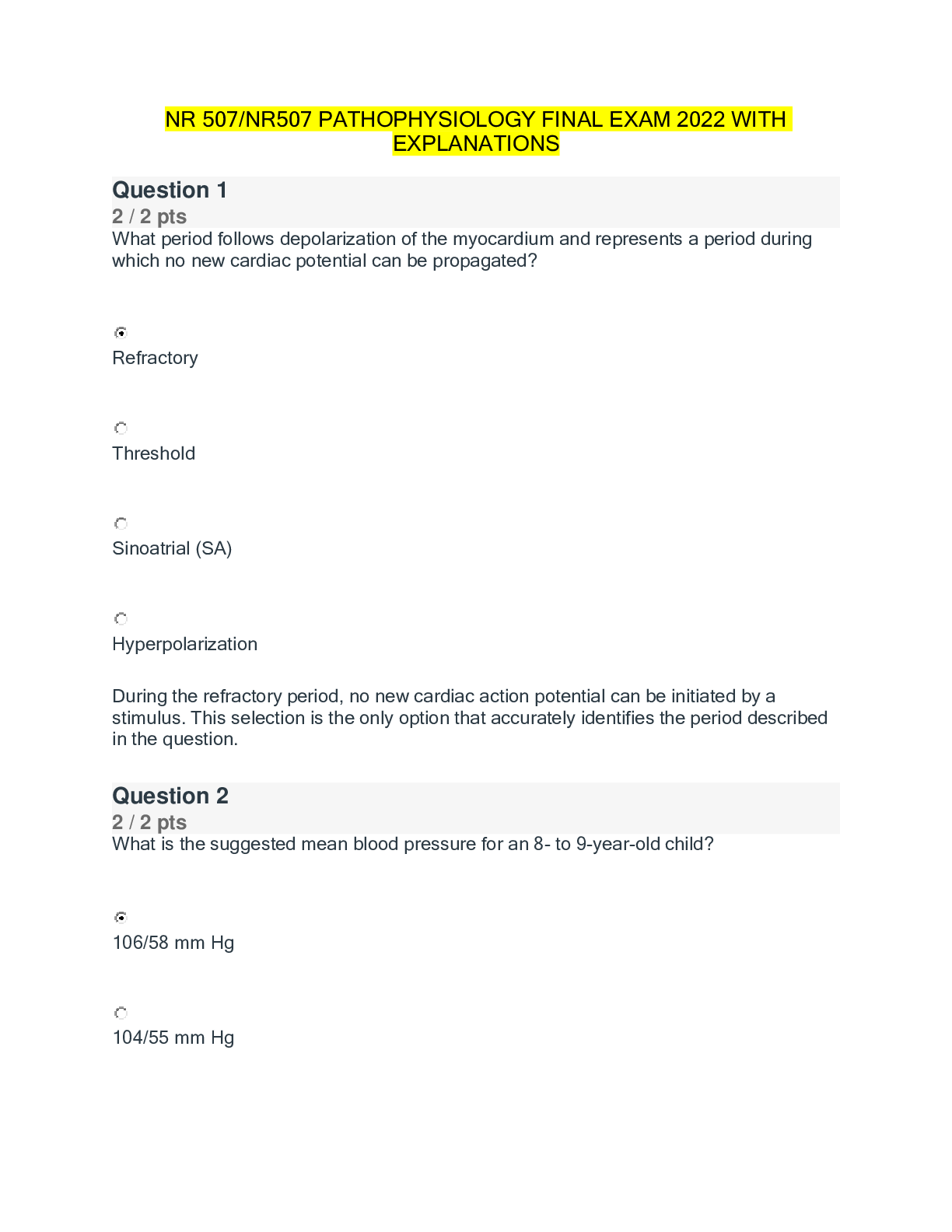
What period follows depolarization of the myocardium and represents a period during
which no new cardiac potential can be propagated?
Refractory
Threshold
Sinoatrial (SA)
Hyperpolarization
During the refractory period, no new cardiac action potential can be initiated by a
stimulus. This selection is the only option that accurately identifies the period described112/62 mm Hg
121/70 mm Hg
The suggested mean blood pressure for an 8- to 9- year-old child is 106/58 mm Hg. For
a child of 6 to 7 years old, 104/55 mm Hg is appropriate; for a 12- to 13-year-old child,
112/62 mm Hg is appropriate, and for a 16- to 18-year-old young man, 121/70 mm Hg is
appropriate.
Which is an example of an endogenous antigen?
Yeast
Cancer cells
Fungus
Bacteria
Of the options provided, endogenous antigens include only those uniquely produced by
cancerous cells.
An infant has a crescendo-decrescendo systolic ejection murmur located between the
second and third intercostal spaces along the left sternal border. A wide fixed splitting of
Question 5
2 / 2 pts
the second heart sound is also found. These clinical findings are consistent with which
congenital heart defect?
Atrioventricular canal (AVC) defect
Patent ductus arteriosus (PDA)
Ventricular septal defect (VSD)
Atrial septal defect (ASD)
Because most children with ASD are asymptomatic, diagnosis is usually made during a
routine physical examination by the auscultation of a crescendo-decrescendo systolic
ejection murmur that reflects increased blood flow through the pulmonary valve. The
location of the murmur is between the second and third intercostal spaces along the left
sternal border. A wide fixed splitting of the second heart sound is also characteristic of
ASD, reflecting volume overload to the right ventricle and causing prolonged ejection
time and a delay of pulmonic valve closure. The presentations of other congenital heart
defects are not consistent with the described symptoms.
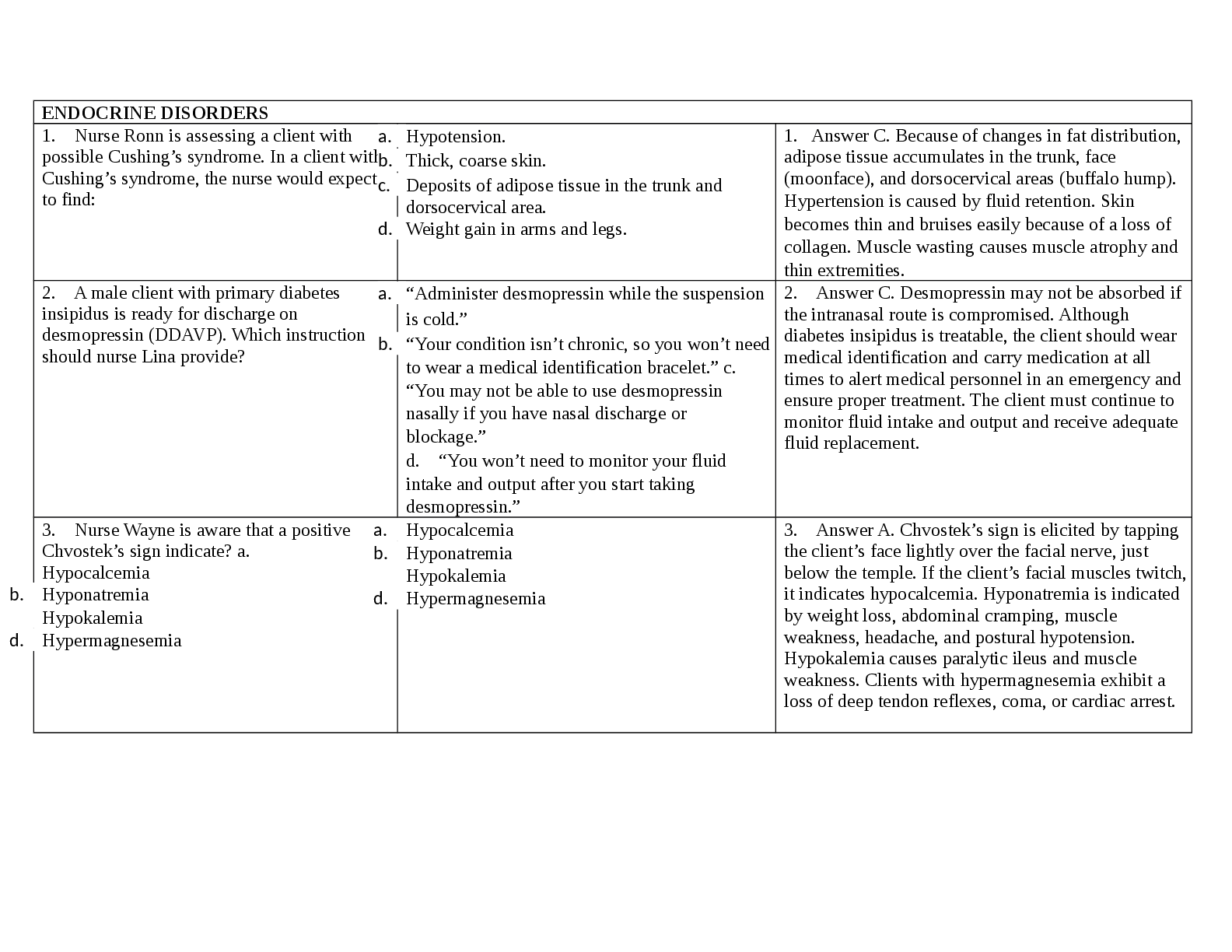
Chvostek and Trousseau signs indicate which electrolyte imbalance?
Hypocalcemia
Hypercalcemiain the question.
What is the suggested mean blood pressure for an 8- to 9-year-old child?
106/58 mm Hg
104/55 mm Hg
[Show More]