The nurse has just reassessed the condition of a postoperative client who was admitted 1 hour ago
to the surgical unit. The nurse plans to monitor which parameter most carefully during the next
hour?
1. Urine output o
...
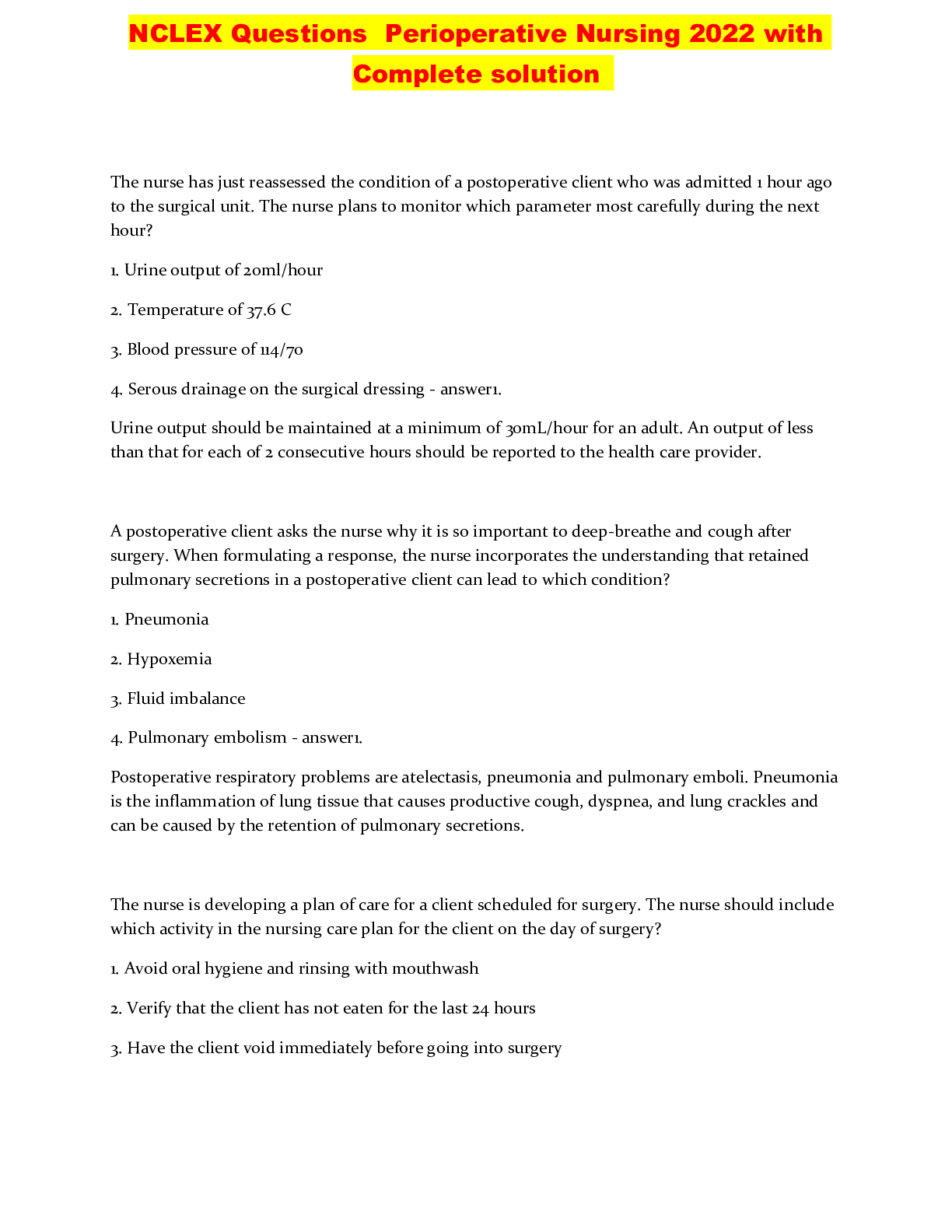
The nurse has just reassessed the condition of a postoperative client who was admitted 1 hour ago
to the surgical unit. The nurse plans to monitor which parameter most carefully during the next
hour?
1. Urine output of 20ml/hour
2. Temperature of 37.6 C
3. Blood pressure of 114/70
4. Serous drainage on the surgical dressing - answer1.
Urine output should be maintained at a minimum of 30mL/hour for an adult. An output of less
than that for each of 2 consecutive hours should be reported to the health care provider.
A postoperative client asks the nurse why it is so important to deep-breathe and cough after
surgery. When formulating a response, the nurse incorporates the understanding that retained
pulmonary secretions in a postoperative client can lead to which condition?
1. Pneumonia
2. Hypoxemia
3. Fluid imbalance
4. Pulmonary embolism - answer1.
Postoperative respiratory problems are atelectasis, pneumonia and pulmonary emboli. Pneumonia
is the inflammation of lung tissue that causes productive cough, dyspnea, and lung crackles and
can be caused by the retention of pulmonary secretions.
The nurse is developing a plan of care for a client scheduled for surgery. The nurse should include
which activity in the nursing care plan for the client on the day of surgery?
1. Avoid oral hygiene and rinsing with mouthwash
2. Verify that the client has not eaten for the last 24 hours
3. Have the client void immediately before going into surgery
NCLEX Questions Perioperative Nursing 2022 with
Complete solution
4. Report immediately any slight increase in BP or pulse - answer3.
The nurse would assist the client to void immediately before surgery so that the bladder will be
empty. Oral hygiene is allowed, but the client should not swallow any water. The client usually has
a restriction of food and fluids for 6 to 8 hours before surgery instead of 24 hours. A slight increase
in BP and pulse is common during the preoperative period due to anxiety.
A client with a perforated gastric ulcer is scheduled for surgery. The client cannot sign the
operative consent form because of sedation from opioid analgesics that have been administered.
The nurse should take which most appropriate action in the care of this client?
1. Obtain a court order for the surgery.
2. Have the charge nurse sign the informed consent immediately
3. Send the client to surgery without the consent form being signed
4. Obtain a telephone consent from a family member, following agency policy - answer4.
Every effort should be made to obtain permission from a responsible family member to perform
surgery if the client is unable to sign the consent form. A telephone consent must be witnessed by
two persons who hear the family member's oral consent. The two witnesses then sign the consent
with the name of the family member, noting that an oral consent was obtained. Consent is not
informed if it is obtained from a client who is confused, unconscious, mentally incompetent, or
under the influence of sedatives. In an emergency the client may not be able to sign and family
members may not be available. In this situation, a health care provider is permitted legally to
perform surgery without consent, but tin this case it is not an emergency. Agency policies
regarding informed consent should always be followed.
A preoperative client expresses anxiety to the nurse about upcoming surgery. Which response by
the nurse is most likely to stimulate further discussion between the client and the nurse?
1. "If it's any help, everyone is nervous before surgery."
2. "I will be happy to explain the entire surgical procedure with you."
3. "Can you share with me what you've been told about your surgery?"
4. "Let me tell you about the care you'll receive after surgery and the amount of pain you can
anticipate". - answer3.
Explanations should begin with the information that the client knows. By providing the client
with individualized explanations of care and procedures, the nurse can assist the client in
handling anxiety and fear for a smooth preoperative experience. Clients who are calm and
NCLEX Questions Perioperative Nursing 2022 with
Complete solution
emotionally prepared for surgery withstand anesthesia better and experience fewer postoperative
complications.
[Show More]