Creating LD50 Graphs for Different Substances
Background
One of the methods that scientists can use to determine the toxicity of a chemical compound is an LD50 test.
This test involves introducing different dose level
...
Creating LD50 Graphs for Different Substances
Background
One of the methods that scientists can use to determine the toxicity of a chemical compound is an LD50 test.
This test involves introducing different dose levels of the compound to be tested to a group of experimental
subjects. The most commonly used experimental subject is lab rats or mice, because they have many
physiologic similarities to humans.
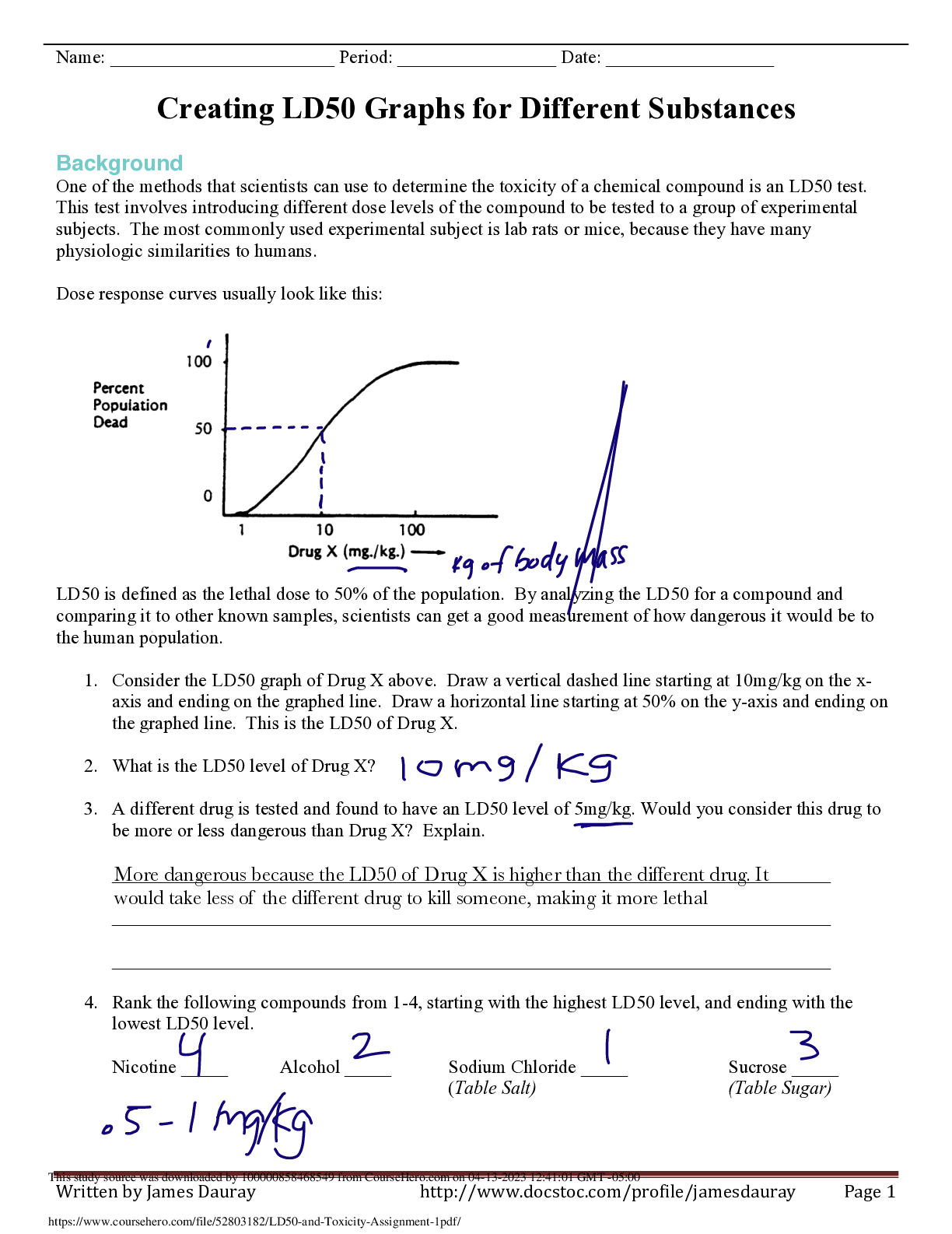
Dose response curves usually look like this:
LD50 is defined as the lethal dose to 50% of the population. By analyzing the LD50 for a compound and
comparing it to other known samples, scientists can get a good measurement of how dangerous it would be to
the human population.
1. Consider the LD50 graph of Drug X above. Draw a vertical dashed line starting at 10mg/kg on the xaxis and ending on the graphed line. Draw a horizontal line starting at 50% on the y-axis and ending on
the graphed line. This is the LD50 of Drug X.
2. What is the LD50 level of Drug X?
3. A different drug is tested and found to have an LD50 level of 5mg/kg. Would you consider this drug to
be more or less dangerous than Drug X? Explain.
4. Rank the following compounds from 1-4, starting with the highest LD50 level, and ending with the
lowest LD50 level.
Nicotine _____ Alcohol _____ Sodium Chloride _____ Sucrose _____
(Table Salt) (Table Sugar)
More dangerous because the LD50 of Drug X is higher than the different drug. It
would take less of the different drug to kill someone, making it more lethal
This study source was downloaded by 100000858468549 from CourseHero.com on 04-13-2023 12:41:01 GMT -05:00
https://www.coursehero.com/file/52803182/LD50-and-Toxicity-Assignment-1pdf/Data Analysis
Lethal dose data is shown below for two toxic chemical compounds: arsenic and sodium cyanide. Graph each
and determine their LD50 levels.
Sodium Cyanide ( Sample size = 190 )
[Show More]