Construction and The Built Environment > QUESTIONS & ANSWERS > WGU D005 Considerations for Instructional Planning | 85 Questions with 100% Correct Answers | Verifi (All)
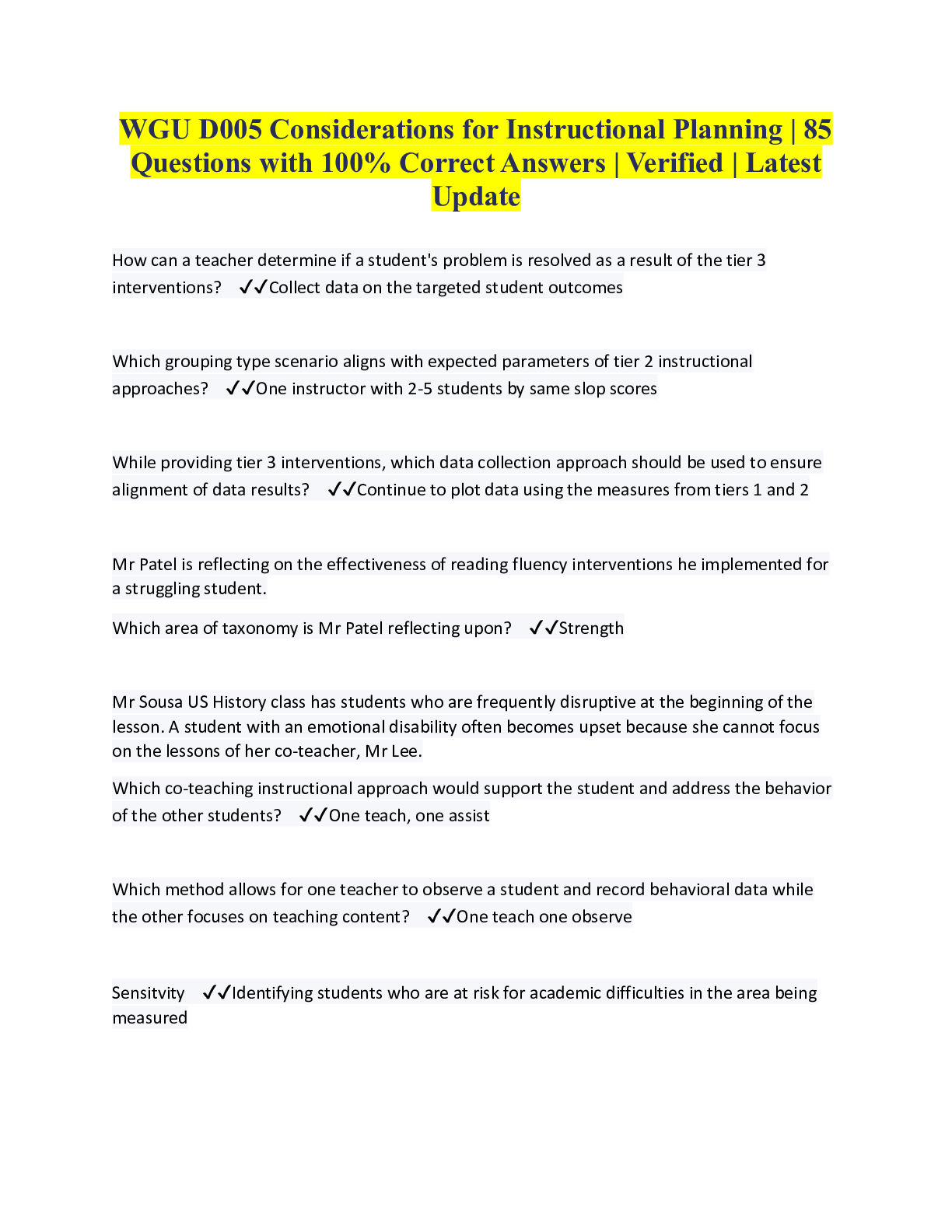
WGU D005 Considerations for Instructional Planning | 85 Questions with 100% Correct Answers | Verified | Latest Update
Document Content and Description Below
WGU D005 Considerations for Instructional Planning | 85 Questions with 100% Correct Answers | Verified | Latest Update How can a teacher determine if a student's problem is resolved as a result of ... the tier 3 interventions? ✔✔Collect data on the targeted student outcomes Which grouping type scenario aligns with expected parameters of tier 2 instructional approaches? ✔✔One instructor with 2-5 students by same slop scores While providing tier 3 interventions, which data collection approach should be used to ensure alignment of data results? ✔✔Continue to plot data using the measures from tiers 1 and 2 Mr Patel is reflecting on the effectiveness of reading fluency interventions he implemented for a struggling student. Which area of taxonomy is Mr Patel reflecting upon? ✔✔Strength Mr Sousa US History class has students who are frequently disruptive at the beginning of the lesson. A student with an emotional disability often becomes upset because she cannot focus on the lessons of her co-teacher, Mr Lee. Which co-teaching instructional approach would support the student and address the behavior of the other students? ✔✔One teach, one assist Which method allows for one teacher to observe a student and record behavioral data while the other focuses on teaching content? ✔✔One teach one observe Sensitvity ✔✔Identifying students who are at risk for academic difficulties in the area being measured Specificity ✔✔Students who perform acceptably on the measures are unlikely to have academic problems in that area Cut scores ✔✔Performance score Slope ✔✔Change in performance over time Fidelity of implementation ✔✔The degree to which instruction is delivered in the way it was intended Direct Assessment Measures ✔✔Checklists of intervention components conducted by a qualified person to observe classroom procedures Indirect methods of fidelity assessment ✔✔Teacher self reports of implementation more general rating scales, teacher interviews, and permanent products of teacher and student work Tier 1 of RTI ✔✔Differentiated instruction methods are implemented by the classroom teacher and monitored through a variety of assessments. Curriculum-based measurements (CBM), like DIBELS for reading skills can help teachers to determine if students are making adequate progress Tier 2 of RTI ✔✔targeted interventions All students are frequently monitored to assess whether they are progressing in the general education classroom. Flexible grouping options can target areas of weakness for specific students who need more time or alternative approaches to master and apply new strategies. Tier 3 of RTI ✔✔intensive interventions and comprehensive evaluation Students are frequently measured for progress and alignment to their specific short term and long term academic goals. The frequency and intensity of the interventions are increased and often involve either collaboration or support, or both, from related specialists. Data-based Individualization (DBI) ✔✔One on one instruction strength taxonomy of intervention Intensity ✔✔the evidence of effectiveness for students with intensive needs; Dosage taxonomy ✔✔the number of opportunities the student has to respond and receive feedback from the teacher; Alignment ✔✔how well the intervention matches the targeted academic skills or behaviors of concern, as well as incorporates grade-appropriate standards or behaviors we would expect for a particular context; Attention to transfer ✔✔The extent to which an intervention is designed to help students transfer the skills they learn to other formats and contexts and realize connections between mastered and related skills comprehensiveness ✔✔how well the intervention incorporates a comprehensive array of explicit instruction principles, like simple, direct language Behavioral support ✔✔whether an academic intervention incorporates behavioral strategies that may support students with self-regulation, motivation, or externalizing behaviors that may impact their ability to learn, or whether a behavioral intervention considers academic components as part of the intervention. Individualization ✔✔focuses on the ongoing use of progress monitoring data and other diagnostic data sources to intensify and individualize the intervention based on student need. This approach mirrors the remaining steps of the DBI process that consist of data collection and modification in an iterative process until improvement is seen. Set up stage ✔✔First 6 dimensions strength, dosage, alignment, attention to transfer, comprehensiveness, and behavioral support Implementation stage ✔✔All 7 dimensions Written language components ✔✔Handwriting, spelling, composition Problem Identification ✔✔Spotting an area of difficulty for students Problem Analysis ✔✔Digging deeper into the area of difficulty and identifying specific components to address Determination of a solution ✔✔Use research based findings from literature and professional wisdom to address the specific components Implementation and evaluation ✔✔Informs how well the solution has worked and what changes need to occur Feedback for struggling students ✔✔Clear concise language, constructive feedback using simple vocabulary asking questions to make sure they have understanding, immediate Systematic instruction ✔✔The process of breaking a skill down into individual components for students and identify the appropriate teaching method or promoting strategy that allows for students to fully comprehend instruction about a new skill or learning objective SCREAM ✔✔Structure Clarity Redundancy Enthusiasm Appropriate rate Maximized engagement Enthusiasm ✔✔Using an upbeat of voice, rapid presentation right and varied inflection Structure ✔✔Discuss with students the purpose of your lesson. Display for students and outline of the lesson. Emphasize the critical points of the lesson. Summarize and review throughout the lesson. Maximized engagement ✔✔Select material that is at the correct level of difficulty. Select material that is motivating and interesting. Use affective questioning techniques. Provide helpful feedback. Praise students frequently. Redundancy ✔✔Continue to re-emphasize key concepts, procedures, and rules during the lesson. This is critical to the success of students. Clarity ✔✔Speak clearly to the objective of the lesson. Eliminate vague language in your presentation. Select vocabulary and syntax that are familiar to all students. Appropriate rate ✔✔Does your answer contain appropriate pacing to keep lessons interesting and motivating? Frequently question students to monitor if you are presenting too fast. Application ✔✔Applying learn skills or content to relevant contexts Provide several instances of different application problems, model procedures in directions in different cases, provide meaningful demonstrations and examples, use active coaching with questioning to prompt correct responding Generalization ✔✔The ability to transfer previous learning to novel situations [Show More]
Last updated: 2 years ago
Preview 1 out of 11 pages
Buy this document to get the full access instantly
Instant Download Access after purchase
Buy NowInstant download
We Accept:

Also available in bundle (1)
Click Below to Access Bundle(s)

Bundle for WGU D005 Exams Compilation | Verified | Guaranteed Success
WGU D005 Exam Practice Questions | 60 Questions with 100% Correct Answers | Verified | Latest Update WGU D005 Considerations for Instructional Planning pre assessment | Questions with 100% Correct...
By Crescent 2 years ago
$12
4
Reviews( 0 )
$10.00
Can't find what you want? Try our AI powered Search
Document information
Connected school, study & course
About the document
Uploaded On
Apr 19, 2023
Number of pages
11
Written in
All

Additional information
This document has been written for:
Uploaded
Apr 19, 2023
Downloads
0
Views
135

 Answered 2023.png)