NR 326 CMS Exam (Answered) With Rationale Graded A+
1 / 20
1. What is Nurse John likely to note in a male client being admitted for alcohol
withdrawal?
A. Perceptual disorders
B. Impending coma
C. Recent alcohol in
...
NR 326 CMS Exam (Answered) With Rationale Graded A+
1 / 20
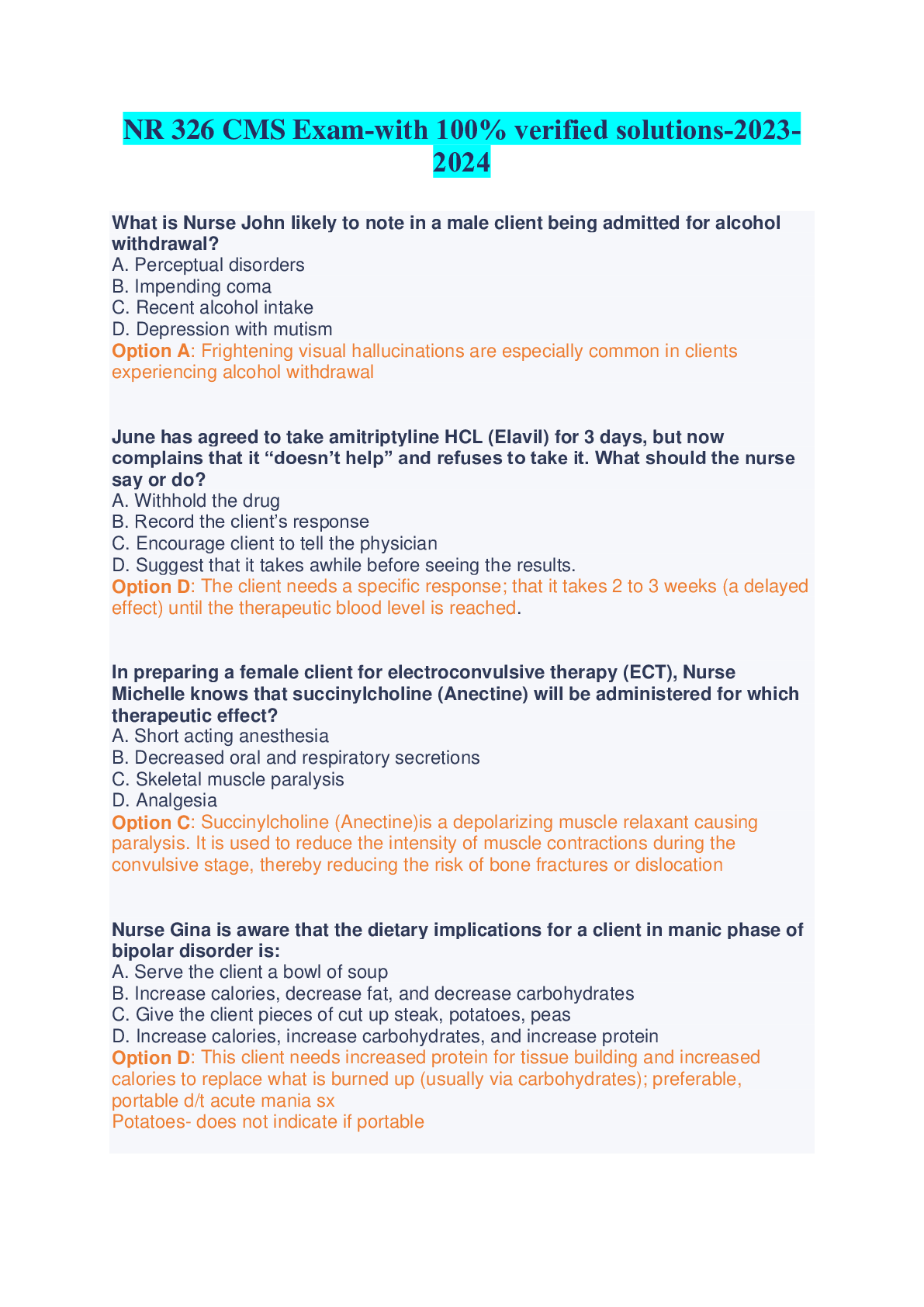
1. What is Nurse John likely to note in a male client being admitted for alcohol
withdrawal?
A. Perceptual disorders
B. Impending coma
C. Recent alcohol intake
D. Depression with mutism: Option A: Frightening visual hallucinations are especially common in clients experiencing alcohol withdrawal
2. June has agreed to take amitriptyline HCL (Elavil) for 3 days, but now
complains that it "doesn't help" and refuses to take it.What should the nurse
say or do?
A. Withhold the drug
B. Record the client's response
C. Encourage client to tell the physician
D. Suggest that it takes awhile before seeing the results.: Option D: The client
needs a specific response; that it takes 2 to 3 weeks (a delayed effect) until the
therapeutic blood level is reached.
3. In preparing a female client for electroconvulsive therapy (ECT), Nurse
Michelle knows that succinylcholine (Anectine) will be administered for
which therapeutic effect?
A. Short acting anesthesia
B. Decreased oral and respiratory secretions
C. Skeletal muscle paralysis
D. Analgesia: Option C: Succinylcholine (Anectine)is a depolarizing muscle relaxant causing paralysis. It is used to reduce the intensity of muscle contractions during the convulsive stage, thereby reducing the risk of bone fractures or dislocation
4. Nurse Gina is aware that the dietary implications for a client in manic phase
of bipolar disorder is:
A. Serve the client a bowl of soup
B. Increase calories, decrease fat, and decrease carbohydrates
C. Give the client pieces of cut up steak, potatoes, peas
D. Increase calories, increase carbohydrates, and increase protein: Option
D: This client needs increased protein for tissue building and increased calories
to replace what is burned up (usually via carbohydrates); preferable, portable d/t
acute mania sx
Potatoes- does not indicate if portable
5. What parental behavior toward a child during an admission procedure
should cause Nurse Ron to suspect child abuse?
A. Flat affectNR 326 CMS Exam (Answered) With Rationale Graded A+
2 / 20
B. Expressing guilt
C. Acting overly solicitous toward the child
D. Ignoring the child: Option C: Acting overly solicitous (overly concerned, mindful, anxiously concerned) toward the child
This behavior is an example of reaction formation, a coping mechanism.
6. Nurse Lynnette notices that a female client with obsessive-compulsive
disorder washes her hands for long periods each day. How should the nurse
respond to this compulsive behavior?
A. By designating times during which the client can focus on the behavior
B. By urging the client to reduce the frequency of the behavior as rapidly as
possible
C. By calling attention to, or attempting to prevent the behavior
D. By discouraging the client from verbalizing anxieties: CORRECT - Option
A: The nurse should designate times during which the client can focus on the
compulsive behavior or obsessive thoughts.
Option B: The nurse should urge the client to reduce the frequency of the compulsive behavior gradually, not rapidly.
Option C: She shouldn't call attention to, or try to prevent the behavior. Trying to
prevent the behavior may cause pain and terror to the client.
Option D: The nurse should encourage the client to verbalize anxieties to help
distract attention from the compulsive behavior.
7. After seeking help at an outpatient mental health clinic, Ruby, who was
raped while walking her dog, is diagnosed with posttraumatic stress disorder
(PTSD). Three months later, Ruby returns to the clinic, complaining of fear,
loss of control, and helpless feelings. Which nursing intervention is most
appropriate for Ruby?
A. Recommending a high protein, low-fat diet
B. Giving sleep medication, as prescribed, to restore a normal sleep-wake
cycle
C. Allowing the client time to heal
D. Exploring the meaning of the traumatic event with the client: CORRECT -
Option D:The client with PTSD needs encouragement to examine and understand
the meaning of the traumatic event and consequent losses. Otherwise, symptoms
may worsen and the client may become depressed or engage in self-destructive
behavior such as substance abuse.
Option A: A special diet isn't indicated unless the client also has an eating disorder
or a nutritional problem.
Option B: The physician may prescribe antianxiety agents or antidepressants
cautiously to avoid dependence; sleep medication is rarely appropriate.NR 326 CMS Exam (Answered) With Rationale Graded A+
3 / 20
Option C: The client must explore the meaning of the event and won't heal without
this, no matter how much time passes. Behavioral techniques, such as relaxation
therapy, may help decrease the client's anxiety and induce sleep. Exposure therapy
may also be indicated.
8. Meryl, age 19, is highly dependent on her parents and fears leaving home
to go away to college. Shortly before the semester starts, she complains
that her legs are paralyzed and is rushed to the emergency department.
When physical examination rules out a physical cause for her paralysis, the
physician admits her to the psychiatric unit where she is diagnosed with
conversion disorder. Meryl asks the nurse, "Why has this happened to me?"
What is the nurse's best response?
A. "You've developed this paralysis so you can stay with your parents.You
must deal with the conflict if you want to walk again."
B. "It must be awful not to be able to move your legs.You may feel better if
you realize the problem is psychological, not physical."
C. "Your problem is real but there is no physical basis for it. We'll work on
what is going on in your life and why it's happened."
D."It isn't uncommon for someone with your personality to develop a conversion disorder during times of stress.": CORRECT - Option C: The nurse must
be honest with the client by telling her that the paralysis has no physiologic cause
while also conveying empathy and acknowledging that her symptoms are real.The
client will benefit from psychiatric treatment, which will help her understand the
underlying cause of her symptoms. After the psychological conflict is resolved, her
symptoms will disappear.
Option A: Telling her that she has developed paralysis to avoid leaving her parents
or that her personality caused her disorder wouldn't help her understand and
resolve the underlying conflict.
Option B: Saying that it must be awful not to be able to move her legs wouldn't
answer the client's question; knowing that the cause is psychological wouldn't
necessarily make her feel better.
[Show More]


.png)





 Answered 2023.png)