ACQ 1010 Module 1 Questions and
Answers Graded A+
System Acquisition Management ✔✔is the process used to acquire quality products which must
satisfy the needs of operational users, provide measureable improvements in
...
ACQ 1010 Module 1 Questions and
Answers Graded A+
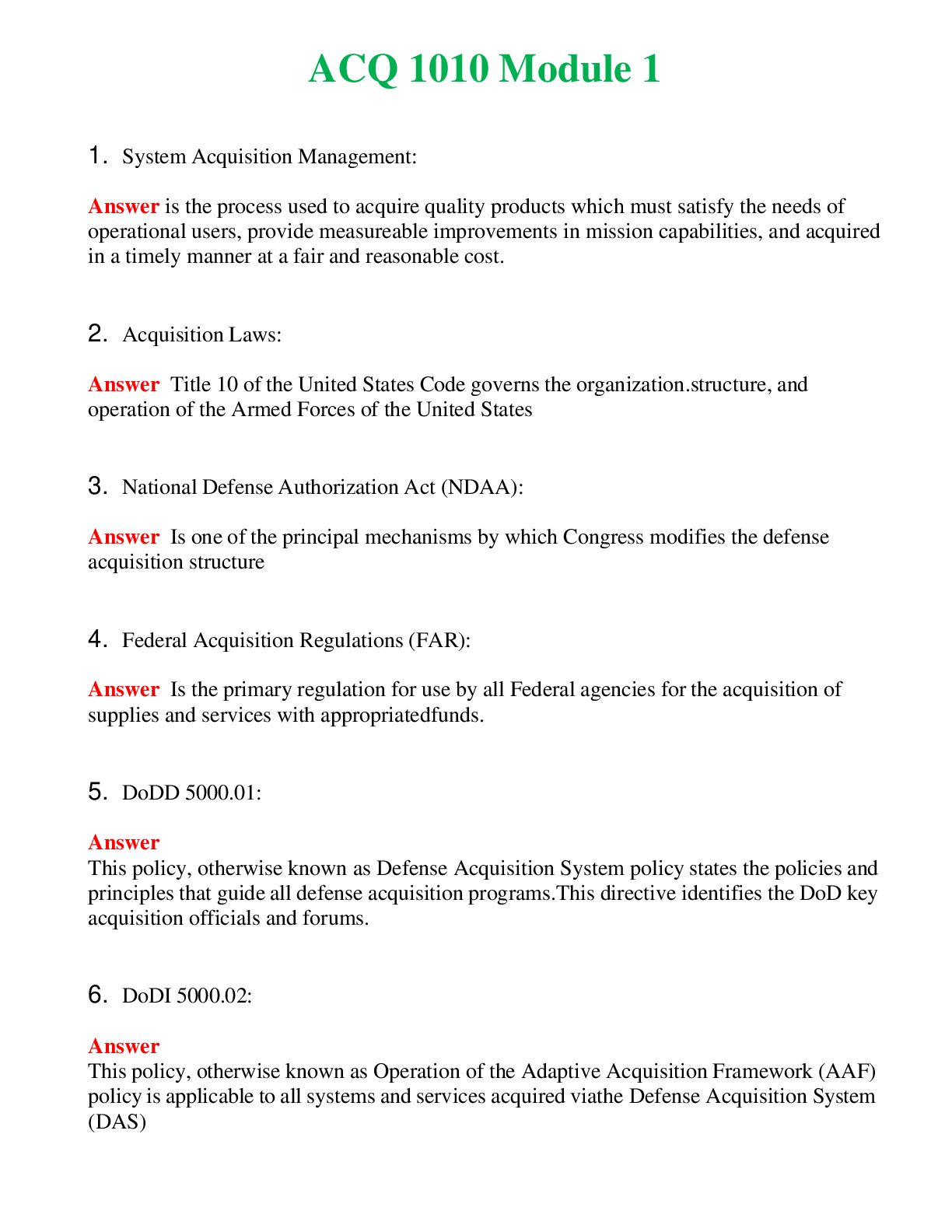
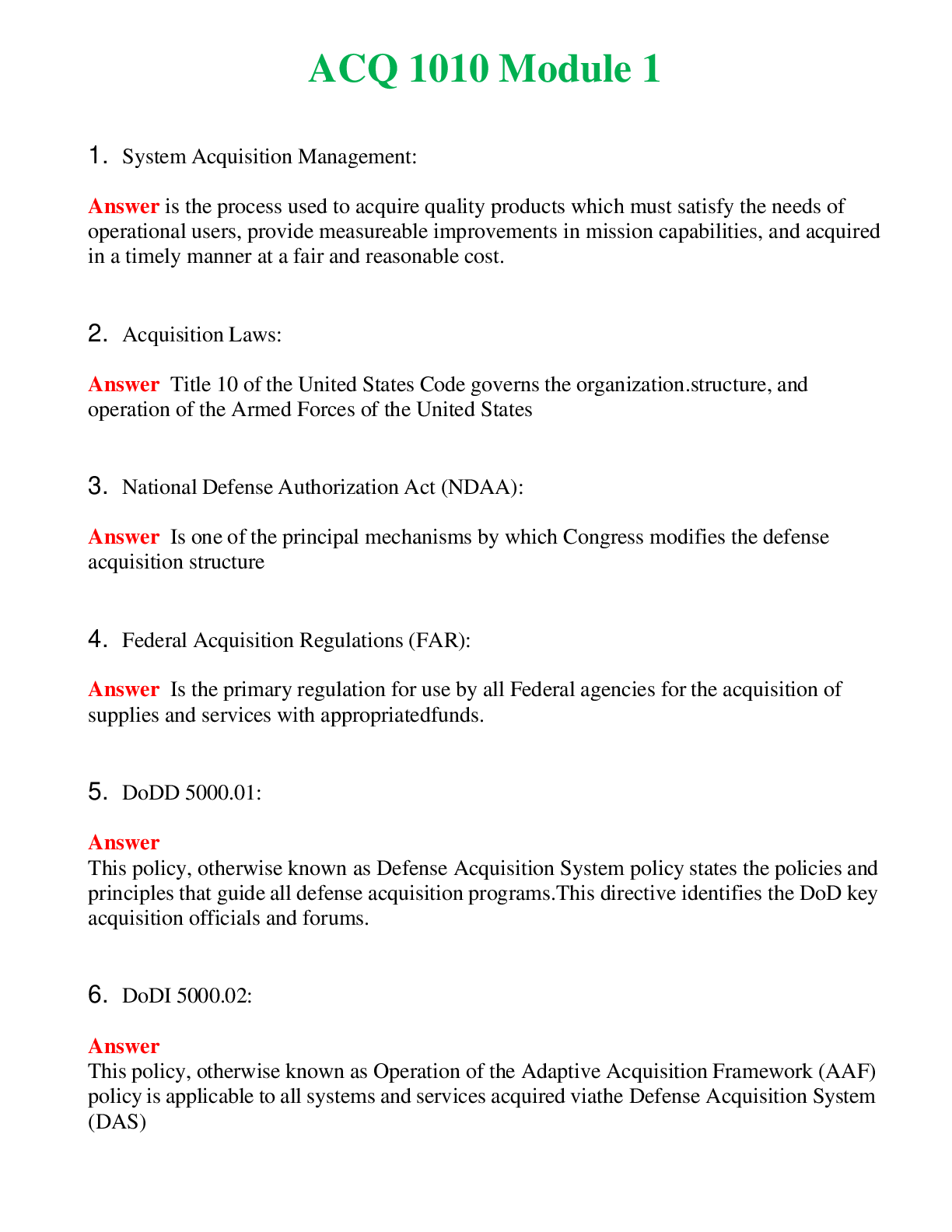
System Acquisition Management ✔✔is the process used to acquire quality products which must
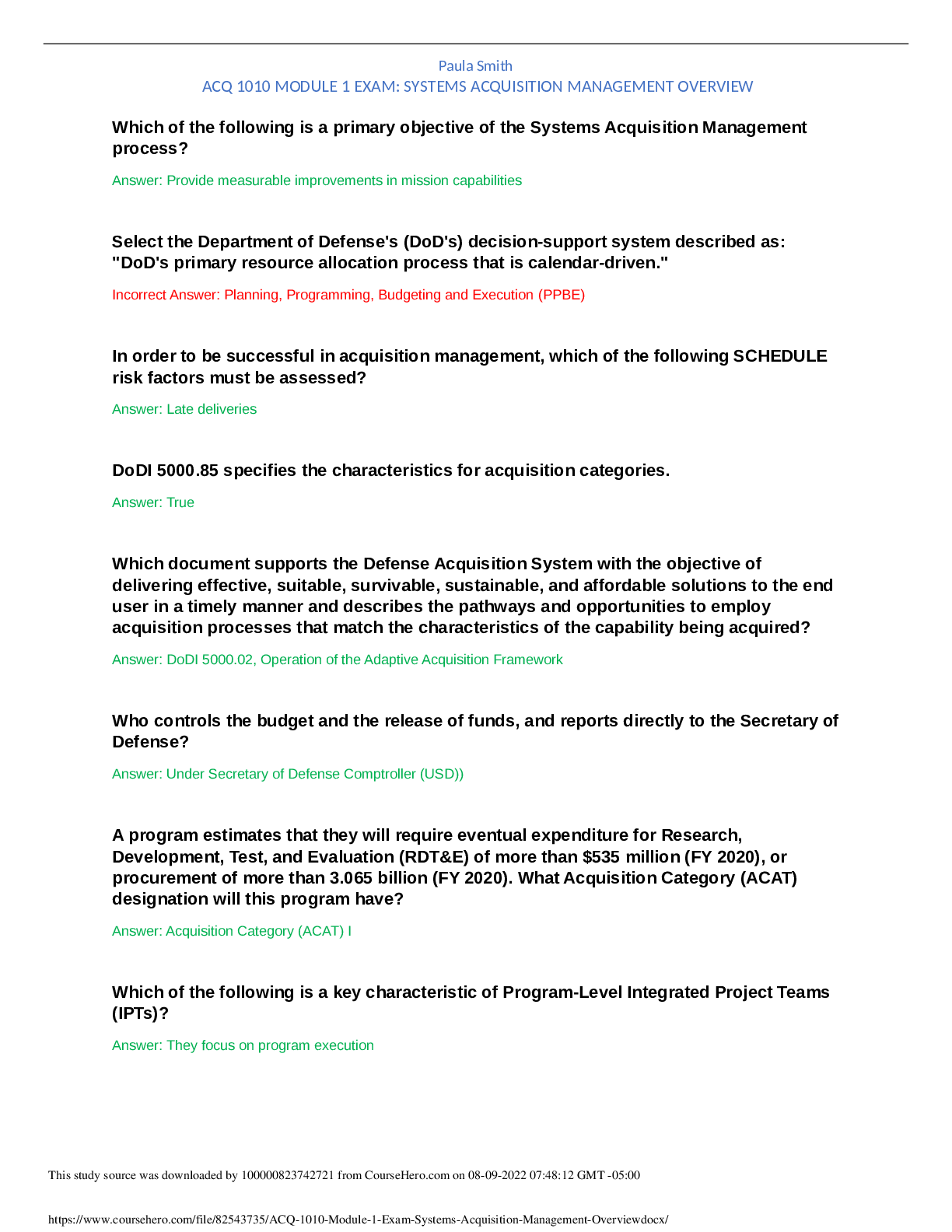
satisfy the needs of operational users, provide measureable improvements in mission capabilities,
and acquired in a timely manner at a fair and reasonable cost.
Acquisition Laws ✔✔Title 10 of the United States Code governs the organization. structure, and
operation of the Armed Forces of the United States
National Defense Authorization Act (NDAA) ✔✔Is one of the principal mechanisms by which
Congress modifies the defense acquisition structure
Federal Acquisition Regulations (FAR) ✔✔Is the primary regulation for use by all Federal
agencies for the acquisition of supplies and services with appropriated funds.
DoDD 5000.01 ✔✔This policy, otherwise known as Defense Acquisition System policy states
the policies and principles that guide all defense acquisition programs. This directive identifies
the DoD key acquisition officials and forums.
DoDI 5000.02 ✔✔This policy, otherwise known as Operation of the Adaptive Acquisition
Framework (AAF) policy is applicable to all systems and services acquired via the Defense
Acquisition System (DAS)
DoDI 5000.85 ✔✔This policy, otherwise known as the Major Capability Acquisition Pathway
policy guides the acquisition of major capability acquisition programs, including major defense
acquisition programs (MDAP); other programs categorized as acquisition category such as
ACAT I-II, automated information systems (AIS), and more
Executive Branch (People) ✔✔President, DoD, the Office of Management and Budget (OMB),
the Department of State, and the National Security Council (NSC)
Executive Branch (Objectives) ✔✔Satisfy national security objectives, maintaining a balanced
force structure, fielding weapon systems to defeat threats to national security, preventing undue
congressional interest/scrutiny, and eliminating fraud, waste, and abuse in federal procuerment
Legislative Branch (Congress) ✔✔Passes laws, provides constitutional checks and balances to
the authority of the Executive Branch, and represent the interests of the people and the States
Legislative Branch (Objective) ✔✔Balancing national security and social needs, distributing
federal dollars by district/state, maximizing competition, controlling industry profits, and
controlling fraud, waste, and abuse
Defense Industry (Contractors) ✔✔Includes large, medium, and small organizations, both U.S.
and foreign, providing goods and services to the DoD
Defense Industry (Objectives) ✔✔Profit and growth, cash flow, market share, stability, and
technological achievement
Office of the Secretary of Defense (OSD) ✔✔Principle staff element of the SECDEF to perform
policy development, planning, resource management, fiscal program management
Secretary of Defense (SECDEF) ✔✔Principal assistant to the President in all matters relating to
national security who is responsible for establishing general policies and programs for the
military departments and agencies, and exercise general authority over those entities.
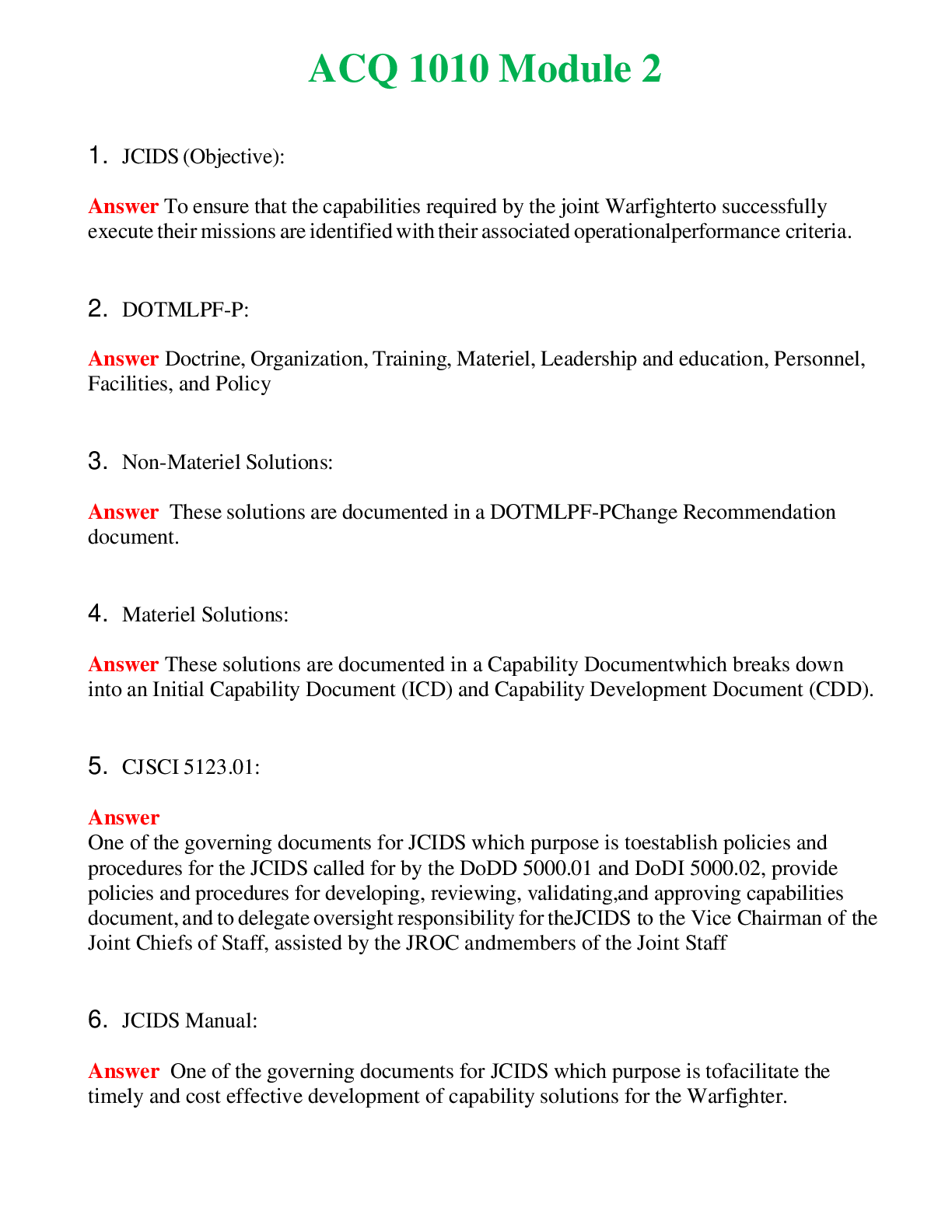
Under Secretary of Defense Comptroller (USD(C)) ✔✔Controls the budget and the release of
funds and is responsible for the Budgeting and Execution phases of the Planning, Programming,
Budgeting, and Execution (PPBE) process
Under Secretary of Defense for Policy (USD(P)) ✔✔Provides policy advice, ensures DoD plan
alignment with national security objective, and maintains responsibility for Defense Planning
and Programming Guidance (DPPG) during the Planning phase of PPBE
Under Secretary of Defense for Acquisitions and Sustainment (USD(A&S)) ✔✔Principal staff
assistant and advisor to the Secretary of Defense and Deputy Secretary of Defense for all matters
relating to the DoD Acquisition System. Additional responsibilities and titles include Defense
Acquisition Executive, Chairs the Defense Acquisition Board (DAB), and makes program
milestone decisions for designated Major Defense Acquisition Programs (MDAPS)
Under Secretary of Defense for Research and Engineering (USD(R&E)) ✔✔Chief Technology
Officer for the DoD charged with development and oversight of DoD technology strategy for the
DoD who develops breakthrough capabilities to hedge against future uncertainties, provides
assistance for rapid technology transitions
Director, Cost Assessment and Program Evaluation (D, CAPE) ✔✔Is responsible for analysis
and advice on matters relating to Planning, Programming, Budgeting, and Execution system
(PPBE system), formulates study guidance for and performance of Analyses of Alternatives
(AoAs) for Major Defense Acquisition Programs (MDAPs)
Director, Operation Test and Evaluation (D, OT&E) ✔✔Provides independent assessment of the
operational effectiveness and suitability of new weapons systems and sends OT&E reports
directly to the SECDEF and Congress
Defense Acquisition Executive (DAE) ✔✔Is the USD (A&S), top-level official for all DoD
system acquisitions and is responsible for supervising the Defense Acquisition System. Acts as
the Milestone Decision Authority (MDA) for Major Defense Acquisitions Programs (MDAPs) &
Major Automated Information Systems (MAIS). Authority can be delegated to the
Component/Service Acquisition Executive and to another OSD Official as the DAE sees fit.
Milestone Decision Authority (MDA) ✔✔Designated individual with overall responsibility for a
program which includes the authority to approve the progress of an acquisition and is held
accountable for the cost, schedule, and performance reporting of the said program. ACAT Level
is determined by the appropriate MDA at the first Milestone (Material Development Decision
(MDD)).
DAB ✔✔Is the Department's senior-level forum for advising the Under Secretary of Defense for
Acquisition and Sustainment (USD(A&S)) on critical decisions concerning Acquisition Category
(ACAT) ID programs, and selected ACAT IA programs.
Component Acquisition Executive (CAE) ✔✔Is the senior official in each DoD Component
responsible for all acquisition functions within that Component. The CAE is the secretary of the
military department, or the head of the defense agency, with power of re-delegation. Additional
responsibilities include being MDA for ACAT IB,C,AC, and III programs.
Program Executive Officer (PEO) ✔✔Is the official who has responsibility for directing several
Major Defense Acquisition Programs (MDAPs) and for assigned major system and non-major
system acquisition programs.
Program Manager (PM) ✔✔Is the designated individual with responsibility for all aspects of a
particular program including the authority to accomplish program objectives for development,
production, and sustainment. Is accountable for credible cost, schedule, and performance
reporting to the Milestone Decision Authority (MDA).
Acquisition Categories (ACAT) ✔✔Acquisition programs -- levels primarily based off of the
cost, but interest level also impacts the level of distinction
Weapon Systems (ACAT) ✔✔Weapon and support equipment such as surveillance systems,
command, control, communications, computers, intelligence, and reconnaissance systems.
Automated Information Systems (AIS) ✔✔Combinations of computer hardware, software, data,
and/or telecommunications equipment that perform functions such as collecting, processing,
storing, transmitting, and displaying information
ACAT I ✔✔ACAT level where Research, Development, Test, and Evaluation (RDT&E) is more
than $535 million and Procurements is more than $3.065 billion in Fiscal Year (FY) 2020.
Programs in this level are MDAP and it may include programs below those cost level if high
interest is shown.
ACAT II ✔✔ACAT level where Research, Development, Test, and Evaluation (RDT&E) is
more than $200 million and Procurement is more than $920 million in FY 2020. Programs in this
level meet criteria for a Major System.
ACAT III ✔✔ACAT level below ACAT II, still related to Air Force
ACAT IV ✔✔ACAT level below ACAT III, Air Force does not have this level. Two categories
in this level, IVT (Test) and IVM (Monitor).
Risk ✔✔Is a measure of future uncertainties in achieving program performance goals and
objectives within defined cost, schedule, and performance constraints
Identified risks ✔✔A future root cause, a probability or likelihood of that future root cause
occurring, the consequence or effect of that future root cause if it occurs.
Mitigating risks ✔✔Risk control, avoidance, acceptance, and transfer
Risk Control ✔✔Reduce risk to an acceptable level, taking actions to reduce the likelihood of a
future root cause to as low as possible in order to minimize potential program impacts
Risk Avoidance ✔✔Reduce risk by eliminating the risk event or condition by taking an alternate
path
Risk Acceptance ✔✔Reduce risk by accepting the potential event or condition and
Risk Transfer ✔✔Reduce risk by reallocating or sharing the risk among entities or processes
Integrated Product Teams (IPTs) ✔✔A multidisciplinary group of people who are collectively
responsible for delivering a defined product or process, functions including building successful
programs, identify and resolve issues, make sound and timely recommendations to facilitate
decision making.
IPTs (Types) ✔✔There are three types of this team -- Overarching, Working Level, and Program
Level.
Overarching IPTs (OIPTs) ✔✔Team that focuses on strategic guidance, program assessment,
issue resolution.
Working Level IPTs (WIPTs) ✔✔Team that focuses on identifying and resolving program
issues, determining program status, and seeking opportunities.
Program Level IPTS (PIPTs) ✔✔Team that focuses on program execution which includes
representative from both government and industry
Decision Support Systems (DSS) ✔✔From concept to deployment, a weapon system goes
through three decision processes to identify the required weapon system, establish a budget, and
acquire the system.
Defense Acquisition System (DAS) ✔✔A decision support system that is event-driven and used
for developing and/or acquiring an item/system.
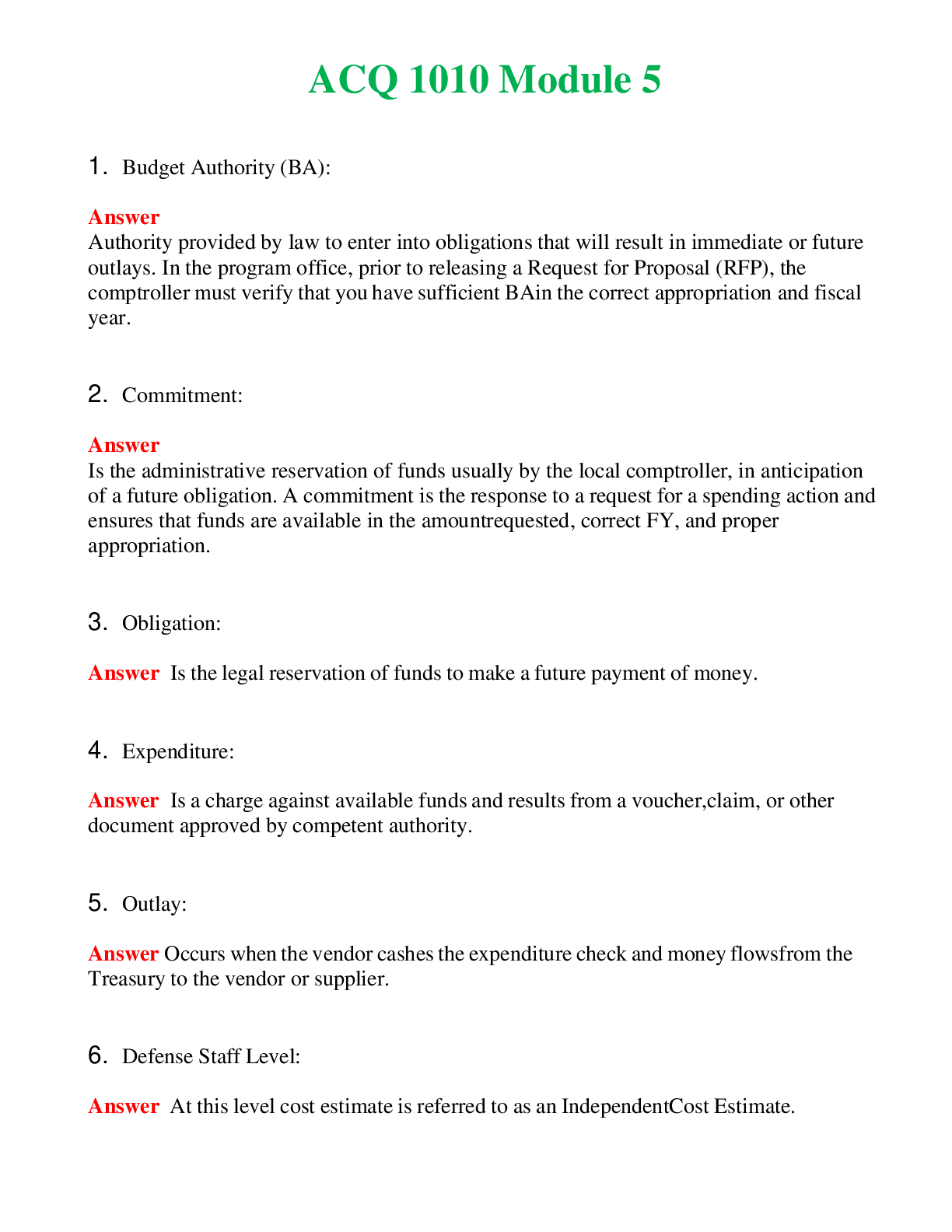
Joint Capabilities Integration and Development System (JCIDS) ✔✔A decision support system
that is needs-driven and used for identifying capability requirements.
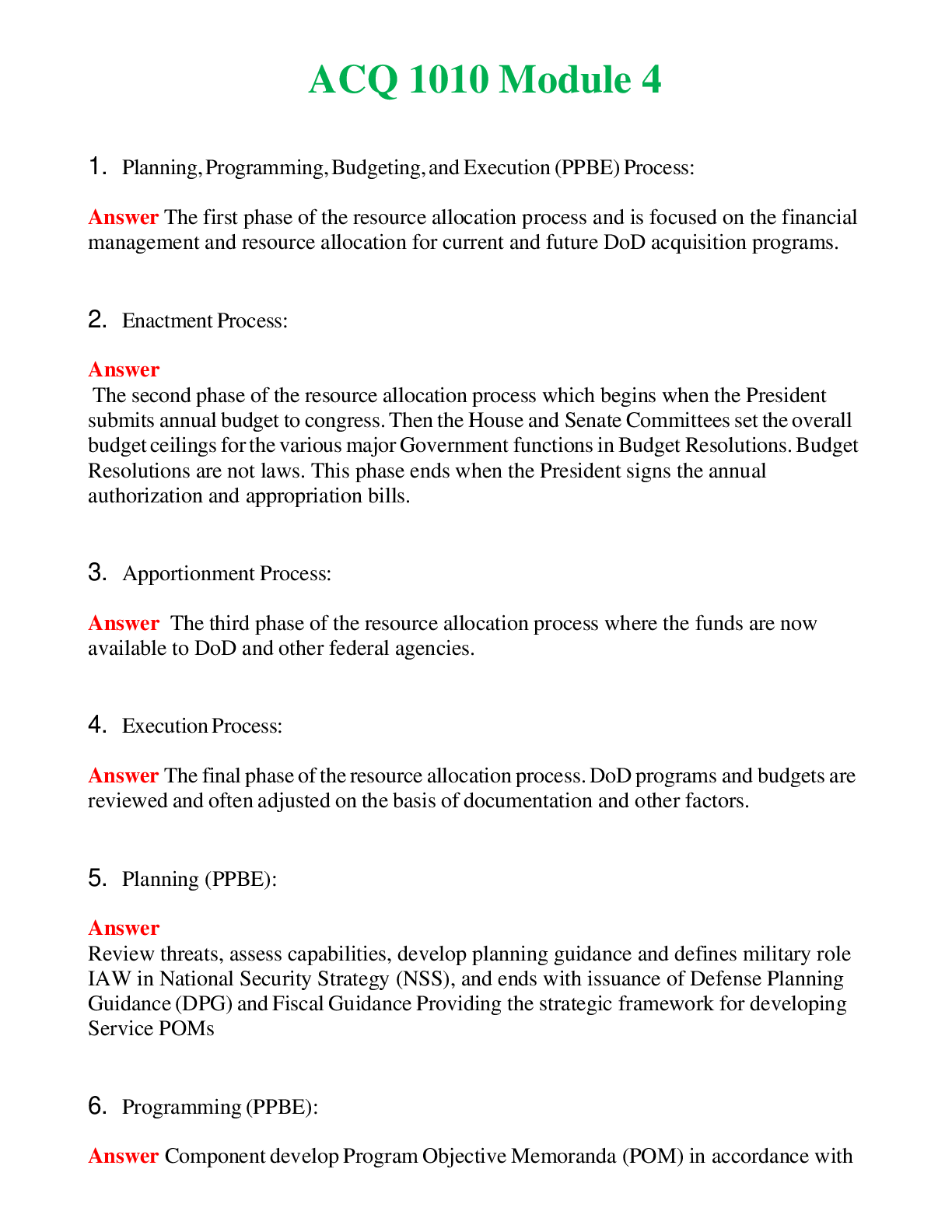
Planning, Programming, Budgeting, & Execution System (PPBE) ✔✔A decision support system
that is calendar-driven and used for allocating resources and budgeting.
Adaptive Acquisition Framework (AAF) ✔✔Objective of this framework is to acquire quality
products that satisfy user needs with measurable improvements to mission capability and
operational support, in a timely manner, and at a fair and reasonable price.
Urgent Capabilities ✔✔This pathway means acquisition is needed within 2 years.
Middle Tier of Acquisition ✔✔This pathway means acquisition is either rapid prototypes to
fielding within 5 years
Major Capabilities Acquisition (MCA) ✔✔This pathway has no set time length but is for
programs that require significant development, time, and financial expenditures
Software Acquisition ✔✔This pathway has not set time length but is for software intensive
systems.
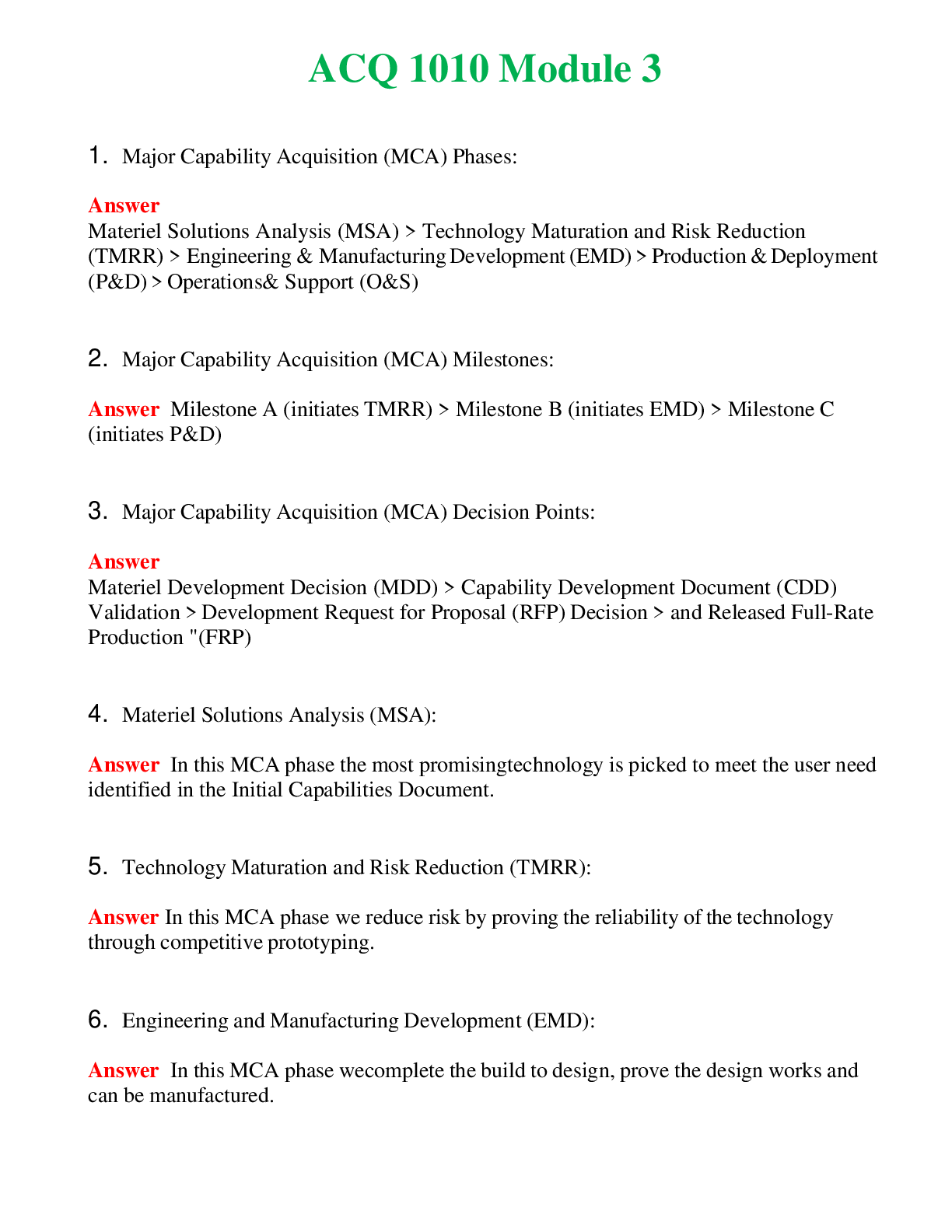
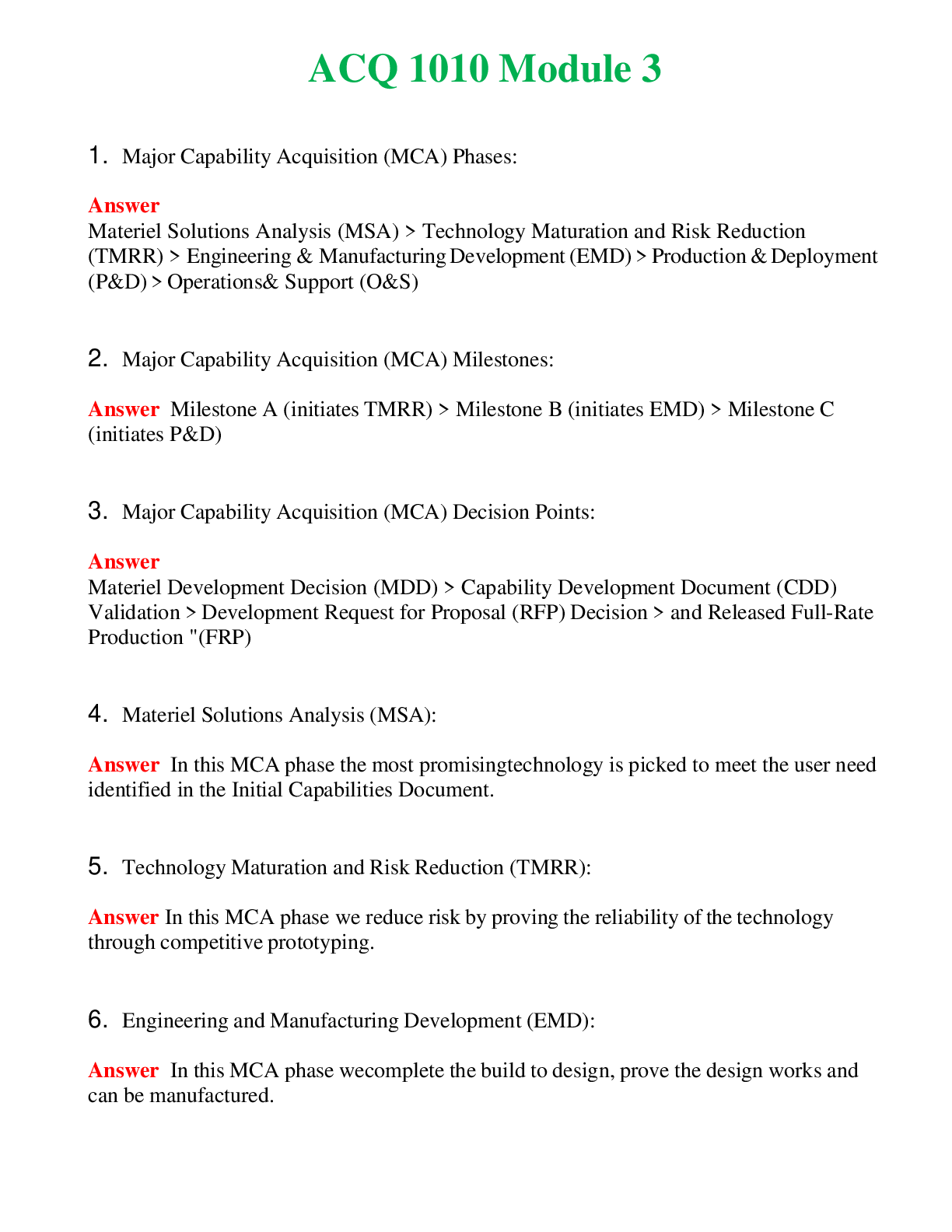
MCA Milestones ✔✔These 3 milestone serve as gates that must be passed through before the
program can proceed to the next phase of the acquisition process.
Milestone A ✔✔Milestone that grants permission to enter into the Technology Maturation and
Risk Reduction (TMRR) Phase.
Milestone B ✔✔Milestone that grant permission to enter into the Engineering and
Manufacturing Development (EMD) Phase.
Milestone C ✔✔Milestone that grants permission to enter the Production and Deployment (PD)
Phase.
MCA pathway ✔✔Has the following five phases: Materiel Solutions Analysis (MSA) >
Technology Maturation and Risk Reduction (TMRR) > Engineering & Manufacturing
Deployment (EMD) > Production & Deployment (PD) > Operations & Sustainment (OS).
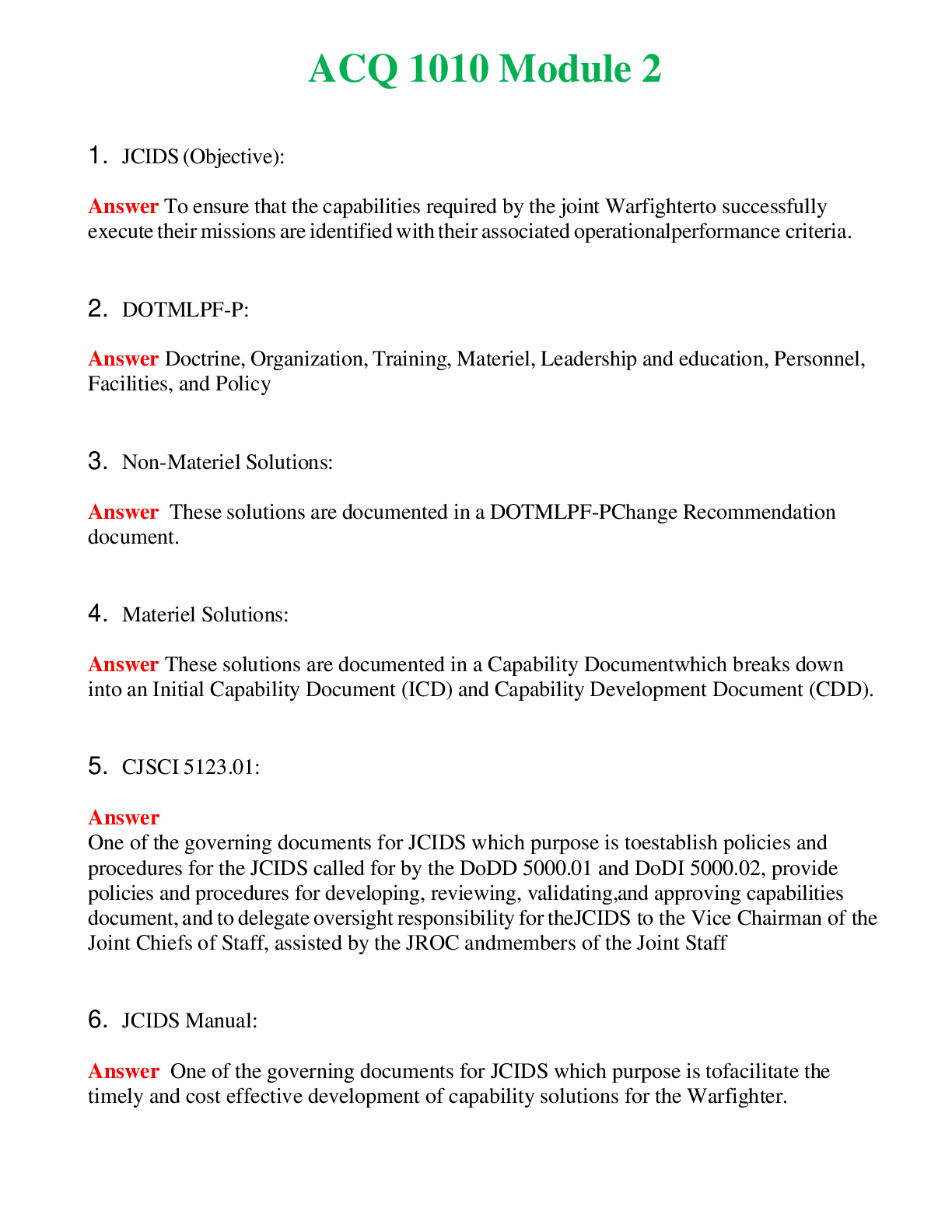
JCIDS Methodology ✔✔Use top level strategic guidance as a basis for identifying and
describing shortfalls in joint warfighting capability, determine functional capability needs and
alternatives for meeting those needs, and provide the basis for establishing priorities by
identifying Warfighter deficiencies or needs
Doctrine, Organization, Training, Materiel, Leadership, Personnel, Facilities, and Policy
(DOTMLPF-P) ✔✔JCIDS document that is refferred to for the requirements generation process.
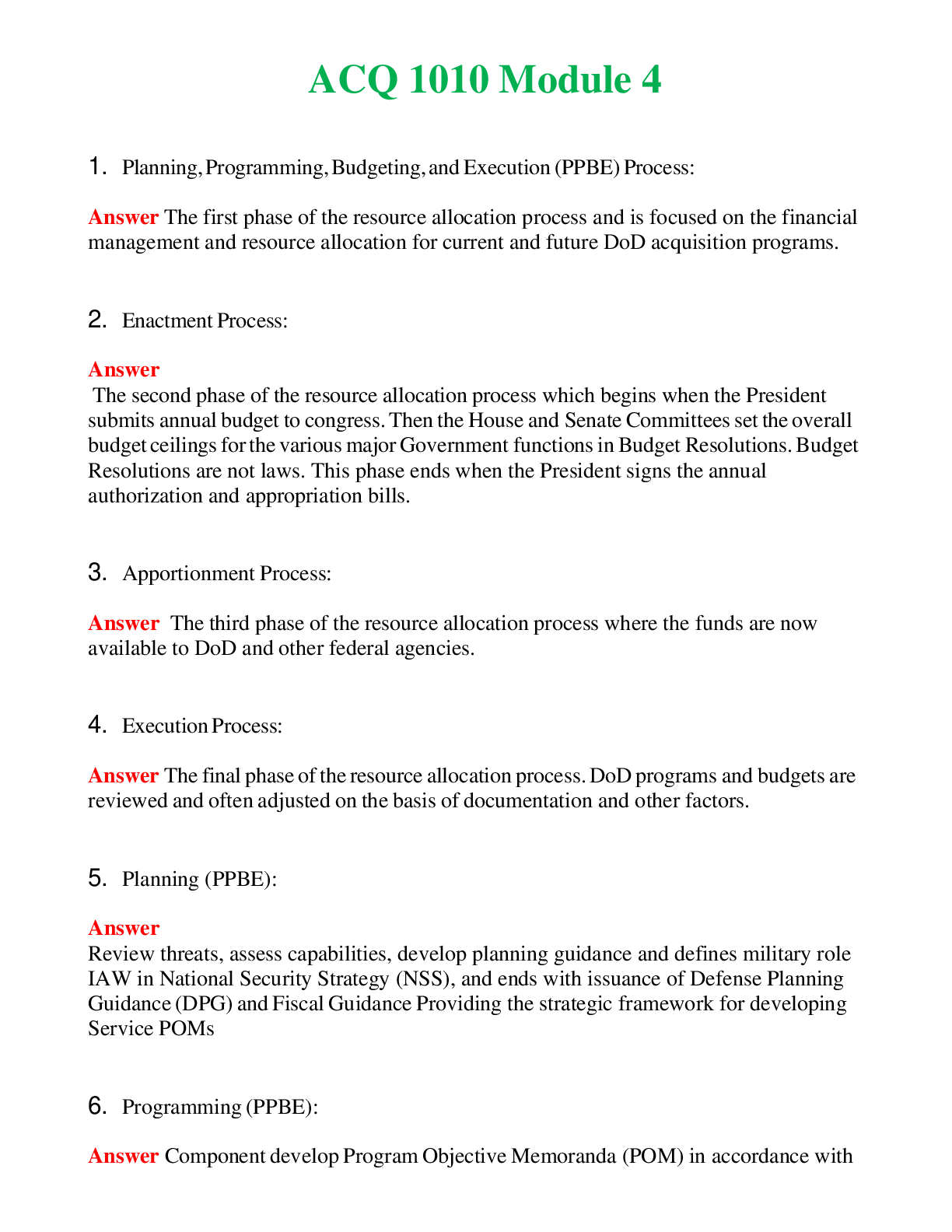
PPBE Methodology ✔✔Calendar-driven process used for securing funding for a major
acquisition program, offers the basis for informed affordability assessment and resource
allocation decisions, and provides a formal, systematic structure for making decisions on policy,
strategy, and the development of forces and capabilities to accomplish anticipated missions.
Planning ✔✔During this stage in PPBE, a national defense strategy is defined and a plan is
developed for executing the strategy.
Programming ✔✔During this stage in PPBE, proposed programs are fleshed out and a Program
Objective Memorandum (POM) is written.
Budgeting ✔✔During this stage in PPBE, which occurs concurrently with the programming
phase, proposed budgets and programs are reviewed and the Budget Estimate Submission (BES)
is prepared
Execution ✔✔During this stage in PPBE, programs are evaluated and measured against
established performance metrics, including rates of funding obligations and expenditures.
[Show More]