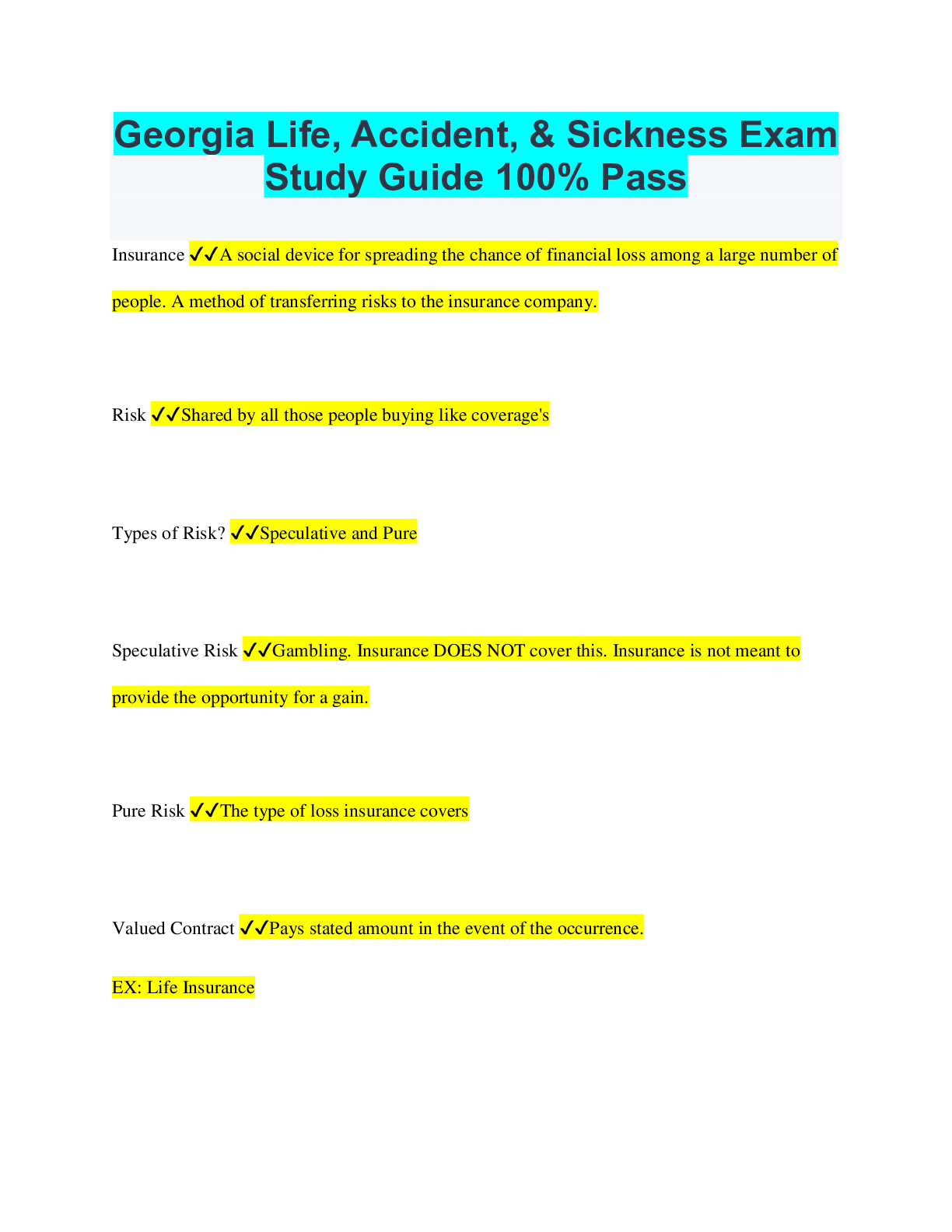
Georgia Life, Accident, & Sickness Exam
Study Guide 100% Pass
Insurance ✔✔A social device for spreading the chance of financial loss among a large number of
people. A method of transferring risks to the insurance comp
...
Georgia Life, Accident, & Sickness Exam
Study Guide 100% Pass
Insurance ✔✔A social device for spreading the chance of financial loss among a large number of
people. A method of transferring risks to the insurance company.
Risk ✔✔Shared by all those people buying like coverage's
Types of Risk? ✔✔Speculative and Pure
Speculative Risk ✔✔Gambling. Insurance DOES NOT cover this. Insurance is not meant to
provide the opportunity for a gain.
Pure Risk ✔✔The type of loss insurance covers
Valued Contract ✔✔Pays stated amount in the event of the occurrence.
EX: Life Insurance
Reimbursement Contract ✔✔Based on the loss you will be paid back a certain amount. EX:
Health Insurance, Disability Insurance, Auto Insurance
Description of Insurance ✔✔A large uncertain loss (death, disability) is exchanged for a small
certain loss (premium). The agreement is between the insurer (the company) and the policy
owner (may or may not be the insured) is established in a legal contract, called a policy. The
contract promises to pay a claim if a loss occurs. If a loss occurs the beneficiary will file a claim.
Who is involved with a Policy? ✔✔Applicant, Policy Owner, Insured, Beneficiary, Insurer,
Third party contract
Applicant ✔✔Person applying for insurance
Policy Owner ✔✔Pays the bill. Has all ownership of rights
Insured ✔✔Person whose life is covered in the policy
Beneficiary ✔✔The person named to receive the proceeds upon the death of the insured. (THIS
CAN BE ANYONE YOU WANT)
Insurer ✔✔The company
Third Party Contract ✔✔A policy that is owned by someone other than the insured. EX: a
husband buys insurance on his wife or a parent buys insurance on a child.
What creates risk? ✔✔Peril and Hazard
Peril ✔✔Is the cause of the loss.
EX: fire, flood, accident
Hazard ✔✔Anything that increases the chance of loss
Moral Hazard ✔✔liar, misrepresents oneself (Ends in an L for LIAR)
Morale Hazard ✔✔bad attitude, careless, a risk taker (ends in an E attitude ends in an E)
EX: speeding ticket, DUI, bad credit
Method of Managing Risks ✔✔Transfer
Buying Insurance ✔✔The risk of the loss is transferred to the insurer and it is shared by other
insured's that have similar characteristics, like age, sex, occupation
Two basic concepts of insurance? ✔✔Pooling Concept and Law of Large Numbers
Pooling Concept ✔✔Looking at a group of people who share similar characteristics to make
predictions
Law of Large Numbers ✔✔the larger the group, the more accurate the prediction.
The Mortality Table ✔✔In use is The Commissioners Standard Ordinary Table. Tracks life
expectancy to age 120.
Exposure Unit ✔✔The person or property being considered
Indemnify ✔✔Returns one to the economic position enjoyed prior to the loss, but restricts one
from making a profit from the loss
Contestable Clause ✔✔Suicide in the first two years is not covered. The insurer will return
premium only, with no interest.
Incontestable ✔✔After two years the life insurance contract for suicide and for fraud is over and
the claim will be paid.
In Health Insurance, Fraud is ______________ ✔✔FOREVER
Exclusion of Catastrophic Losses ✔✔Some losses are so large no insurer could ever cover them.
War, military service, aviation, and certain hazardous hobbies or occupations (MUST BE
NAMED IN POLICY)
Types of Commercial Insurers? ✔✔Stock Insurance Company and Mutual Company
Stock Insurance Company ✔✔Owned by the stockholders, sells NON-PARTICIPATING
POLICIES, the board of directors is elected by the stockholders, profits go to the stockowners
(Stock dividends), STOCK DIVIDENDS ARE TAXABLE AS INCOME
Mutual Company ✔✔Owned by the policy owners, sells PARTICIPATION POLICIES, the
board of directors is elected by the policy owners, profits go to the policy owners (Policy
dividends), POLICY DIVIDENDS ARE NOT TAXABLE SINCE THEY ARE "RETURN OF
AN OVERCHARGE"
Types of Non-Commercial Insurers ✔✔Reciprocal, Fraternal Insurers, Lloyds, Assessment
Insurers, Reinsurance, Self-Insurance
Reciprocal ✔✔Unincorporated groups of people that "band" together to self insure their own
risks. Each member is called a SUBSCRIBER. Each subscribers has his own account into which
he pays premiums and earns interest. When one of the subscriber has a loss then each subscriber
is charged is fair share. It is managed by an "Attorney-in-fact". SHORT-TERM
AGREEMENTS. RECIPROCAL'S DO NOT TRANSACT LIFE INSURANCE. Stock insurance
companies ARE NOT reciprocal. Mutual insurance companies ARE
Fraternal Insurers ✔✔Like a "Fraternity". As a member you have certain privileges and
responsibilities. Engage in charitable activities. Because of membership they have access to
insurance. NOT FOR PROFIT
Lloyds ✔✔Not an insurance company. It is a big building that houses underwriters. The
underwriter represents a group of investors, called SYNDICATE. Lloyd's handles SPECIAL
RISK POLICIES. Special hazards such as a dancer insuring her legs, or a race car driver insuring
his life while racing. LLOYD'S DOES NOT TRANSACT LIFE INSURANCE.
Reinsurance ✔✔Insurance between insurance companies. Used to protect against catastrophic
loss. a) ceding company (the company that writes the contract) b) reinsurer (the company that
has accepted part of the risk). Treaty agreements are automatic; each insurer takes a certain
percent of whatever amount the ceding company writes
Reserve ✔✔An accounting measurement of the insurer's liability to the policyholder. To be
considered financially healthy or "solvent" an insurer must have 85% of their contract liabilities
in a reserve.
The Patriot Act ✔✔Seeks to prevent funding for terrorist acts
McCarran-Ferguson Act (Public Law 15) ✔✔In 1945, over ruling the court by stating
affirmatively that regulation of insurance was the job of the states. not the federal government.
The law exempted insurance from federal antitrust rules if it was covered by state regulation. If
there are any "holes" in state regulations, the Fed address it. This is what is in place today.
ORDER OF REGULATION IS: STATE, THEN FEDERAL GOVERNMENT
Who Regulates Insurance? ✔✔National Association of Insurance Commissioners (NAIC)
State Insurance Commissioners
National Association of Insurance Commissioners (NAIC) ✔✔Impose strong influence on
regulation within the insurance industry. NAIC has done much to help insurers to standard
policies.
State Insurance Commissioners ✔✔the regulatory authority; they have to say "grace" over
everything. Before a proposed rule or regulation can become effective it must be on file as a
matter of public record for at least 10 days. The legality must be approved by the Attorney
General.
About the Commissioner ✔✔Elected by the voters, the people. term of office for 4 years.(T-E-RM). The Chief Deputy will post a bond in the amount of $15,000. The commissioner must hold a
hearing when required by law or upon written demand. Hearings much be held in 30 days, unless
postponed by mutual consent. Commissioner must give 10 day notice of hearing for general
insurance matters and 15 days notice for unfair trade practices.
Violation of code/rule ✔✔probation for up to 1 year and $1000 for non-willful & $5000 for
willful
Guilty of Insurance Fraud ✔✔If the loss is $500 or ore it is a FELONY- prison from 2-10 years
and fine up to $10,000
Fraud- ✔✔an intentional act designed to deceive and induce another party to part with something
or application, embezzlement, fake claims, fake policies. ALWAYS INVOLVES INTENT
Cease & Desist ✔✔The commissioner may order this and "stop this immediately" occurs
Fair Credit Reporting Act ✔✔A federal law which protects the consumer's right to privacy and
sets up procedures for reporting agencies to follow in their reporting practices to ensure that the
records are confidential, accurate and properly used.
Investigative Consumer Report ✔✔A whole new fresh report. Interviews are conducted. The
consumer must be given 3 DAYS NOTICE if they are going to do an investigative Report
Penalty ✔✔obtaining a consumer report under false pretenses is $5000 or prison for 1 year or
both
Notice of Information Practices ✔✔Must be given at time of application- disclosure statement
Information and Privacy Protection Act ✔✔Gives consumer the right to see information an
insurer has on the and also says the company cannot give out information unless consumer
signed a release form. Violation of the Privacy Act the fine is $10000 if it is frequent then the
fine can be $50000.
Unfair Trade Practices ✔✔Misrepresentation of Dividends, Blindness, Twisting, Rebates,
Malfeasance
Misrepresentation of Dividends ✔✔You can not say what they will get back, but it is OK to give
dividend ESTIMATES
Blindness ✔✔You are not able to discriminate someone just because the are blind
Twisting ✔✔Replacement brought about by misrepresentation
Rebates ✔✔Offering something of value to make a sale; kickback of commissions.
EX: If you buy this policy then i will split the percentage of what i make and pay you for buying
the policy.
Malfeasance ✔✔The performance an act that is legally unjustified, harmful, or contrary to law; a
wrong doing (used especially of an act in violation of a public trust)
National Do Not Call List ✔✔Managed and enforced by the Federal Trade Commission & state
officials. Calls from or on behalf of political organizations, charities, telephone surveyors are
permitted, as well as calls from companies that have the express written permission of the
consumer.
May call between 8am and 9pm, unless someone is on no call list. Violations could be fined up
to $16000 per incident
Transacting Business ✔✔Inducing toward or soliciting for new business
[Show More]