Nr 222 exam 1, 46 Questions with Answers
definition of nursing - CORRECT ANSWER diagnosis and treatment of human responses to health and illness.
characteristics of a profession - CORRECT ANSWER -requires extended
...
Nr 222 exam 1, 46 Questions with Answers
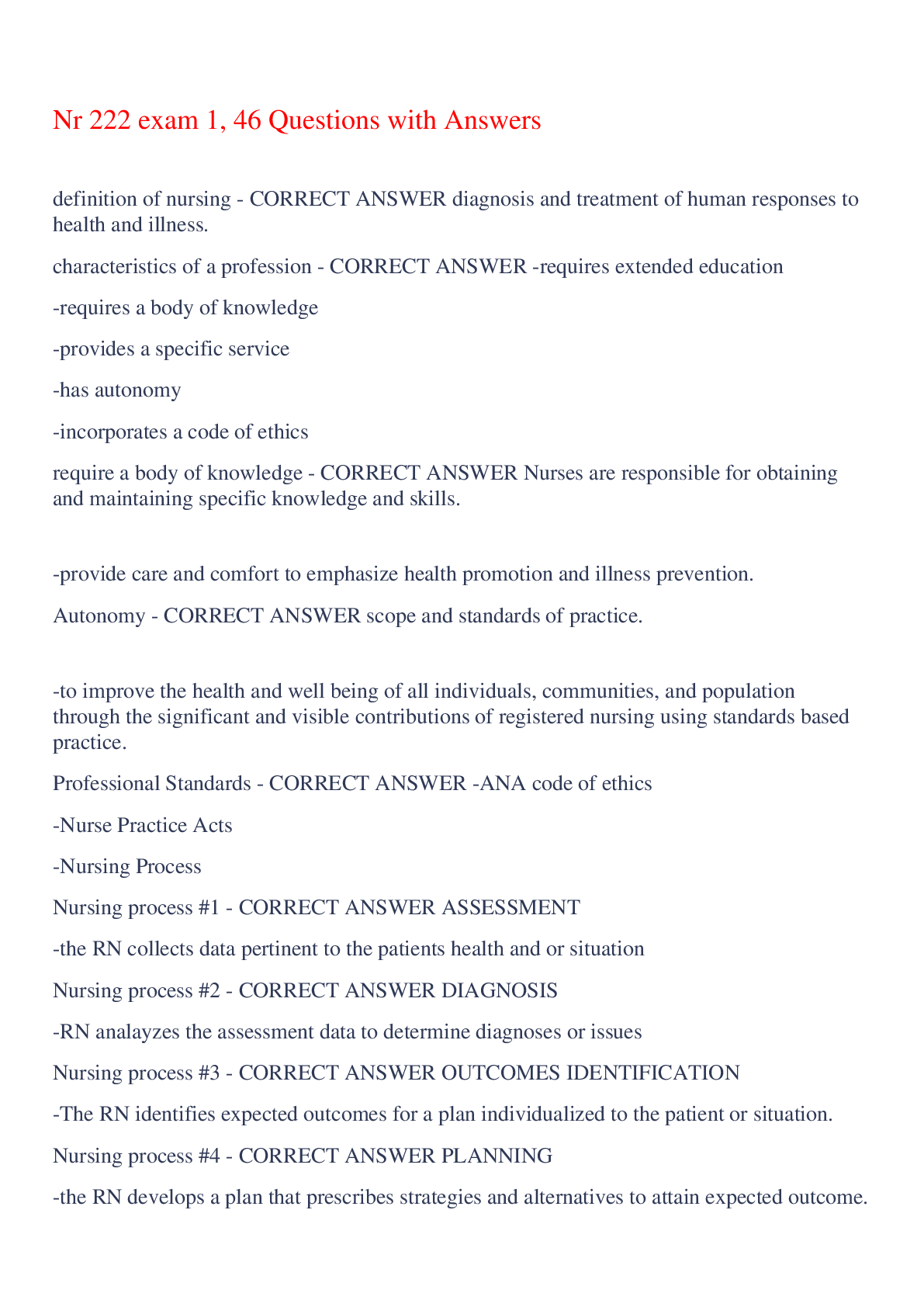
definition of nursing - CORRECT ANSWER diagnosis and treatment of human responses to health and illness.
characteristics of a profession - CORRECT ANSWER -requires extended education
-requires a body of knowledge
-provides a specific service
-has autonomy
-incorporates a code of ethics
require a body of knowledge - CORRECT ANSWER Nurses are responsible for obtaining and maintaining specific knowledge and skills.
-provide care and comfort to emphasize health promotion and illness prevention.
Autonomy - CORRECT ANSWER scope and standards of practice.
-to improve the health and well being of all individuals, communities, and population through the significant and visible contributions of registered nursing using standards based practice.
Professional Standards - CORRECT ANSWER -ANA code of ethics
-Nurse Practice Acts
-Nursing Process
Nursing process #1 - CORRECT ANSWER ASSESSMENT
-the RN collects data pertinent to the patients health and or situation
Nursing process #2 - CORRECT ANSWER DIAGNOSIS
-RN analayzes the assessment data to determine diagnoses or issues
Nursing process #3 - CORRECT ANSWER OUTCOMES IDENTIFICATION
-The RN identifies expected outcomes for a plan individualized to the patient or situation.
Nursing process #4 - CORRECT ANSWER PLANNING
-the RN develops a plan that prescribes strategies and alternatives to attain expected outcome.
Nursing process #5 - CORRECT ANSWER IMPLEMENTATION
-coordination of care
-health teaching and promotion
-consultation
-prescriptive authority and treatment
Nursing process #6 - CORRECT ANSWER EVALUATION
-The RN evaluates progress toward attainment of outcomes.
Nurse Practice Acts - CORRECT ANSWER NPAs regulate the scope of nursing practice and protect public health, safety, and welfare. This protection includes shielding the public from unqualified and unsafe nurses.
ANA Code Of Ethics - CORRECT ANSWER Code of Ethics for Nurses with Interpretive Statements is a guide for carrying out nursing responsibilities that provide quality nursing care; it also outlines the ethical obligations of the profession
Professional Roles - CORRECT ANSWER Advocate
consultant
care giver
educator
researcher
Professional Responsibility - CORRECT ANSWER Provide care and comfort and to emphasize health promotion and illness prevention.
Nursing Process vs Nursing Theory - CORRECT ANSWER Nursing PROCESS is systematic steps for delivery of nursing care.
A Theory is a set of concepts, definitions and assumptions that explain a phenomenon. Theory generates nursing knowledge for use in practice.
A nursing theory is a conceptualization of some aspect of nursing that describes, explains, predicts, or prescribes nursing care
Nursing Theory Related to Culture - CORRECT ANSWER Leininger
Framework-With this transcultural care theory, caring is the central and unifying domain for nursing knowledge and practice.
GOAL-Provide care consistent with nursing's emerging science and knowledge with caring as central focus
Nursing Theory Related to Systems - CORRECT ANSWER neuman
FRAMEWORK-Stress reduction is goal of systems model of nursing practice. Nursing actions are in primary, secondary, or tertiary level of prevention.
GOAL-Help individuals, families, and groups attain and maintain maximal level of total wellness by purposeful interventions
Nursing Theory Related to caring - CORRECT ANSWER nightingale
FRAMEWORK-Nurse manipulates patient's environment to include appropriate noise, nutrition, hygiene, light, comfort, socialization, and hope.
Nursing Theory Related to Health Promotion - CORRECT ANSWER peplau
Goal-Develop interaction between nurse and patient
Framework- Nursing is a significant, therapeutic, interpersonal process. Nurses participate in structuring health care systems to facilitate interpersonal relationships.
Chamberlain college of nursing philosophy - CORRECT ANSWER Dynamic, holistic process that projects a person's perceived state of wellness. Health promotion, wellness, restoration and revitalization activities influence a person's level of health and energy. Optimal health implies the achievement of the highest level of natural balance in all spheres throughout the entire life continuum spheres throughout the entire life continuum.
Who Definition of health - CORRECT ANSWER "state of complete physical, mental, and social well-being, not merely the absence of disease or infirmity"
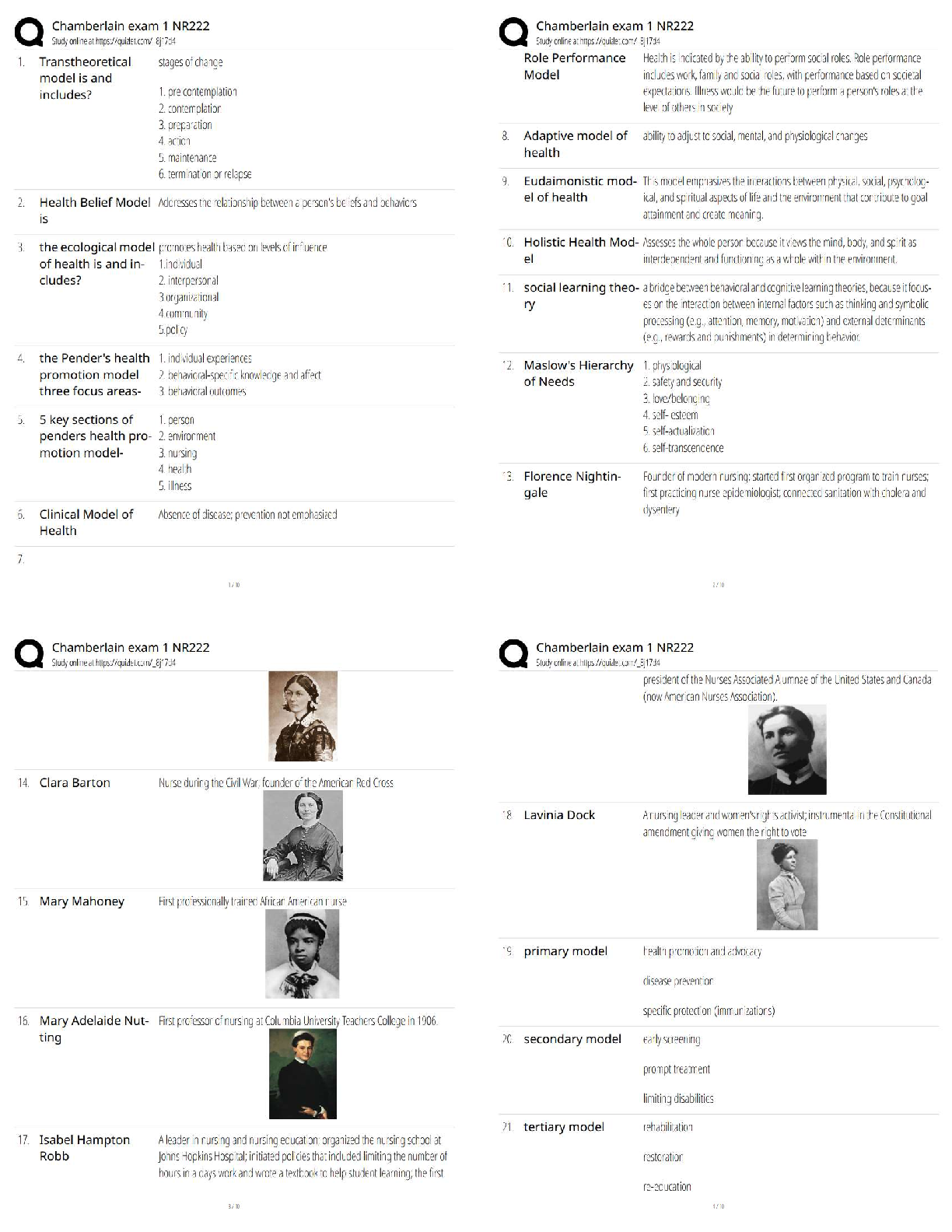
CLINICAL MODEL - CORRECT ANSWER TRADITIONAL MEDICAL MODEL. PATIENT SEEKS MED CARE WITH SIGNS AND SYMPTOMS OF DX.
defined by absence of signs and symptoms of illness, even though suspected. Individual may not seek preventative care or waits too long, until they are very ill. Conventional model of the discipline of medicine
ROLE PERFORMANCE MODEL - CORRECT ANSWER OCCUPATIONAL HEALTH MODEL.
defined by ability to perform social roles with work, family, and based on performance by societal standards. This is the model is basis for occupational health evaluations, school, and physician -excused absences.
ADAPTIVE MODEL - CORRECT ANSWER ILLNESS OCCURS IF A PERSON FAILS TO ADAPT.
defined by peoples ability to adjust positively to social, mental, and physiological change is the measure of their health. Illness occurs when the person fails to adapt or becomes maladaptive to these changes. This model has become more accepted by American culture
eudaimonistic model - CORRECT ANSWER defined by exuberant well-being indicating optimal health. It emphasizes interactions between physical, social, psychological, and spiritual aspects of life and the environment that contribute to goal attainment and create meaning.
Health Belief Model - CORRECT ANSWER addresses the relationship between a person's beliefs and behaviors. The health belief model helps you understand factors influencing patients' perceptions, beliefs, and behavior to plan care that will most effectively assist patients in maintaining or restoring health and preventing illness
Health Promotion Model - CORRECT ANSWER The health promotion model (HPM) proposed by Pender was designed to be a "complementary counterpart to models of health protection" .
Health promotion is directed at increasing a patient's level of well-being.
--The model focuses on the following three areas: (1) individual characteristics and experiences, (2) behavior-specific knowledge and affect, and (3) behavioral outcomes.
Domain - CORRECT ANSWER central concepts or beliefs of a discipline
Domains of Health A - CORRECT ANSWER a. Biological
- genetic characteristics that influence health
Domains of Health B - CORRECT ANSWER B. Sociological
- Cultural, community, family influences
Domains of Health C - CORRECT ANSWER C. Psychological
- Mental health, attitude
Domains of Health D - CORRECT ANSWER D. Spiritual
- Values and beliefs
Domains of Health E - CORRECT ANSWER E. Environmental
- physical surrounding
Domains of Health F - CORRECT ANSWER F. Sexual
- sexual identity, expression, attitudes
Internal Variables Influencing Health Beliefs & Practices - CORRECT ANSWER Developmental stage
Intellectual background
Perception of functioning
Emotional factors
Spiritual factors
External Variables Influencing Health Beliefs & Practices - CORRECT ANSWER Family practices
Socioeconomic factors
Cultural background
healthy people 2020 - CORRECT ANSWER National 10 year health promotion for Americans, Assess health risks, public priorities, preparedness and prevention
healthy people 2020 overall goals - CORRECT ANSWER -Attain longer lives free of preventable diseases
-Achieve health equity and eliminate health disparities
-Create social and physical environments that promote health
-Promote quality of life, health development, and healthy behaviors across all lifespans.
primary prevention - CORRECT ANSWER i. health promotion and education ii. policy and political advocacy.
i.e: nutrition, vaccinations, sanitation; anything to promote healthful behaviors to avoid illness
secondary prevention - CORRECT ANSWER i. early diagnosis and prompt treatment ii. limit disability.
ie: to eliminate disease and prevent further complications. limit disease and prevent death, return to health
tertiary prevention - CORRECT ANSWER i. restoration and rehabilitation; ii. maximizing capabilities.
ie: therapies, maximizing remaining capabilities and capacities.
Cognitive learning - CORRECT ANSWER Cognitive learning—Strategies and tools to support teaching cognitive-type content include lecture, reading materials, panel discussion, audiovisual materials, programmed instruction, computer-assisted instruction (CAI), and problem-based learning (e.g., case studies and care plans).
Psychomotor learning - CORRECT ANSWER Strategies and tools used to teach psychomotor skills include demonstration and return demonstration, simulation models, audiovisual materials (e.g., videotapes), and printed materials (especially with photographs and illustrations).
Affective learning - CORRECT ANSWER Strategies and tools for promoting effective learning include role-modeling, panel discussion, mentoring, one-to-one counseling and discussion, audiovisual materials (e.g., DVDs, streaming video, movies), and printed materials.
evidence-based practice - CORRECT ANSWER clinical decision-making that integrates the best available research with clinical expertise and patient characteristics and preferences
[Show More]