NSG 6435 Wk 8 Quiz
NSG 6435 W8 Quiz
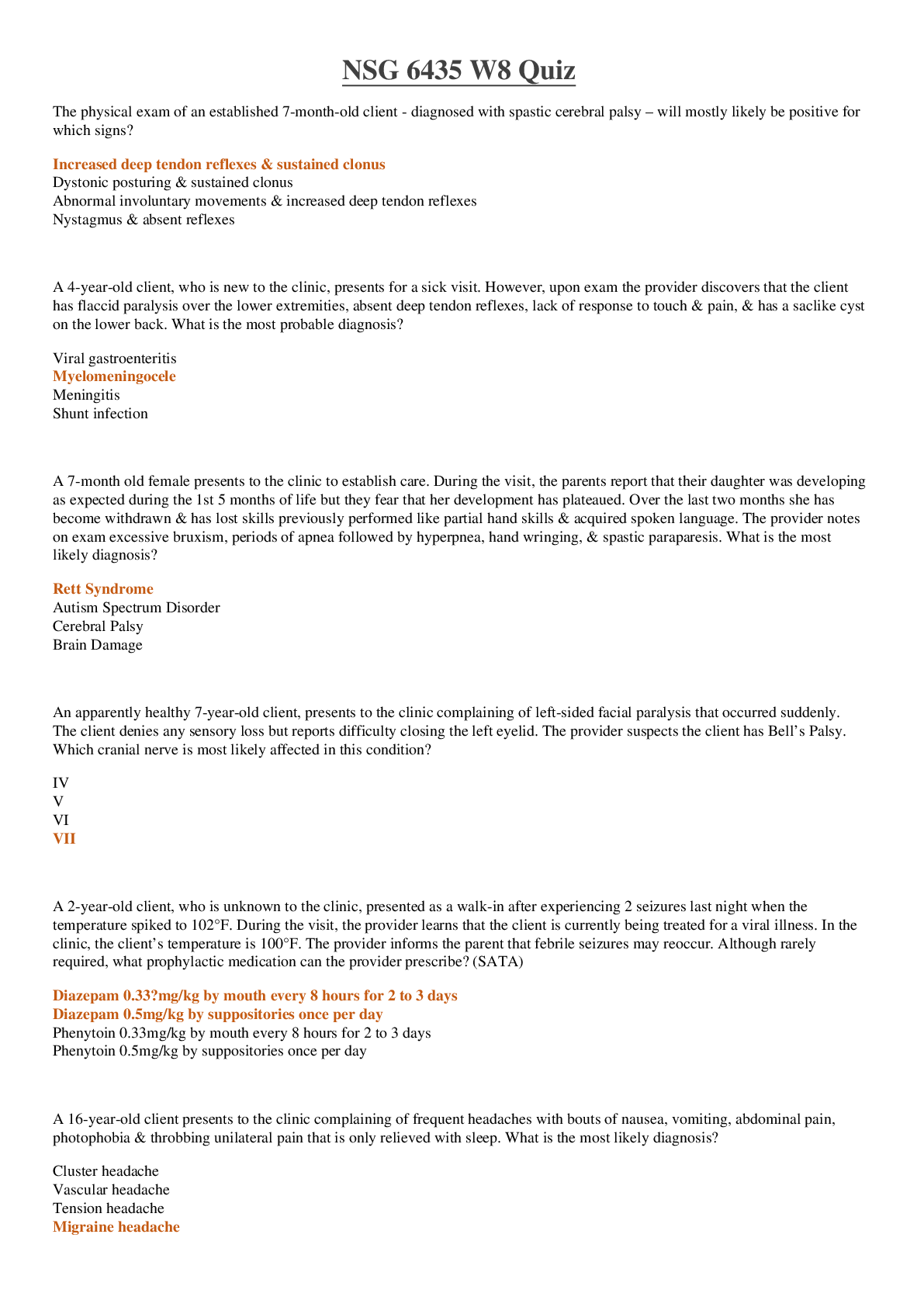
1. The physical exam of an established 7-month-old client - diagnosed with spastic cerebral palsy – will mostly likely be positive for which signs?
Increased deep tendon
...
NSG 6435 Wk 8 Quiz
NSG 6435 W8 Quiz
1. The physical exam of an established 7-month-old client - diagnosed with spastic cerebral palsy – will mostly likely be positive for which signs?
Increased deep tendon reflexes & sustained clonus
Dystonic posturing & sustained clonus
Abnormal involuntary movements & increased deep tendon reflexes
Nystagmus & absent reflexes
2. A 4-year-old client, who is new to the clinic, presents for a sick visit. However, upon exam the provider discovers that the client has flaccid paralysis over the lower extremities, absent deep tendon reflexes, lack of response to touch & pain, & has a saclike cyst on the lower back. What is the most probable diagnosis?
Viral gastroenteritis
Myelomeningocele
Meningitis
Shunt infection
3. A 7-month old female presents to the clinic to establish care. During the visit, the parents report that their daughter was developing as expected during the 1st 5 months of life but they fear that her development has plateaued. Over the last two months she has become withdrawn & has lost skills previously performed like partial hand skills & acquired spoken language. The provider notes on exam excessive bruxism, periods of apnea followed by hyperpnea, hand wringing, & spastic paraparesis. What is the most likely diagnosis?
Rett Syndrome
Autism Spectrum Disorder
Cerebral Palsy
Brain Damage
4. An apparently healthy 7-year-old client, presents to the clinic complaining of left-sided facial paralysis that occurred suddenly. The client denies any sensory loss but reports difficulty closing the left eyelid. The provider suspects the client has Bell’s Palsy. Which cranial nerve is most likely affected in this condition?
IV
V
VI
VII
5. A 2-year-old client, who is unknown to the clinic, presented as a walk-in after experiencing 2 seizures last night when the temperature spiked to 102°F. During the visit, the provider learns that the client is currently being treated for a viral illness. In the clinic, the client’s temperature is 100°F. The provider informs the parent that febrile seizures may reoccur. Although rarely required, what prophylactic medication can the provider prescribe? (SATA)
Diazepam 0.33 mg/kg by mouth every 8 hours for 2 to 3 days
Diazepam 0.5mg/kg by suppositories once per day
Phenytoin 0.33mg/kg by mouth every 8 hours for 2 to 3 days
Phenytoin 0.5mg/kg by suppositories once per day
6. A 16-year-old client presents to the clinic complaining of frequent headaches with bouts of nausea, vomiting, abdominal pain, photophobia & throbbing unilateral pain that is only relieved with sleep. What is the most likely diagnosis?
Cluster headache
Vascular headache
Tension headache
Migraine headache
7. A 15-year-old client presents to the clinic complaining of tension headaches. The provider understands that the client will experience pain to what region of the head?
At the back of the head
On both sides of the head
At the top of the head
On one side of the head
8. The parents of a 4-year-old client hysterically call the office to seek assistance after their child hit his head on the brick walkway & lost consciousness for 10 minutes. What possible complications/conditions is the client at risk for? (SATA)
Concussions
Intracranial lesions
Cerebral contusions
Febrile seizures
9. Seventy-two hours after an emergency delivery, a newborn develops respiratory insufficiency, dysphagia, hypotonia, ptosis, weakness, weak cry, poor sucking, choking, expressionless face, & absent Moro reflex. Based on the symptomology the provider suspects that the newborn may be showing signs of Myasthenia Gravis. Which clinical test, when performed, may confirm this diagnosis?
Administering the short-acting cholinesterase inhibitor, edrophonium.
Administering the long-acting cholinesterase inhibitor, neostigmine.
Administering the short-acting cholinesterase inhibitor, pyridostigmine.
Administering the long-acting cholinesterase inhibitor, Rivastigmate.
10. A 16-year-old client, new to the clinic, presents with complaints of weakness & Landry ascending paralysis progressing over the last few weeks. The provider suspects Guillain-Barré syndrome based on the reported symptoms. However, as the collection of the client’s health history continues, a past infection with which virus supports the providers suspicions?
Enterovirus
Epstein-Barr virus
Haemophilusinfluenzae
Hantavirus
ö
Overall Grade: 10 / 10 - 100 %
[Show More]


.png)
 Questions and Answers (latest Update), All Correct, Download to Score A.png)



.png)