*NURSING  >  MED-SURG EXAM  >  Med Surg Question, Answers and Rationale (All)

Med Surg Question, Answers and Rationale

Document Content and Description Below

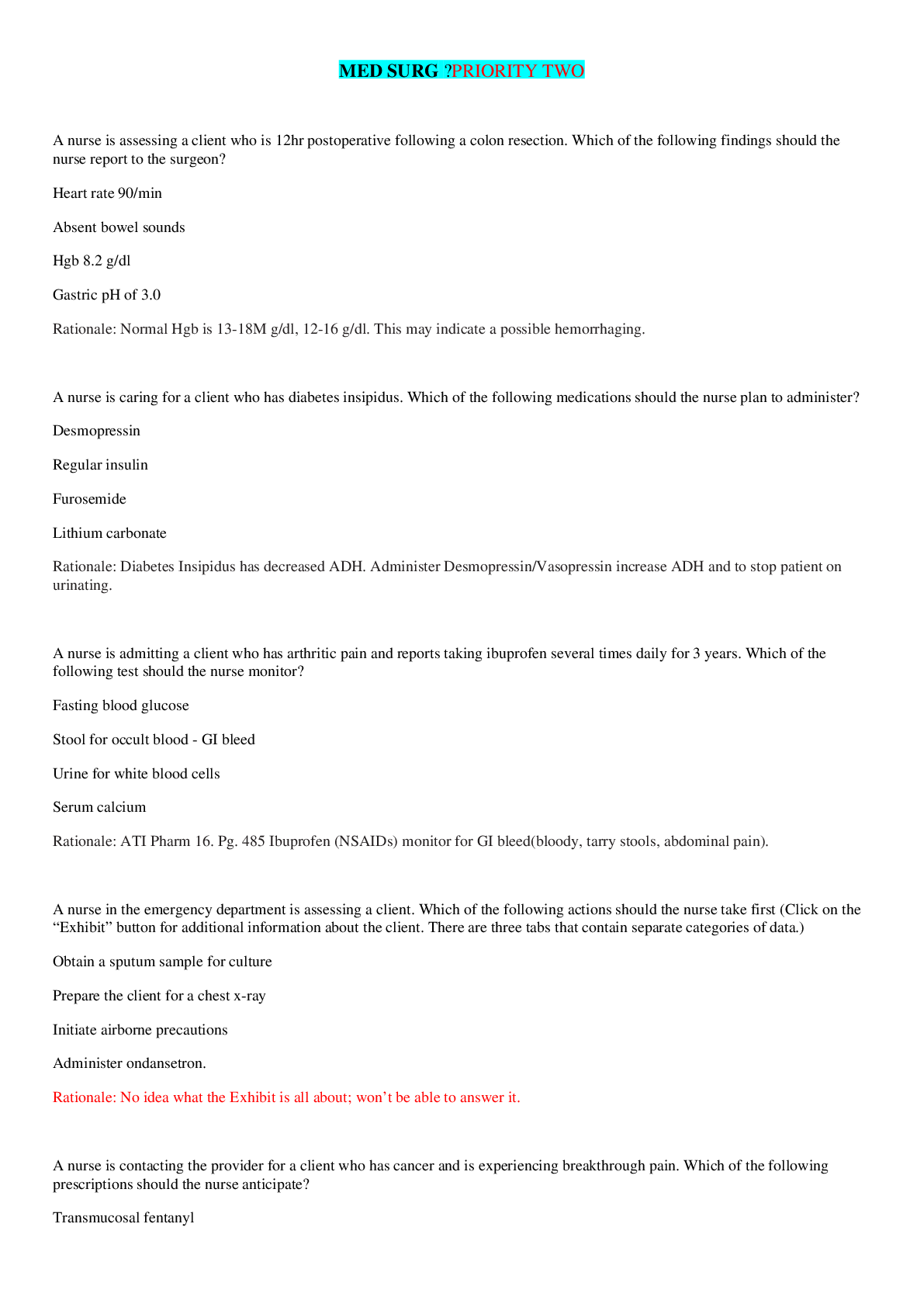
Med Surg Question, Answers and Rationale 1. A nurse is assessing a client who is 12hr postoperative following a colon resection. Which of the following findings should the nurse report to the surgeo ... n? a. Heart rate 90/min b. Absent bowel sounds c. Hgb 8.2 g/dl d. Gastric pH of 3.0 Rationale: Normal Hgb is 13-18M g/dl, 12-16 g/dl. This may indicate a possible hemorrhaging. 2. A nurse is caring for a client who has diabetes insipidus. Which of the following medications should the nurse plan to administer? a. Desmopressin b. Regular insulin c. Furosemide d. Lithium carbonate Rationale: Diabetes Insipidus has decreased ADH. Administer Desmopressin/Vasopressin increase ADH and to stop patient on urinating. 3. A nurse is admitting a client who has arthritic pain and reports taking ibuprofen several times daily for 3 years. Which of the following test should the nurse monitor? a. Fasting blood glucose b. Stool for occult blood - GI bleed c. Urine for white blood cells d. Serum calcium Rationale: ATI Pharm 16. Pg. 485 Ibuprofen (NSAIDs) monitor for GI bleed (bloody, tarry stools, abdominal pain). 4. A nurse in the emergency department is assessing a client. Which of the following actions should the nurse take first (Click on the “Exhibit” button for additional information about the client. There are three tabs that contain separate categories of data.) a. Obtain a sputum sample for culture b. Prepare the client for a chest x-ray c. Initiate airborne precautions d. Administer ondansetron. Rationale: No idea what the Exhibit is all about; won’t be able to answer it. 5. A nurse is contacting the provider for a client who has cancer and is experiencing breakthrough pain. Which of the following prescriptions should the nurse anticipate? a. Transmucosal fentanyl b. Intramuscular meperidine c. Oral acetaminophen d. Intravenous dexamethasone Rationale: ATI pg. 27 Morphine sulfate and fentanyl are opioid agents used to treat moderate to severe pain. A short-acting pain medication is administered for breakthrough pain. 6. A nurse is admitting a client who reports chest pain and has been placed on a telemetry monitor. Which of the following should the nurse analyze to determine whether the client is experiencing a myocardial infarction? a. PR interval b. QRS duration c. T wave d. ST segment Rationale: ST elevation indicates MI. ST depression indicates ischemia 7. A nurse is teaching a client who has ovarian cancer about skin care following radiation treatment. Which of the following instructions should the nurse include? a. Pat the skin on the radiation site to dry it b. Apply OTC moisturizer to the radiation site c. Cover the radiation site loosely with a gauze wrap before dressing d. Use a soft washcloth to clean the area around the radiation site Rationale: pg. 584. Dry the area thoroughly using patting motions. 8. A nurse is caring for a client who is receiving a blood transfusion. The nurse observes that the client has bounding peripheral pulses, hypertension, and distended jugular veins. The nurse should anticipate administering which of the following prescribed medications? a. Diphenhydramine b. Acetaminophen c. Pantoprazole d. Furosemide Rationale: S/S may indicate fluid retention or heart failure. It is important to administer diuretics to prevent cardiovascular/respiratory distress. 9. A nurse is assessing a client who is receiving magnesium sulfate IV for the treatment of hypomagnesemia. Which of the following findings indicates effectiveness of the medication? a. Lungs clear b. Apical pulse 82/min c. Hyperactive bowel sounds d. Blood pressure 90/50 mm Hg Rationale: pg. 278 Confirmed on answer sheet 10. A nurse is reviewing a client’s ABG results pH 7.42, PaC02 30 mm Hg, and HCO3 21 mEq/L. The nurse should recognize these findings as indication of which of the following conditions? a. Metabolic acidosis b. Metabolic alkalosis c. Compensated respiratory alkalosis d. Uncompensated respiratory acidosis Rationale: because the HCO3 21 trying to compensate for respiratory alkalosis. 11. A nurse is caring for a client who has a deep partial thickness burns over 15% of her body which of the following labs should the nurse expect during the first 24 hours A. Decreased BUN (elevated due to fluid loss) B. Hypoglycemia (High due to stress) C. Hypoalbuminemia (Low due to fluid loss) D. Decreased Hematocrit (Elevated due to 3rd spacing during resuscitation phase) Rationale: Pg. 481 ATI. Total protein and albumin- low due to fluid loss. [Show More]

Last updated: 2 years ago

Preview 1 out of 25 pages

Buy Now

Instant download

We Accept:

Payment methods accepted on Scholarfriends (We Accept)
Preview image of Med Surg Question, Answers and Rationale document

Buy this document to get the full access instantly

Instant Download Access after purchase

Buy Now

Instant download

We Accept:

Payment methods accepted on Scholarfriends (We Accept)

Reviews( 0 )

$10.00

Buy Now

We Accept:

Payment methods accepted on Scholarfriends (We Accept)

Instant download

Can't find what you want? Try our AI powered Search

108
0

Document information


Connected school, study & course


About the document


Uploaded On

Apr 30, 2023

Number of pages

25

Written in

All

Seller


Profile illustration for NurseCyn
NurseCyn

Member since 2 years

0 Documents Sold

Additional information

This document has been written for:

Uploaded

Apr 30, 2023

Downloads

 0

Views

 108

Document Keyword Tags

Recommended For You

Get more on MED-SURG EXAM »
$10.00
What is Scholarfriends

Scholarfriends.com Online Platform by Browsegrades Inc. 651N South Broad St, Middletown DE. United States.

We are here to help

We're available through e-mail, Twitter, Facebook, and live chat.
 FAQ
 Questions? Leave a message!

Follow us on
 Twitter

Copyright © Scholarfriends · High quality services·