Philosophy > QUESTIONS & ANSWERS > Philosophy : Dworkin, Justice for Hedgehogs, Baedeker. (All)
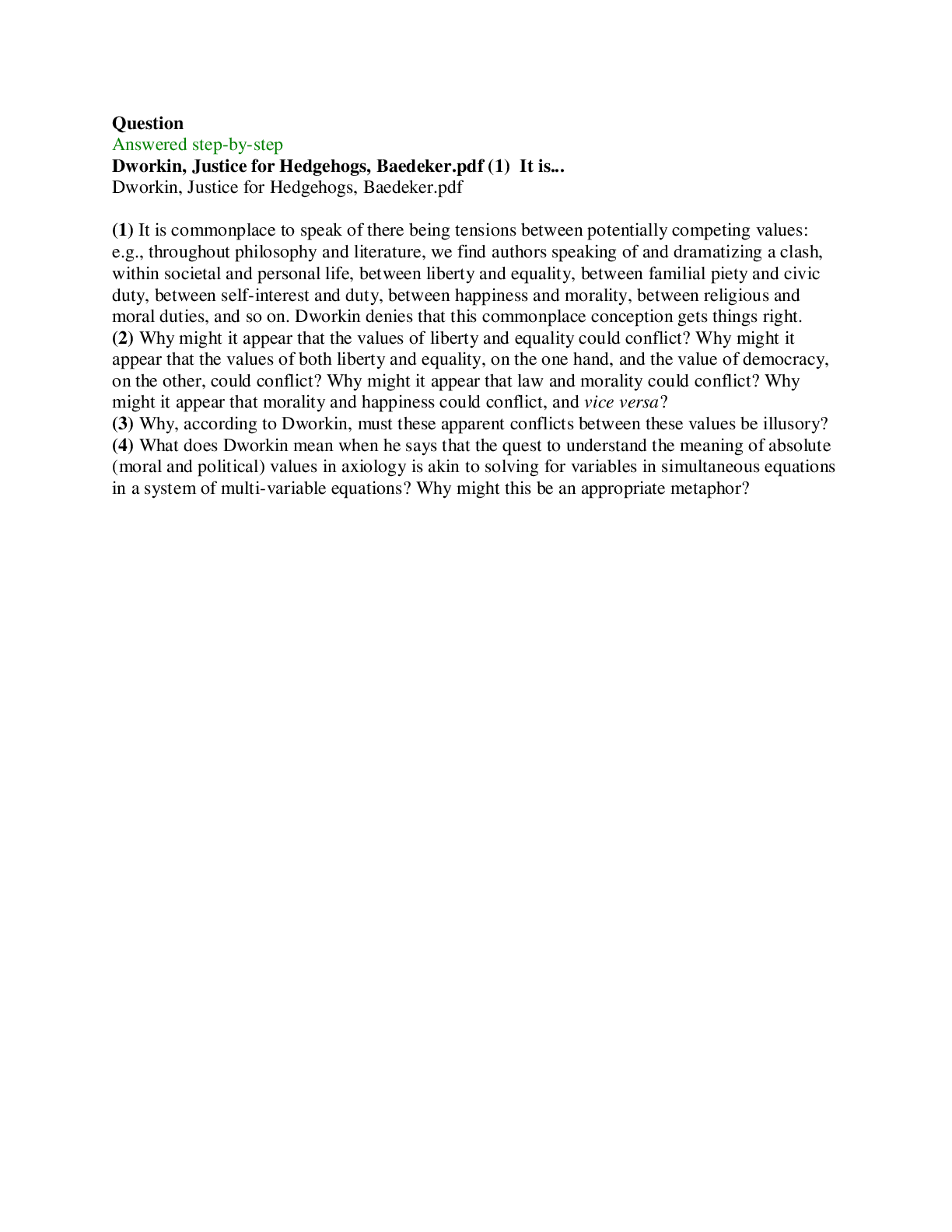
Dworkin, Justice for Hedgehogs, Baedeker.pdf (1) It is commonplace to speak of there being tensions between potentially competing values: e.g., throughout philosophy and literature, we find authors ... speaking of and dramatizing a clash, within societal and personal life, between liberty and equality, between familial piety and civic duty, between self-interest and duty, between happiness and morality, between religious and moral duties, and so on. Dworkin denies that this commonplace conception gets things right. (2) Why might it appear that the values of liberty and equality could conflict? Why might it appear that the values of both liberty and equality, on the one hand, and the value of democracy, on the other, could conflict? Why might it appear that law and morality could conflict? Why might it appear that morality and happiness could conflict, and vice versa? (3) Why, according to Dworkin, must these apparent conflicts between these values be illusory? (4) What does Dworkin mean when he says that the quest to understand the meaning of absolute (moral and political) values in axiology is akin to solving for variables in simultaneous equations in a system of multi-variable equations? Why might this be an appropriate metaphor? [Show More]
Last updated: 2 years ago
Preview 1 out of 3 pages
Buy this document to get the full access instantly
Instant Download Access after purchase
Buy NowInstant download
We Accept:
Can't find what you want? Try our AI powered Search
Connected school, study & course
About the document
Uploaded On
Apr 30, 2023
Number of pages
3
Written in
All
This document has been written for:
Uploaded
Apr 30, 2023
Downloads
0
Views
60
Scholarfriends.com Online Platform by Browsegrades Inc. 651N South Broad St, Middletown DE. United States.
We're available through e-mail, Twitter, Facebook, and live chat.
FAQ
Questions? Leave a message!
Copyright © Scholarfriends · High quality services·