1. Question :
(TCOs 2 and 3) In Chapter 1, we learned how to recognize the main issue in a passage. Consider the following example:
“We have little choice but to concentrate our energy-policy efforts on renewable resou
...
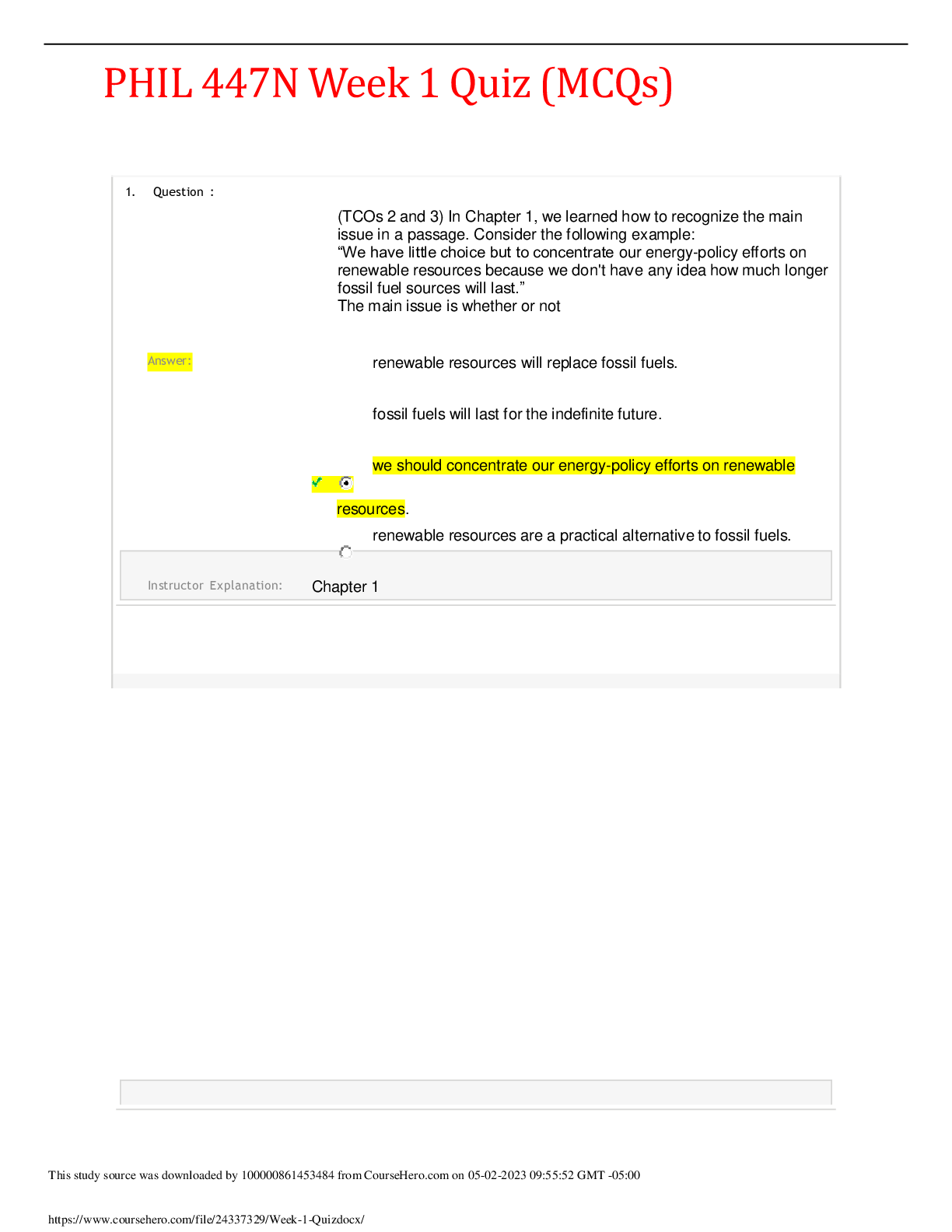
1. Question :
(TCOs 2 and 3) In Chapter 1, we learned how to recognize the main issue in a passage. Consider the following example:
“We have little choice but to concentrate our energy-policy efforts on renewable resources because we don't have any idea how much longer fossil fuel sources will last.”
The main issue is whether or not
Answer: renewable resources will replace fossil fuels. fossil fuels will last for the indefinite future.
we should concentrate our energy-policy efforts on renewable
resources.
renewable resources are a practical alternative to fossil fuels.
Instructor Explanation: Chapter 1
Question 2. Question :
(TCOs 2 and 3) In Chapter 1, we learned how to recognize the main issue in a passage. Consider the following example:
“A lot of people think that the gender of a Supreme Court justice doesn't make any difference. But with two women on the bench, cases dealing with women's issues are being handled differently.”
The main issue is whether or not
Answer: there should be more women on the Supreme Court.
there are sufficient number of women on the Supreme Court. the gender of the Supreme Court justices is something people
think about.
the gender of the Supreme Court justices makes a difference in
cases dealing with women’s issues.
Instructor Explanation: Chapter 1
Comments:
Question 3. Question :
(TCOs 1 and 2) In Chapter 1, we learned how to recognize the main issue in a passage. Consider the following example:
“In pre-civil war Spain, the influence of the Catholic church must have been much stronger on women than on men. You can determine this by looking at the number of religious communities, such as monasteries, nunneries, and so forth. A total of about 5,000 such communities existed in 1931; 4,000 of them were female, whereas only 1,000 of them were male. Seems to me that proves my point about the Church's influence on the sexes.”
The issue is whether or not the Catholic church of pre-war Spain
Answer: built more nunneries than monasteries.
had greater influence on women than on men. oppressed women.
oppressed men.
Instructor Explanation: Chapter 1
Question 4. Question :
(TCOs 1 and 2) In Chapter 1, we learned how to recognize the main issue in a passage. Consider the following example:
“The winner of this year's spelling bee is a straight-A student whose favorite subject is science, which isn't surprising, because students interested in science learn to pay attention to details.”
The main issue is whether or not
Answer: learning science will improve a student's ability to spell. learning science teaches a student to pay attention to details. students should learn science to prepare for the spelling bee.
being a straight-A student whose favorite subject is science helped
a student to win the spelling bee.
Instructor Explanation: Chapter 1
Question 5. Question :
(TCO 4) In Chapter 1, we learned how to recognize cognitive bias which are psychological factors unconsciously affecting belief formation.
Consider the following example:
“The TV show The Sopranos might have been a pretty good series without the profanity that occurred all the way through it. But without the profanity, it would not have been believable. Those people just talk that way. If you have them speaking Shakespearean English or middle-class suburban English, then nobody is going to pay any attention to the message because nobody will see it as realistic. It's true, of course, that like many other programs with some offensive feature, whether it's bad language, sex, or whatever, it will never appeal to the squeamish.”
The cognitive bias used in this passage is:
Answer: in-group bias. loss aversion.
false consensus effect. belief bias.
Instructor Explanation: Chapter 1
* Times are displayed in (GMT-07:00) Mountain Time (US & Canada)
[Show More]